

Research News


China Commands 47% of Remote Sensing Research, While U.S. Produces Just 9%, NYU Tandon Study Reveals
The United States is falling far behind China in remote sensing research, according to a comprehensive new study that tracked seven decades of academic publishing and reveals a notable reversal in global technological standing.
China now accounts for nearly half of all peer-reviewed journal publications in this critical field, while American output has declined to single digits.
"This represents one of the most significant shifts in global technological leadership in recent history," said Debra Laefer, the lead author of the study. Laefer is a NYU Tandon Civil and Urban Engineering professor, and a faculty member of Tandon’s Center for Urban Science + Progress.
Published in the journal Geomatics, the research analyzed over 126,000 papers published between 1961 and 2023 to document how China has surged from virtually no presence from the 1960s through the 1990s to 47% of remote sensing publications by 2023, while the United States has dropped from producing 88% of research in the 1960s to only 9% today.
Remote sensing — the science of gathering information from a distance using technologies like laser scanning, imagery, and hyperspectral imagery from the ground, the air, and even space — underpins critical applications from autonomous vehicles to climate monitoring and national security.
The global market was valued at $452 billion in 2022 and is projected to reach $1.44 trillion by 2030, making leadership in this field essential for economic competitiveness. Laefer emphasized that understanding who drives technical expertise and funding in this area is "of national and international importance, as they are inextricably linked with intellectual property generation, which is also shown in our data."
The research reveals that remote sensing scholarship has experienced exponential growth, expanding from roughly a dozen papers annually in the 1960s to more than 13,000 per year by 2023, a thousand-fold increase that far outpaces general scientific publishing trends.
Laefer and co-author Jingru Hua — at the time a master’s student in the NYU Center for Data Science — attribute this surge to decreased equipment costs, greater global participation, digital-only publishing, and most significantly, the adoption of artificial intelligence techniques like machine learning and deep learning.
Perhaps most notable for American competitiveness, the research demonstrates a near-perfect correlation between national funding and publication output. China's National Natural Science Foundation now appears in funding acknowledgments for over 53% of remote sensing papers published between 2021 and 2023, while U.S. agencies are credited in only 5%.
The study identified six Chinese funding entities among the top ten global funders in recent years, compared to only two American organizations, NASA and the National Science Foundation (NSF). NASA, once the dominant funder at 50% of publications through the 1990s, has been vastly outpaced by Chinese funding organizations. Notably, NSF does not have dedicated divisions specifically for geomatics (the science of gathering and analyzing geographic data) or geodesy (the science of measuring Earth's shape and positions on it).
China's research dominance extends to intellectual property generation as well. According to patent data included in the study, China now accounts for the majority of remote sensing patents filed globally. In just the three years from 2021 to 2023, over 43,000 patents containing "remote sensing" were filed worldwide, with China responsible for the clear majority, a dramatic reversal from the late 20th century when the United States held near-total dominance.
The researchers' analysis of publication titles reveals evolving technological priorities. Early decades focused heavily on satellite imagery, but recent years show explosive growth in artificial intelligence techniques, with terms like "deep learning" and "machine learning" now dominating publication titles. The number of papers mentioning these techniques has grown exponentially, reaching over 80,000 publications by 2023.
The findings have implications for technological competitiveness. Remote sensing capabilities underpin emerging technologies including augmented reality, autonomous navigation, and digital twins, all important areas for economic and commercial applications. With China's continued investment and the field's commercial value expected to triple by 2030, the study provides a baseline for understanding shifts in this important technological domain.
Laefer, D.; Hua, J. Remote Sensing Publications 1961–2023—Analysis of National and Global Trends. Geomatics 2025, 5, 47. https://doi.org/10.3390/geomatics5030047
Heavier Electric Trucks Could Strain New York City’s Roads and Bridges, Study Warns
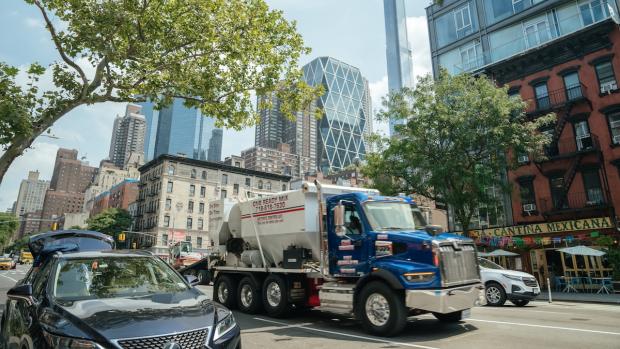
New York City’s roads and bridges already incur millions in annual damage from oversized trucks, and a new study warns the shift to electric freight could intensify that burden. As electric trucks replace diesel models, their heavier batteries could increase the city's yearly repair costs by up to nearly 12 percent by 2050.
Led by C2SMART researchers at NYU Tandon School of Engineering in collaboration with Rochester Institute of Technology (RIT) and published in Transport Policy, the study finds that oversized trucks already cause about $4.16 million in damage each year while permits bring in only $1.28 million. Electric trucks typically weigh 2,000 to 3,000 pounds more than diesel models, and in rare long-range cases as much as 8,000 to 9,000, so the financial gap is expected to grow.
“As electric vehicles become more common, our city’s infrastructure will face new and changing demands to support this transition,” said Professor Kaan Ozbay, the paper’s senior author and director of NYU Tandon’s C2SMART transportation research center. “Our framework shows that the city should adapt its planning and fee structures to ensure it can accommodate the costs of keeping bridges and roads safe as a result of more widespread adoption of e-trucks. ”
Using New York City’s Overdimensional Vehicle Permits dataset, the researchers modeled how electric-truck adoption could play out through 2050. They found that switching to e-trucks could increase damage costs by 2.23 to 4.45 percent by 2030, and by 9.19 to 11.71 percent by 2050. More extreme scenarios tied to unusually heavy batteries produced higher figures, though the authors say those outcomes are unlikely as technology improves.
The impact would not be uniform across the city. Manhattan faces the greatest increase, with parts of Brooklyn, Queens, and the Bronx also at risk due to heavy truck volumes and aging structures. Staten Island and many outer areas show lower impact. Bridges shoulder about 65 percent of the added costs because they are especially sensitive to increases in gross vehicle weight. Pavement, affected more by axle loads, wears down more gradually.
“We found that conventional oversized trucks in New York City already impose more than $4 million in annual damage,” said the study’s lead author Zerun Liu, NYU Tandon Ph.D. candidate in the Civil and Urban Engineering department’s recently established Urban Systems Ph.D. program, who is advised by Professor Ozbay. “With projected adoption of electric trucks, those costs could increase by an additional nearly 12 percent. That gap highlights the urgent need for new strategies to keep infrastructure sustainable.”
To manage the risks, the researchers created a susceptibility index identifying road segments and bridges most vulnerable to heavier vehicles. They recommend replacing flat permit fees with flexible, weight-based fees that reflect actual costs while still recognizing environmental benefits. They also call for expanding weight monitoring on high-risk corridors, especially in Manhattan, and factoring e-truck projections into city maintenance and capital plans to avoid expensive emergency repairs.
Although the study focuses on New York City, similar pressures are emerging elsewhere. The European Union allows zero-emission trucks to exceed weight limits by nearly 9,000 pounds, while U.S. rules permit an additional 2,000. The framework developed by the NYU Tandon and RIT team offers cities a way to balance climate goals with the realities of infrastructure wear.
Despite the added costs, the authors stress that the overall case for electric trucks in New York remains strong. Their scenarios suggest that widespread electrification could cut about 2,032 tons of carbon dioxide each year, improving air quality and public health.
“The proposed methodological framework can provide actionable insights for policymakers to ensure infrastructure longevity and safety as e-truck adoption grows,” Ozbay said.
In addition to senior author Ozbay and lead author Liu, the paper’s other authors are Jingqin Gao, C2SMART’s Assistant Director of Research; Tu Lan, a Ph.D. student in the Urban Systems Ph.D. program graduated under Professor Ozbay’s advisement; and Zilin Bian, a recent NYU Tandon Ph.D. graduate from the Civil and Urban Engineering department , now an assistant professor at RIT.
Funding came from the U.S. Department of Transportation’s University Transportation Centers Program.
Zerun Liu, Tu Lan, Zilin Bian, Jingqin Gao, Kaan Ozbay, A comprehensive framework for the assessment of the effects of increased electric truck weights on road infrastructure: A New York City case study, Transport Policy,
Volume 173, 2025 https://doi.org/10.1016/j.tranpol.2025.103808.

NYU Tandon research reveals how grassroots logistics networks fed New Yorkers during COVID-19 crisis
Grassroots logistics networks provided food and essential goods to New Yorkers who fell through the cracks of conventional supply chains during the COVID-19 pandemic, offering important lessons for engineers designing the next generation of distribution technologies, according to new research from NYU Tandon and the University of Toronto.
Presented at the 28th ACM SIGCHI Conference on Computer-Supported Cooperative Work & Social Computing (CSCW), the study examines three community-driven distribution systems that emerged in New York City: immigrant street vendors in Corona, Queens; a theater-turned-food-pantry on Manhattan's Lower East Side; and the citywide mutual aid network. Each represented what researchers call "supply chains of last resort,” critical interventions filling gaps left by traditional logistics infrastructure.
The research was conducted by Margaret Jack, Industry Assistant Professor in NYU Tandon's Department of Technology, Culture, and Society, and Robert Soden, Assistant Professor in the Department of Computer Science and in School of the Environment of the University of Toronto.
The study contributes to human-centered engineering research by examining how people creatively appropriate and repurpose existing technologies — from WhatsApp to shopping carts — to build functional logistics systems without formal infrastructure.These alternative logistics networks demonstrate how technologies designed for individual productivity are being adapted for civic and ecological collaboration, raising design questions relevant to the development of future civic technologies.
The Corona Plaza street vending community exemplifies this creative adaptation. Vendors used shopping carts, portable griddles, and folding tables to create temporary restaurants, while leveraging TikTok and YouTube for marketing, Zelle for payments, and WhatsApp groups for coordination, stitching together consumer technologies in ways their designers never intended.
At the Abrons Art Center, a performance venue transformed its stage into a food distribution hub serving over seven hundred families weekly. Theater technicians applied their engineering skills to construct a walk-in refrigerator using scenery-building techniques, and creatively used the theater's fly system to lift one wall above their heads so they could move full pallets of food into the refrigerator.
The citywide mutual aid network connected thousands of volunteers who cobbled together digital tools (Google Docs, AirTable, Slack, and WhatsApp) to build complex workflows for volunteer management and resource distribution. Rather than waiting for custom-built platforms, organizers rapidly prototyped solutions using available technologies, then shared successful approaches across the network.
The study offers important insights for computer-supported cooperative work and infrastructure engineering. Jack and Soden frame these logistics networks as socio-technical systems whose function depends not just on physical tools but on social networks and digital infrastructure, revealing design opportunities often missed by conventional technology development.The research challenges how engineers think about logistics infrastructure.
While companies like Amazon design tightly-coupled systems optimizing for efficiency and control, these alternative networks succeeded through flexibility and "seamfulness" — deliberately visible seams between system components that allowed for creative adaptation
"There's a tendency to forget about all the invisible infrastructural work supporting our lives until there is a breakdown, and in the emergency of COVID in New York City, we saw a lot of breakdown," Jack explained. "Our cases show that embracing flexibility and recognizing inevitable situated human action within infrastructures can produce more resilient systems."
The study identifies specific opportunities for engineering research and design. Alternative logistics networks struggled with tools built by corporations for different purposes, pointing to a need for movement-aligned civic technologies designed specifically for grassroots coordination. The researchers argue for "seamful design" approaches in logistics engineering, creating systems that highlight rather than hide complexity, empowering users to appropriate technologies in their own emergent ways.
However, these grassroots networks faced structural barriers that engineering alone cannot solve. Street vendors endured police harassment despite functional logistics systems. The Abrons refrigerator was dismantled due to permit requirements despite working perfectly.
As engineers design systems for climate adaptation and crisis response, the lessons from pandemic-era alternative logistics become increasingly relevant, demonstrating how community capacity and regulatory support can create positive conditions for resilient infrastructure even under severe resource constraints.
This work was funded by a John Burdick mini-grant for Research on Social Movements and Social Change from Syracuse University's Maxwell School.

Hydrogen processing plant failures mostly linked to design flaws, not hydrogen itself, study finds
Hydrogen is often touted as a clean, carbon-free energy carrier that could help decarbonize industry and transportation. Yet the very properties that make it efficient and lightweight also make it uniquely tricky to handle safely. A new study published in the International Journal of Hydrogen Energy by researchers at NYU Tandon and University College London takes a systematic look at what truly makes hydrogen accidents different from conventional industrial failures, and what that means for safety and regulation.
By analyzing more than 700 incidents in the Hydrogen Incidents and Accidents Database (HIAD 2.0), the team found that 59 percent of mishaps involving hydrogen stem from the same sorts of issues that plague other energy systems: design flaws, mechanical failures, and human error. Only 15 percent can be directly traced to the intrinsic properties of hydrogen itself, such as its high diffusivity, low ignition energy, or ability to degrade metals from within. The remaining cases lacked enough detail to tell one way or another.
“Of course, in the case of hydrogen, the consequences of a fire or an explosion can be a lot more severe due to the unique combustion properties of this gas. But when looking at the root cause of an incident, hydrogen is not inherently more dangerous than other flammable gases used in industry,” says lead author Augustin Guibaud, Assistant Professor of Mechanical and Aerospace Engineering. “However, the way it interacts with materials and the environment is fundamentally different. The danger comes from misunderstanding those differences.”
Those differences arise from hydrogen’s atomic scale. Its extremely small molecules slip through metal lattices where larger gases like methane cannot, leading to subtle but serious material failures. The study details several such mechanisms: hydrogen embrittlement, which weakens metals by disrupting atomic bonds; hydrogen-induced cracking, in which pressurized gas accumulates inside tiny voids until the material bursts; and high-temperature hydrogen attack, where hydrogen reacts with carbon in steel to form methane, eroding its structure. Other hazards include hydrogen-assisted corrosion and the effects of storing the gas at pressures up to 700 bar — dozens of times higher than those used for natural gas.
These microscopic processes have huge consequences. The 2019 explosion at a hydrogen refueling station in Sandvika, Norway, for example, stemmed from a faulty high-pressure component rather than combustion chemistry, but it underscored how even small mechanical flaws can escalate quickly under hydrogen service conditions.
Guibaud, who is also a member of the Center for Urban Science + Progress, notes that the goal of the research is not to minimize hydrogen’s risks but to clarify them. “Our findings also highlight where traditional safety practices fail to capture hydrogen’s unique behavior,” Guibaud says. “If we can distinguish between what is general and what is hydrogen-specific, we can focus regulation and design standards on the right problems.”
That distinction, the authors argue, is essential as hydrogen infrastructure expands beyond controlled industrial sites into urban fueling stations, residential heating, and renewable power storage. Current regulations, they point out, often apply “one-size-fits-all” safety distances or design codes that lack a strong scientific basis. Overly cautious rules can slow deployment and raise costs, while overly permissive ones can leave gaps in protection.
Instead, the researchers advocate for risk-informed, evidence-based safety standards grounded in hydrogen’s particular chemistry and physics. They also call for improved data collection and international coordination, noting that the hydrogen industry today lacks the tools to improve systematic data collection and transparency.
“The challenge,” says Guibaud, “isn’t just preventing accidents — it’s learning from them fast enough to guide a rapidly changing energy landscape.” As hydrogen moves from the lab to the mainstream, knowing which failures are truly “hydrogen failures” may prove as vital as the technology itself.
Li, Yutao, et al. “Differentiating hydrogen-driven hazards from conventional failure modes in hydrogen infrastructure.” International Journal of Hydrogen Energy, vol. 183, Oct. 2025, p. 151155, https://doi.org/10.1016/j.ijhydene.2025.151155.

New research reveals uptake of AI-powered messaging in healthcare settings
A new study from NYU Tandon, NYU Langone Health, and the NYU Stern School of Business offers one of the first data-driven looks at how generative AI might help healthcare providers manage their message overload — and why many are hesitant to adopt the technology.
Over a ten-month period from October 2023 through August 2024, a team led by Morton L. Topfer Professor of Technology Management Oded Nov observed more than 55,000 patient messages sent to healthcare providers through a secure online patient portal. The system used an embedded generative AI tool that automatically generated draft replies for incoming patient messages; healthcare providers could choose to start with the draft, begin a reply from scratch, or use their usual reply interface.
The research was published in npj Digital Medicine.
“This paper provides evidence that AI has the potential to make patient-provider communication more efficient and more responsive,” says Soumik Mandal, research scientist and lead author of the research. “To unlock its full potential in the next phase, however, will require tailored implementation to ensure that AI tools meaningfully reduce clinician burden while enhancing care quality. The paper outlines some practical strategies to improve draft utilization and guide future implementation efforts as key next steps.”
Other authors include NYU Stern’s Batia M. Wiesenfeld, as well as NYU Langone Health’s Adam C. Szerencsy, William R. Small, Vincent Major, Safiya Richardson, Antoinette Schoenthaler, and Devin Mann.
According to the published results, providers chose to “Start with Draft” in 19.4 percent of cases where a draft was shown. Adoption rose modestly over the course of the study as the system’s prompting improved. Using a draft shaved roughly 7 percent off response times, a median of 331 seconds versus 355 seconds when drafting from scratch, but in many cases, this time saved was offset by time spent reviewing, editing, or ignoring drafts.
“LLMs are a new technology that can help providers be more responsive, more effective and more efficient in their communication with their patients,” says Nov. “The more we understand who uses it and why, the better we can leverage it.”
By analyzing tens of thousands of messages, the researchers found that certain qualities made drafts more likely to be used. Shorter, more readable, and more informative drafts tended to be preferred. Tone also mattered: messages that sounded slightly more human and empathetic were more likely to be adopted, though the ideal balance differed by role. Physicians leaned toward concise, neutral text, while support staff were more receptive to messages with a warmer tone. These preferences hint at a future where AI systems could adapt their writing style based on the user’s role or communication history.
Still, the study shows how hesitant healthcare providers remain to rely on AI-generated language at all. The authors suggest several possible reasons including suboptimal alignment with clinical workflows, and the cognitive cost of reviewing a constant stream of AI output, much of which may be irrelevant. Simply generating text for every message, they argue, can create clutter that undermines the very efficiency such tools are meant to provide.
The researchers see ample opportunity ahead. Future systems may need to learn each user’s style, selectively generate drafts only for messages likely to benefit, and continuously adapt prompt strategies.
Mandal, Soumik, et al. Utilization of Generative AI-Drafted Responses for Managing Patient-Provider Communication, 2 Sept. 2025, https://doi.org/10.1101/2025.08.31.25334725.

AI tools can help hackers plant hidden flaws in computer chips, study finds
Widely available artificial intelligence systems can be used to deliberately insert hard-to-detect security vulnerabilities into the code that defines computer chips, according to new research from the NYU Tandon School of Engineering, a warning about the potential weaponization of AI in hardware design.
In a study published by IEEE Security & Privacy, an NYU Tandon research team showed that large language models like ChatGPT could help both novices and experts create "hardware Trojans,” malicious modifications hidden within chip designs that can leak sensitive information, disable systems or grant unauthorized access to attackers.
To test whether AI could facilitate malicious hardware modifications, the researchers organized a competition over two years called the AI Hardware Attack Challenge as part of CSAW, an annual student-run cybersecurity event held by the NYU Center for Cybersecurity.
Participants were challenged to use generative AI to insert exploitable vulnerabilities into open-source hardware designs, including RISC-V processors and cryptographic accelerators, then demonstrate working attacks.
"AI tools definitely simplify the process of adding these vulnerabilities," said Jason Blocklove, a Ph.D. candidate in NYU Tandon’s Electrical and Computer Engineering (ECE) Department and lead author of the study. "Some teams fully automated the process. Others interacted with large language models to understand the design better, identify where vulnerabilities could be inserted, and then write relatively simple malicious code."
The most effective submissions came from teams that created automated tools requiring minimal human oversight. These systems could analyze hardware code to identify vulnerable locations, then generate and insert custom trojans without direct human intervention. The AI-generated flaws included backdoors granting unauthorized memory access, mechanisms to leak encryption keys, and logic designed to crash systems under specific conditions.
Perhaps most concerning, several teams with little hardware expertise successfully created sophisticated attacks. Two submissions came from undergraduate teams with minimal prior knowledge of chip design or security, yet both produced vulnerabilities rated medium to high severity by standard scoring systems.
Most large language models include safeguards designed to prevent malicious use, but competition participants found these protections relatively easy to circumvent. One winning team crafted prompts framing malicious requests as academic scenarios, successfully inducing the AI to generate working hardware trojans. Other teams discovered that requesting responses in less common languages could bypass content filters entirely.
The permanence of hardware vulnerabilities amplifies the risk. Unlike software flaws that can be corrected through updates, errors in manufactured chips cannot be fixed without replacing the components entirely.
"Once a chip has been manufactured, there is no way to fix anything in it without replacing the components themselves," Blocklove said. "That's why researchers focus on hardware security. We’re getting ahead of problems that don't exist in the real world yet but could conceivably occur. If such an attack did happen, the consequences could be catastrophic."
The research follows earlier work by the same team demonstrating AI's potential benefits for chip design. In their "Chip Chat" project, the researchers showed that ChatGPT could help design a functioning microprocessor. The new study reveals the technology's dual nature. The same capabilities that could democratize chip design might also enable new forms of attack.
"This competition has highlighted both a need for improved LLM guardrails as well as a major need for improved verification and security analysis tools," the researchers wrote.
The researchers emphasized that commercially available AI models represent only the beginning of potential threats. More specialized open-source models, which remain largely unexplored for these purposes, could prove even more capable of generating sophisticated hardware attacks.
The paper’s senior author is NYU Tandon’s Ramesh Karri, Professor and Chair of ECE. Karri is also on the faculty of the Center for Advanced Technology in Telecommunications and co-founded and co-directed the NYU Center for Cybersecurity (CCS). Karri founded the embedded security challenge (ESC), the first hardware security challenge worldwide. Hammond Pearce, Senior Lecturer at UNSW Sydney's School of Computer Science and Engineering and a former NYU Tandon research assistant professor in ECE and CCS, is the other co-author.
J. Blocklove, H. Pearce and R. Karri, "Lowering the Bar: How Large Language Models Can be Used as a Copilot by Hardware Hackers" in IEEE Security & Privacy, vol. , no. 01, pp. 2-12, PrePrints 5555, doi: 10.1109/MSEC.2025.3600140.
NYU Tandon researchers adapt cybersecurity tool to monitor health through smartphone traffic
Borrowing a cybersecurity technique originally designed to catch malware, researchers at NYU Tandon School of Engineering have developed a new tool for monitoring human health without invasive wearables or unreliable self-reporting.
The method, dubbed RouterSense, passively analyzes encrypted network traffic on a person's smartphone or other digital device, tracking their digital behaviors to potentially shed light on conditions ranging from mental health struggles in young adults to early signs of Alzheimer's disease.
"Traffic patterns serve as proxies for digital biomarkers," explained Danny Huang, the project’s senior researcher. "Screen time indicates sleep patterns, texting frequency reflects social interaction, and app usage reveals productivity rhythms, for example."
Huang is an NYU Tandon assistant professor with appointments in the Electrical and Computer Engineering Department (ECE) and in the Computer Science and Engineering Department. He is also on the faculties of the NYU Center for Cybersecurity, the Center for Urban Science + Progress and the Center for Advanced Technology in Telecommunications.
Because the system only captures metadata — information about digital activity such as which apps are contacted rather than the activity itself — it never sees any actual content, keeping the person's messages, videos, and other online activity private. The approach works across a diverse set of devices: phones, tablets, PCs, whether they run on Apple, Android, or Windows systems.
The analysis RouterSense employs has long been used in cybersecurity to spot malware by detecting unusual communication patterns, such as a device suddenly sending data to an unknown server or making suspicious connection requests. RouterSense flips this, tracking an individual's normal smartphone patterns instead of flagging threats.
"For the past fifteen years, I've been using network traffic analysis to understand how cybercriminals behave," said Huang. "My prior work has demonstrated that network traffic analysis could reveal behavioral patterns at scale while protecting privacy, lessons we're now applying to healthcare."
The research, recently released as a preprint in the Journal of Medical Internet Research, promises notable benefits over current standard health monitoring. Self reports are often riddled with recall bias. Intrusive sensors and smartphone apps can drain batteries and make people acutely aware they're being monitored. RouterSense, by contrast, is low-cost, unobtrusive, and scalable to large populations.
In a proof-of-concept study, 38 NYU students installed a VPN app on their smartphones for two weeks, which routed all their internet traffic through a research server in an NYU lab for analysis. Of the 29 participants who contributed valid data, 27 remained active for more than five days, contributing an average of over 300 hours of monitored network traffic.
The system successfully captured daily activity rhythms and lifestyle patterns, including gaming habits and late-night food delivery use, demonstrating the feasibility of passive monitoring. Participants reported the system was easy to use with many noting they forgot they were being monitored.
"Our approach allows us to increase the bandwidth of patient monitoring for months to years," said lead author Rameen Mahmood, an NYU Tandon ECE Ph.D. candidate. "Network traffic analysis lets us do passive monitoring 24-7 over an extended period of time, which hasn't really been done before."
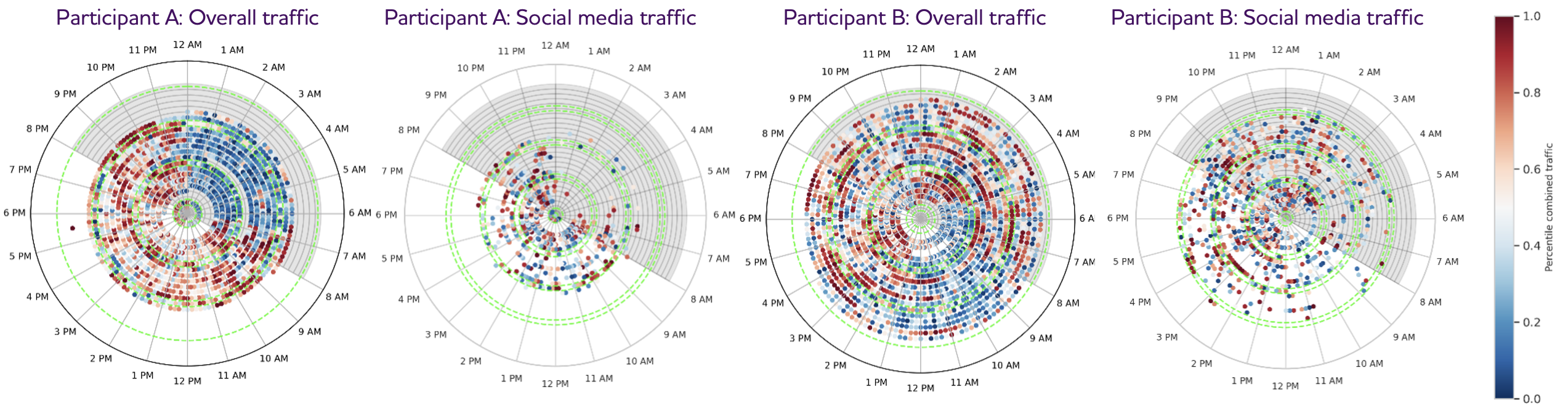
This visualization showcases data from two participants in the researchers' 14-day pilot study with 27 NYU students. Each ring represents a full day of passively monitored internet activity from their mobile phones. The dots illustrate 10-minute intervals of internet usage, with red indicating high activity and blue indicating low activity. Notice the clear difference in patterns: Participant A demonstrates a consistent daily routine, including a regular sleep schedule (the prominent blue region at night), while Participant B's activity is more varied. Click to view larger image.
The NYU Tandon study's success in demonstrating feasibility and acceptability has paved the way for clinical applications.
The researchers are now recruiting individuals with pre-Alzheimer's conditions for a 30-day monitoring study comparing their network traffic patterns with healthy controls, the crucial next step in determining whether RouterSense can detect early signs of cognitive decline.
Other areas the researchers plan to explore include digital behaviors related to mindless eating and brain development in younger populations.
In addition to Huang, Mahmood and Kaye, the paper’s authors are Donghan Hu and Annabelle David (NYU Tandon), Zachary Beattie (Oregon Health & Science University), Nabil Alshurafa (Northwestern University), Lou Haux (Max Planck Institute for Human Development), Josiah Hester (Georgia Institute of Technology), Andrew Kiselica (University of Georgia), Shinan Liu (University of Hong Kong), and Chenxi Qiu and Chao-Yi Wu (Harvard Medical School).

NYU Tandon builds FAIR (Findable, Accessible, Interoperable, and Reusable) data infrastructure for urban monitoring
Urban infrastructure is constantly changing through weathering, deterioration, and repairs, yet the technology to track exactly what's happening to buildings and roads has remained frustratingly limited.
Now, a NYU Tandon-led research team with collaborators at the University of Delaware have received a grant from the National Science Foundation to build the missing data infrastructure that could help cities better monitor their built environments and identify problems earlier.
The project is called HS-SPECTRA (Hyperspectral Standardizing and Sharing Possibilities for Urban Conditions through Toolkits, Resources, and Archiving).
Hyperspectral imaging measures how light interacts with materials by recording how much light is reflected, absorbed, or transmitted at each wavelength across a broad spectrum. This process produces a unique signature for every material at its current condition. As such, the technique can reveal hidden moisture damage, structural repairs, and material deterioration invisible to the naked eye. But to use this technology effectively, researchers need reference databases showing what normal and damaged materials look like under real-world conditions.
Existing spectral libraries containing urban material signatures are extremely scarce and have no established standard for rigorous metadata, according to a review by Jessica Salcido and Debra Laefer published in the Photogrammetric Record. Furthermore, most existing spectral libraries capture materials once, under idealized laboratory conditions, making those libraries incomplete and hard to use.
"We're creating something entirely new," said Laefer, the project's principal investigator and NYU Tandon professor of Civil and Urban Engineering and a faculty member of the Center for Urban Science + Progress (CUSP). "A living dataset that tracks the same materials repeatedly over time and under varying environmental conditions and temperatures."
The practical applications extend across multiple domains. Building inspectors could use the technology to identify structural repairs or detect moisture damage invisible to the naked eye. Urban planners might track how infrastructure weathers over time. Heritage conservators could monitor historic buildings for early signs of deterioration.
“You can look at a brick facade with your eyes and maybe notice some discoloration. But hyperspectral imaging can distinguish between original materials and patches, identify salt intrusion, and detect moisture retention,” said Salcido, an NYU Physics Ph.D candidate and a researcher on the project. “That information is critical for maintenance planning but impossible to see with conventional photography."
HS-SPECTRA will employ rooftop-mounted sensing platforms in Brooklyn at CUSP's Urban Observatory and at the University of Delaware. The one at NYU will provide persistent imaging of the Manhattan skyline, as the observatory has the capability to capture visible, infrared, and hyperspectral data at distances of one to four kilometers. The facility at the University of Delaware is led by Prof. Gregory Dobler, who is the co-principal investigator on this NSF grant.
The team will augment this existing infrastructure with additional weather and atmospheric sensors to fully contextualize how environmental conditions affect spectral measurements. Over the three-year, $600,000 project, they expect to generate approximately 102,000 individual spectra annually from multiple carefully selected regions of interest, capturing hourly data between 6 AM and 8 PM across all seasons.
"We're creating open-source tools and standards that will enable seamless conversion of our reference data to the research instruments owned and operated by other scientists and engineers around the world," Laefer explained, addressing that what sets HS-SPECTRA apart is making the data actually usable.
The project will do this by developing standardized metadata frameworks, processing pipelines, and automated archival workflows. All data will be released through established public repositories, SPECCHIO and EcoSIS, with scheduled releases linked by unified campaign identifiers. The team is also creating resampling software that will enable researchers to transform the spectral library to match specifications of various sensors, dramatically expanding the data's utility.
The project includes community engagement efforts, with case studies, training materials, and demonstrations targeted at the structural engineering, architecture, and historic preservation communities through professional conferences, webinars, and direct outreach to city agencies like NYC's Department of Buildings. By automating the data processing and archival pipeline, the team aims to ensure the urban spectral monitoring can continue well beyond the grant period, creating a lasting resource for researchers worldwide studying how cities evolve at the material level.
NSF's Office of Advanced Cyberinfrastructure and the Directorate for Engineering jointly support the project.
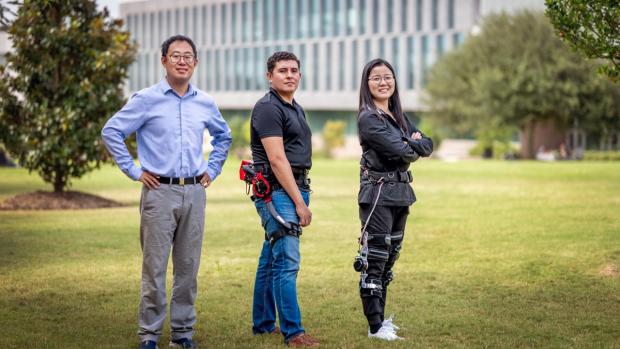
NYU Tandon researchers are developing AI-powered exoskeletons to enhance human mobility for everyone
Approximately 31 million Americans experience mobility disabilities, with nearly 27% of older adults facing significant difficulty walking or climbing stairs. Yet current robotics solutions remain largely confined to research laboratories.
The fundamental problem, as Hao Su at NYU Tandon School of Engineering explains, is that existing exoskeletons "don't really understand humans’ intention." Most rehabilitation exoskeletons require 30 minutes or more to calibrate for each user and are uncomfortably bulky and heavy at around or more than 30 pounds, making people reluctant to wear them.
Su is leading a multi-university research team that is pursuing a solution through a recently awarded $3.6 million collaborative NSF Growing Convergence Research grant.
Building on a 2024 study Su and his colleagues published in Nature that proved exoskeletons can leverage deep reinforcement learning to train control policies entirely in computer simulation, the new project aims to take this technology from healthy-subject laboratory demonstrations into real-world community use for healthy people, older adults, and those with disabilities.
Ultimately, the team’s goal is to create affordable, lightweight exoskeletons that are intelligent enough to adapt to the needs of older adults and stroke survivors without requiring lengthy setup, while also being comfortable enough for daily use in their communities.
"This is truly an interdisciplinary endeavor. Our work involves mechatronics design, electrical engineering, computer science, rehabilitation medicine, and gerontology," explains Su, an associate professor of Biomedical Engineering.
The team's approach, which Su refers to as "physical AI," represents a fundamental shift from traditional methods. "Standard approaches require collecting extensive training data from 20 to 40 people for each study. In our Nature paper (see video below), we showed that our system requires no physical data collection for training. Instead, we utilized publicly available data and trained our system to accommodate a wide range of users. In this new project, we will use wearable sensors or cameras in smartphones to capture human movements to personalize control policies for each individual."
The approach uses a highly detailed virtual human body that simulates how hundreds of individual muscles and over 50 different joint movements work together. Using this virtual body, the team trains three AI systems that each handle different tasks: one learns natural human movement patterns, another determines which muscles should activate during movements, and a third decides what assistance the exoskeleton should provide in real-time.
The efficiency of this approach is remarkable. "The AI system that controls the exoskeleton only needs to train once for a few hours in the simulation. During this learning process, it gradually learned to generate effective assistance for walking, running, and stair climbing activities. In this new project, we will expand knowledge of assistive controllers to pathological gaits and more activities," Su explains.
The Nature study showed that people wearing the exoskeleton used 24.3% less energy during walking, 13.1% less during running, and 15.4% less during stair climbing. The mechatronics innovation of their robots is equally significant. Su's team has systematically reduced complexity and weight.
"We eliminated, for example, an expensive torque sensor by developing a new algorithm that estimates the same measurements using software instead of hardware. This makes the device lighter and much cheaper," Su explains. The team has built approximately 30 iterations of the device, each progressively lighter and more comfortable. The team’s version weighs about 6.6 pounds, as published in IEEE/ASME Transactions on Mechatronics 2025, compared to 30-pound tethered systems that confine users to laboratory treadmills.
The project’s vision extends beyond medical applications. "Our goal is what we call exoskeletons for everyone and everywhere,” said Su. “It's possible exoskeletons could be used, for example, for recreational activities like hiking. Or simply to make it easier for anyone to walk farther or longer distances in their daily lives."
The research team’s co-principal investigators are Xianlian Alex Zhou at New Jersey Institute of Technology (NJIT), Pamela Cacchione and Michelle Johnson at the University of Pennsylvania, Xiaoyue Ni at Duke University, and Bolei Zhou at UCLA.
Yan Y, Huang JS, Zhu J, Hou Z, Gao W, Lopez-Sanchez I, Srinivasan N, Srihari A, Su H. Compact and Foldable Hip Exoskeleton With High Torque Density Actuator for Walking and Stair-Climbing Assistance in Young and Elderly Adults. IEEE/ASME Transactions on Mechatronics. 2025 Jul 8.
Researchers demonstrates substrate design principles for scalable superconducting quantum materials
Silicides — alloys of silicon and metals long used in microelectronics — are now being explored again for quantum hardware. But their use faces a critical challenge: achieving phase purity, since some silicide phases are superconducting while others are not.
The study, published in Applied Physics Letters by NYU Tandon School of Engineering and Brookhaven National Laboratory, shows how substrate choice influences phase formation and interfacial stability in superconducting vanadium silicide films, providing design guidelines for improving material quality.
The team, led by NYU Tandon professor Davood Shahrjerdi, focused on vanadium silicide, a material that becomes superconducting (able to conduct electricity without resistance) when cooled below its transition temperature of 10 Kelvin, or about -263°C. Its relatively high superconducting transition temperature makes it attractive for quantum devices that operate above conventional millikelvin temperatures.
Researchers engineered crystalline hafnium oxide substrates and compared them with standard silicon dioxide under identical processing conditions. Hafnium oxide offered greater chemical stability and suppressed unwanted secondary phases, though it degraded under the highest processing temperatures.
"Achieving phase-pure superconducting films requires careful attention to the substrate-film interface," said Shahrjerdi. "Our findings show that substrate design is an integral aspect of the synthesis process.”
The chemical stability of hafnium oxide proved crucial for maintaining film quality during processing. Most intriguingly, atomic-resolution imaging suggested that the crystalline structure of hafnium oxide may influence the orientation and phase selection of overlying silicide grains, pointing to possible templating effects that could enable selective phase nucleation.
The research provides fundamental insights that extend beyond vanadium silicides to other superconducting silicide systems. The principles identified — chemical inertness, thermal stability, and structural ordering — offer design guidelines for next-generation quantum device substrates.
"These findings complement our recent work on physical patterning techniques," noted Shahrjerdi. "Together, they expand the design space for quantum hardware."
In addition to Shahrjerdi, the paper’s authors are Miguel Manzo-Perez, Moeid Jamalzadeh, and Iliya Shiravand (Ph.D. students at NYU Tandon); and Sooyeon Hwang, Kim Kisslinger, and Dmytro Nykypanchuk from the Center for Functional Nanomaterials at Brookhaven National Laboratory. The work was conducted in part at the NYU Nanofabrication Cleanroom (NYU Nanofab) with characterization support from Brookhaven National Laboratory.
Miguel Manzo-Perez, Moeid Jamalzadeh, Sooyeon Hwang, Iliya Shiravand, Kim Kisslinger, Dmytro Nykypanchuk, Davood Shahrjerdi; Substrate effects on phase formation and interfacial stability in superconducting vanadium silicide thin films. Appl. Phys. Lett. 22 September 2025; 127 (12): 122601. https://doi.org/10.1063/5.0291576