

Robotics & Embodied Intelligence
Innovation at the nexus of AI, wireless, robotics, and the physical world
Robotics and Artificial Intelligence (AI) are both expansive fields far from reaching their full potential. Here at Tandon, we believe the most promising future lies at the intersection of the two with Embodied Intelligence where AI and wireless innovation merges with the physical world to create a new generation of smart, autonomous systems.
A technological revolution is approaching as AI innovations enable robots, self-driving vehicles, and smart cities to sense, learn, and act intelligently within their environments. By uniting robotics, machine learning, and computer vision, we are solving critical challenges in manufacturing, transportation, healthcare, and infrastructure while preparing and reshaping society for a more intelligent future.
Academic Programs
UndergraduateBachelor's Degrees
Master's Degrees
Doctorate Degrees
* Online Only Degree
+ Available Online and On Campus
Hands-on Learning: Vertically Integrated Projects
Vertically Integrated Projects (VIP) are multi-year, multidisciplinary projects that emphasize innovative and research-active education.
NYU Robotic Design Team

Smart Chemical Emission Navigation Tracker (SCENT)
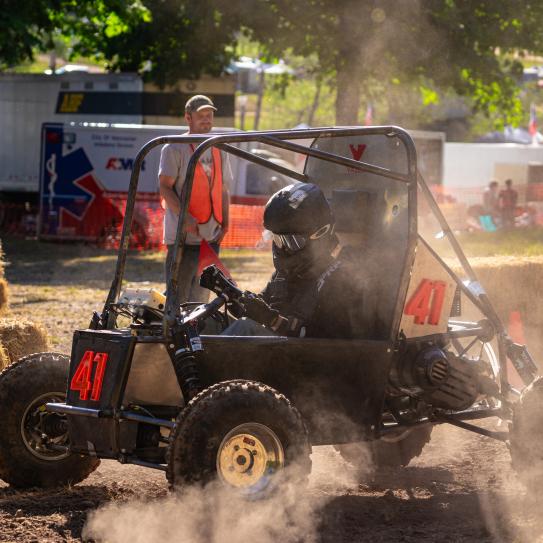
NYU Motorsports
ARC Robotics: Team Ultraviolet (Formerly RoboMaster) (GY)
Latest Stories & Events
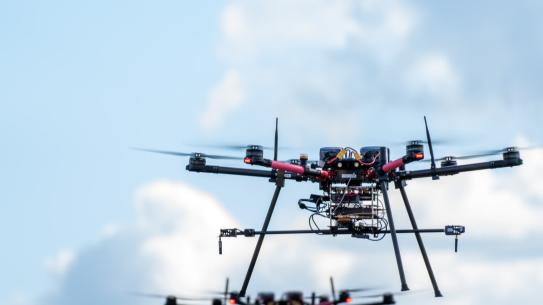



Research Centers and Labs
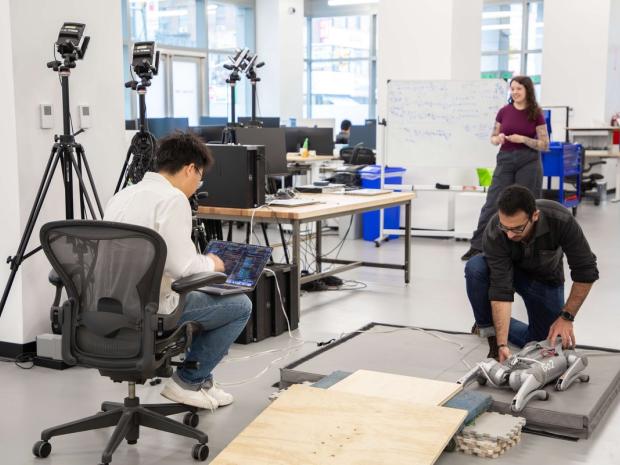
NYU Center for Robotics and Embodied Intelligence (CREO)
We strive to advance research, education, and innovation at the intersection of AI and robotics to enhance everyone’s quality of life through socially beneficial technologies.
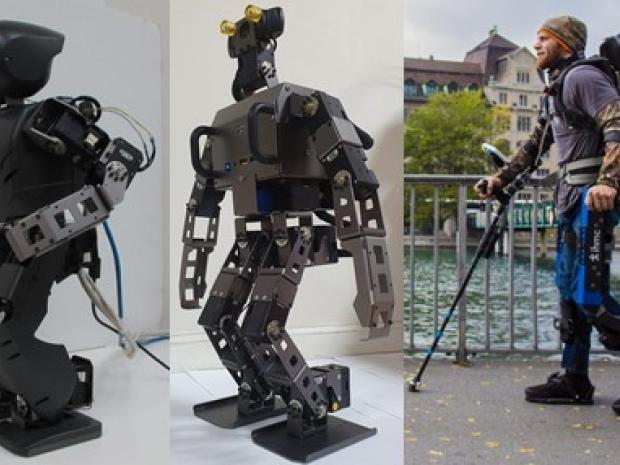
Applied Dynamics and Optimization Laboratory
We aim to establish mathematical models, quantitative criteria, and algorithmic/computational foundations toward their implementations in robotics (for design and control), biomechanical systems (for prediction and analysis), and their intersections such as lower-body wearable robots.
AI4CE Lab
The AI4CE Lab aims to advance Robotics and AI in areas such as localization, mapping, navigation, mobile manipulation, and scene understanding to address infrastructure challenges on Earth and beyond, including construction robotics, manufacturing automation, and autonomous vehicles.

Biomechatronics and Intelligent Robotics Lab
Research focuses on innovative robotic technologies to assist people in areas like walking, surgery, and rehabilitation. Sample projects include a reinforcement learning-powered exoskeleton that reduces human energy use, a versatile catheter robot for safer surgeries, and MRI-guided robots to improve prostate cancer biopsies.
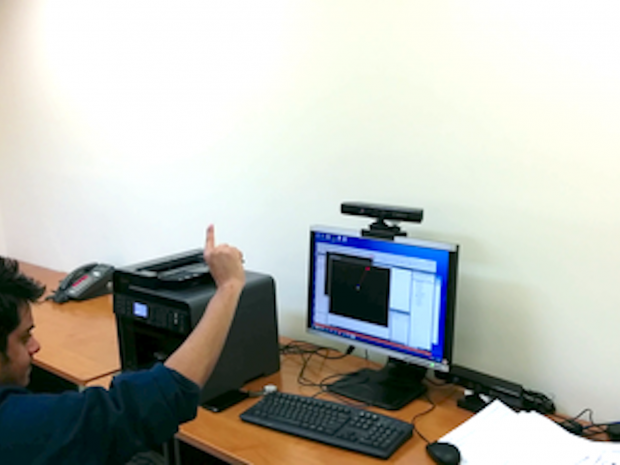
Control and Network (CAN) Lab
The CAN Lab, led by Professor Zhong-Ping Jiang, develops fundamental principles and tools for the stability analysis and control of nonlinear dynamical networks, with applications to information, mechanical, and biological systems.
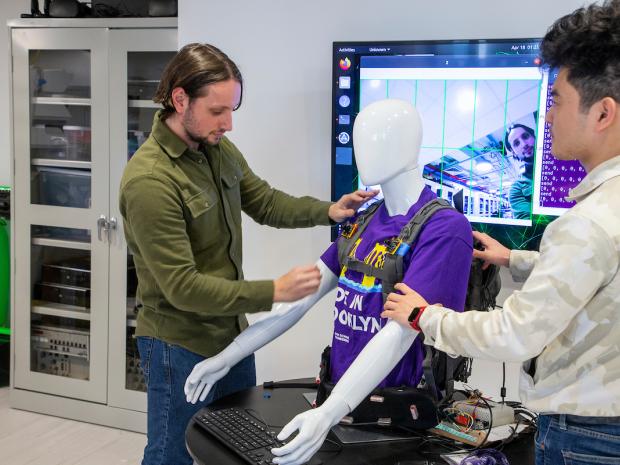
Dynamical Systems Laboratory (DSL)
Professor Maurizio Porfiri’s group conducts multidisciplinary research in the theory and application of dynamical systems, motivated by the objectives of advancing engineering science and improving society. Their theoretical expertise is in controls, networks, nonlinear dynamics, and time-series, while our application domain is in modeling and analysis of physical, social, and technical systems.

Laboratory for Agile and Resilient Complex Systems
Our goal is to develop new control and game-theoretic tools for designing agile and resilient control for smart energy systems, communication networks, secure cyber-physical systems, and human-in-the-loop systems.
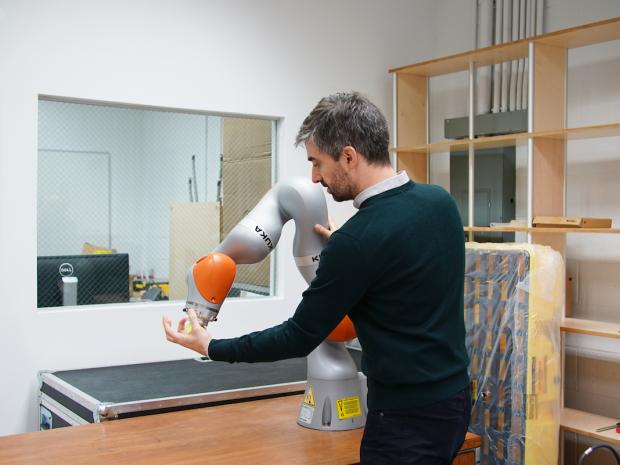
Machines in Motion
We try to understand the fundamental principles for robot locomotion and manipulation that will endow robots with the robustness and adaptability necessary to efficiently and autonomously act in an unknown and changing environment.