

How Peter Coen (‘83) Is “Quietly” Helping Make Aviation History
The Alum Has Played a Major Role in the Development of NASA's X-59, a Groundbreaking Supersonic Aircraft
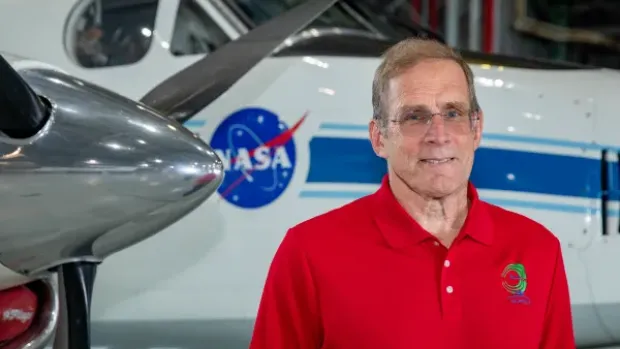
Alum Peter Coen earned a Bachelor's degree in Aerospace Engineering
As a teenager, Peter Coen had a modest ambition: to become an airplane mechanic one day. After a teacher at New York City’s specialized Aviation Career & Technical Education High School encouraged him to think bigger, however, he set his sights on earning a bachelor’s degree in aerospace engineering.
The Polytechnic Institute of New York (now NYU Tandon School of Engineering) had already forged a rich aerospace legacy when Coen enrolled at its Farmingdale campus. The legendary Antonio Ferri — one of the defining figures of American supersonic science — had been a towering presence there as the director of the school’s Aerospace Institute, the head of its Department of Aerospace Engineering and Applied Sciences, and the driving force behind its construction of what was then the world’s most advanced hypersonic wind tunnel. Ferri had died in 1975, but his influence lived on in the faculty who had learned under him. For a student like Coen, already drawn to flight, it was a stimulating intellectual environment.
Coen graduated in 1983 with a bachelor's degree in aerospace engineering, a fascination with the physics of sound, and the academic foundation for a career that would eventually put him at the center of one of the most significant aviation projects since Chuck Yeager broke the sound barrier in 1947.
One problem in particular captured Coen's attention: sonic booms. When an aircraft breaks the sound barrier, it generates shock waves that propagate to the ground as an explosive crack — a jarring disturbance that led aviation regulators to ban commercial supersonic flight over land in the United States in 1973, effectively grounding the Concorde and its successors from ever crossing the continental interior. It was a problem with enormous practical stakes: as long as supersonic flight meant sonic booms, it would remain confined to transoceanic routes and military applications, forever out of reach for most of the world's travelers as a commercial reality.
That prohibition has stood for more than 50 years, but Coen has spent much of his career working to change the circumstances surrounding it.
Thanks in part to an alumni connection, after graduating from what was then generally known as “Poly,” Coen was hired by NASA. Through a cooperative program with the George Washington University, he earned a master’s degree in Aeronautics and began a four-decade career in supersonic research. He worked on technology integration across multiple generations of aircraft studies, contributed to the DARPA-NASA Shaped Sonic Boom Demonstration — which proved in flight that the fundamental physics of boom reduction could actually work — and spent years building consensus among aerospace companies, the FAA, and international aviation organizations around new standards for acceptable supersonic noise over land. He became, in effect, not just an engineer but a diplomat of sorts.
Now, his work has contributed to a historic milestone: NASA's X-59, the centerpiece of the agency's Quesst mission and the product of years of design and testing, completed its first flight on October 28, 2025, taking off from Lockheed Martin's Skunk Works facility in Palmdale, California, and flying for 67 minutes before landing at NASA's Armstrong Flight Research Center in Edwards.
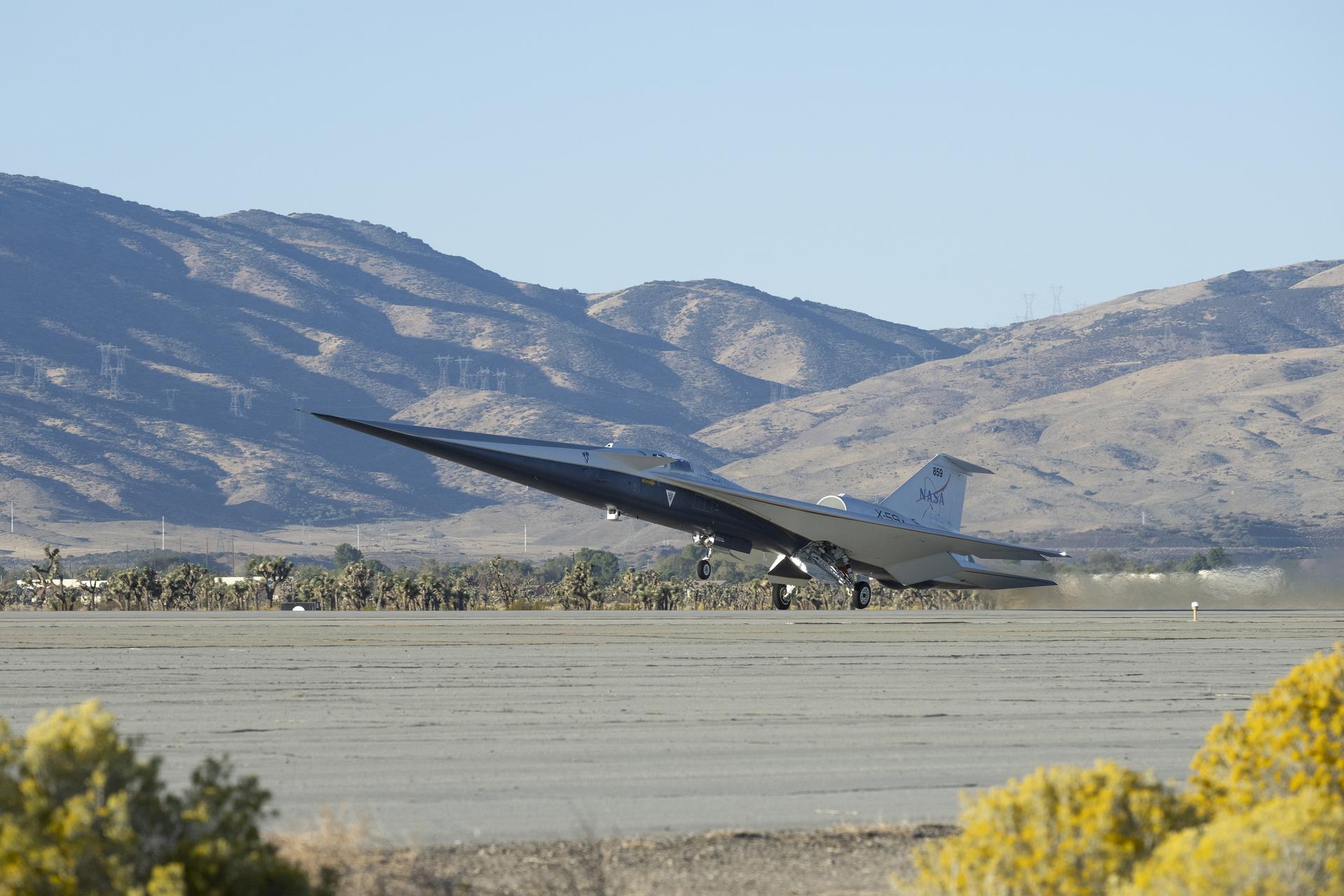
The mission's name reflects the effort to overcome this challenge. It is, in fact, a Quesst with a “double s” nod to supersonic flight. “Boom," even “low boom," is not a part of the mission name — because when journalists encounter that word in connection with a flight path over a populated community, the coverage rarely does justice to the science. The X-59 is designed to reduce the loud sonic boom that occurs when flying at supersonic speeds to a quieter sonic “thump,” barely audible on the ground.
That reduction in noise requires ingenious engineering. The aircraft's long, slender nose — so prominent it became the signature image when NASA and Lockheed publicly debuted the plane in early 2024 — is fundamental to spreading the shock waves apart so they never coalesce into the double-crack that gives a traditional sonic boom its impact. Behind the nose, nearly every feature of the airframe’s shape contributes to the distribution of the shock waves. Even the unique top-mounted engine redirects the inlet shock upward and away from the ground. Although the first flight reached only 230 mph and 12,000 ft, the X-59 will soon soar, quietly, to its target cruising speed of about 925 mph at 55,000 feet.
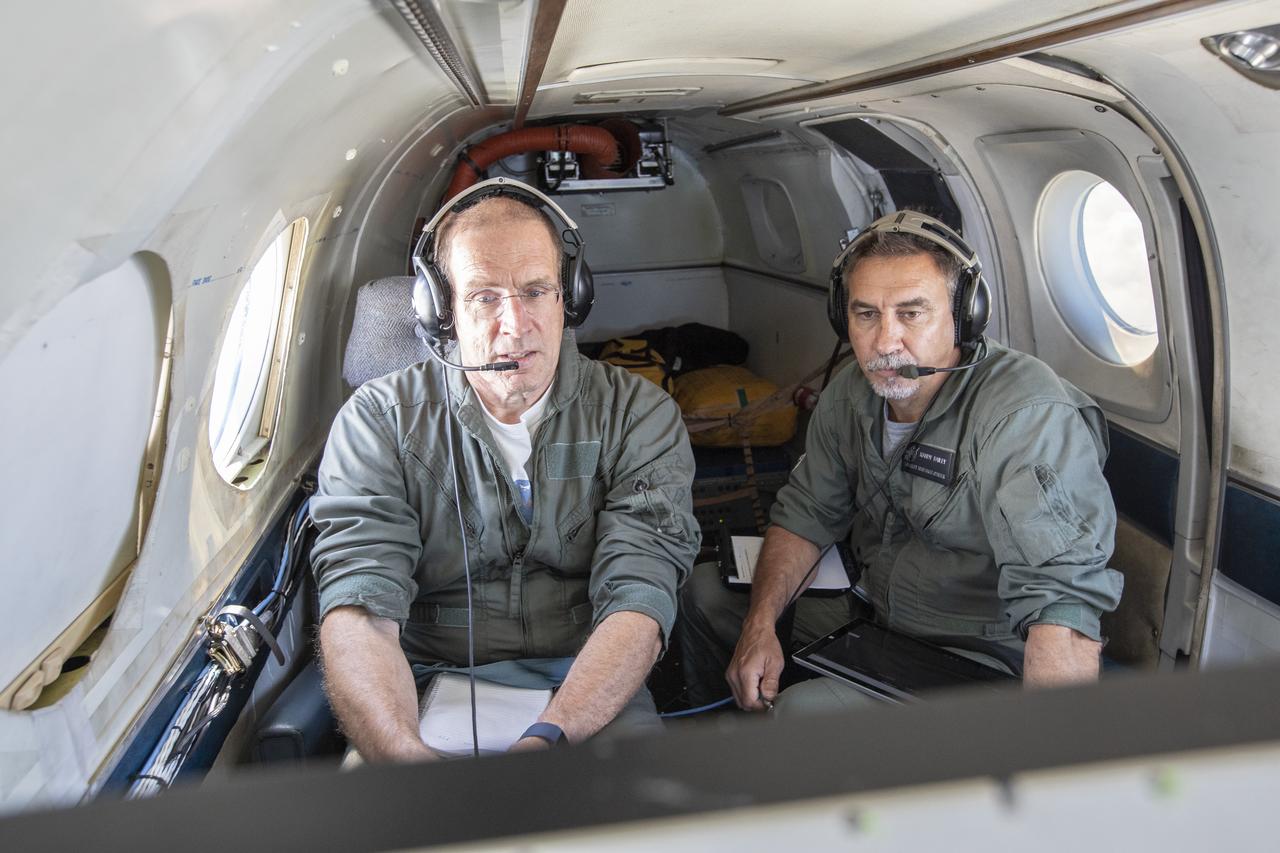
Coen's role in all of this, as the Quesst Mission Integration Manager, is to ensure that the aircraft development, acoustic validation, and community testing remain coordinated, on track, and a source of useful data. NASA's goal is to fly the X-59 over various U.S. communities, collecting ground measurements and survey responses from residents to understand their perceptions of the sonic thump, and then share those findings with national and international regulators to establish new, data-driven standards for supersonic flight over land.
When the X-59 lifted off for the first time last October, a circle closed that had opened in a Long Island classroom more than 40 years ago. A student who initially wanted only to fix airplanes learned instead to reimagine what flight itself could be. (And don’t worry — he has also realized his original dream. As a licensed private pilot with his own plane, he regularly gets to do hands-on maintenance.)