


Overview
The M.S. in Electrical Engineering is a 30-credit program in the Department of Electrical and Computer Engineering. You build depth in one area and take electives across the department. Areas include microelectronics, chip design and security, analog and RF circuits, wireless communications and networking, energy systems, machine learning and signal processing, robotics, and biomedical systems. Courses combine design, simulation, and lab work, and students can take a project or thesis option. Graduates go into semiconductor, communications, energy, and defense industries, or continue to a Ph.D.
Prerequisites
- Advanced Mathematics (Calculus, Differential Equations, Linear Algebra)
- Circuit Theory & Analysis
- Signals & Systems
- Computer Programming / Algorithmic Foundations
Application Requirements
- Online application
- Official Transcripts
- Resume
- Statement of Purpose
- 1-minute video
- 2 Letters Of Recommendation
- English Language Proficiency Testing (where applicable)
- $90 application fee
Find out more about Admission Requirements.
Tuition varies based on your program, term admitted and credit hours.
We are committed to keeping graduate studies affordable for all of our students. You’ll have access to on-campus employment programs that include teaching and research assistantships, as well as financial aid, scholarships, grants, and loans.
Explore our Tuition, Financial Aid and Scholarships page to learn more about these opportunities.
Prospective Students
For questions about the application process, application status or to talk to an admissions counselor:
Office of Graduate Enrollment and Admissions
NYU Tandon School of Engineering
engineering.gradinfo@nyu.edu
646-997-3182
Alternatively, you can contact the department directly at Tandon-ECE-Grad-Admissions@nyu.edu
Accepted and Enrolled Students
For questions about the curriculum or courses:
Department of Electrical and Computer Engineering
NYU Tandon School of Engineering
370 Jay Street, 9th Floor
Brooklyn, NY 11201
ece-announcements@nyu.edu
646-997-3590
For advising questions:
ECE Graduate Advising Office
ecegrad@nyu.edu
646-997-3884
At a Glance
Top 50
Best Graduate Electrical Engineering Programs
(U.S. News & World Report)
Top 50
Best Overall Engineering Schools
(U.S. News & World Report)
$108,102
Average Base Salary
Class of 2025 Master’s Graduates
Market Outlook
NYC Advantage
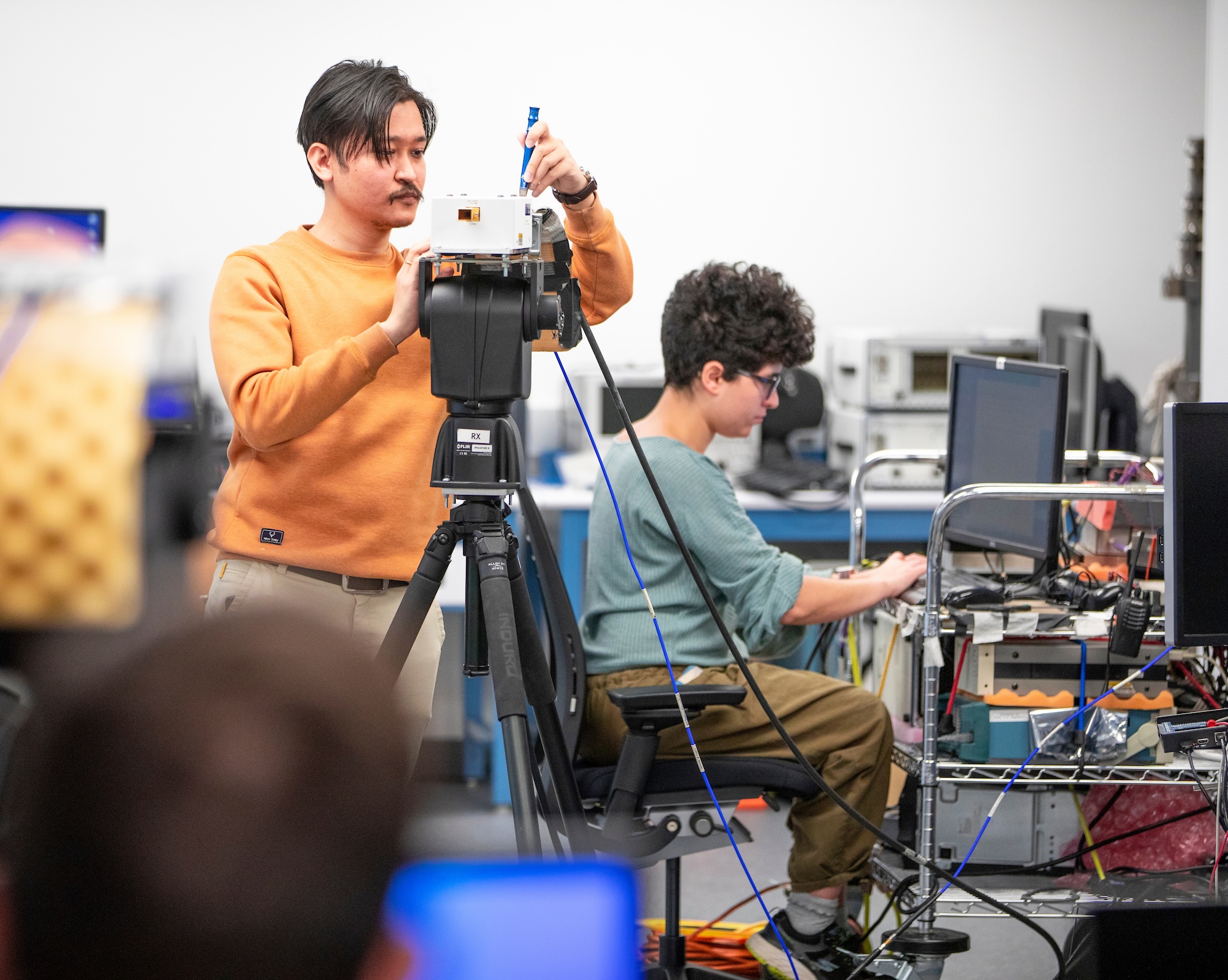
NYU Tandon electrical engineering students benefit from an unparalleled advantage: direct proximity to New York City’s thriving tech ecosystem, booming startup hubs, and world-class research labs. The department connects you directly to industry leaders, global corporate headquarters, and major tech innovators. Studying in NYC provides immediate access to internships, networking, and career pathways in smart cities, communications, and green technology.

Curriculum
The program will prepare you for a professional career as an entrepreneur, a practicing engineer in industry, business or government at an advanced level, or to pursue a Ph.D. degree in electrical engineering.
| Requirement Area | Credits |
|---|---|
| Core Requirements | 6 |
| ECE Electives | 18 |
| Free Electives | 6 |
| Total Credits | 30 |
You can choose a concentration from a number of stimulating fields, including the following:
- Communications, Networking and Signal Processing
- Computer Engineering and VLSI
- Energy systems and power electronics
- Electromagnetics and analog/RF/Biomedical circuits
- Systems, control, and robotics
Meet our Faculty and Alumni






Computer Engineering, M.S.

Emerging Technologies, M.S.

Computer Science, M.S.
To earn a Master of Science in Electrical Engineering, students must complete 30 credits to qualify for graduation.
The M.S. in Electrical Engineering program is offered in on-campus full-time, on-campus part-time, and flexible online formats.
Fall Semester
- December 1: M.S. priority consideration
- February 15: M.S. general consideration
Spring Semester
- November 1: M.S. general consideration
- Online application
- Official Transcripts
- Resume
- Statement of Purpose
- 1-minute video
- 2 Letters Of Recommendation
- English Language Proficiency Testing (where applicable)
- $90 application fee
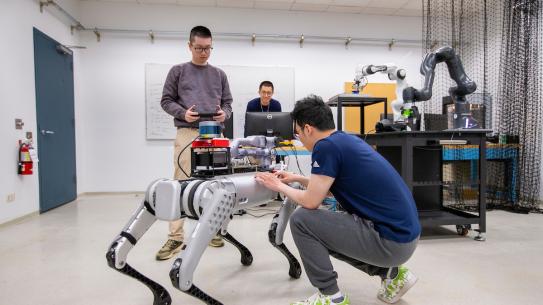
M.S. in Electrical Engineering students have access to state-of-the-art research centers and facilities, including NYU WIRELESS, the NYU MakerSpace, cleanrooms, and specialized laboratories for bio-electronics, robotics, micro-electronics, power systems, and signal processing.
Yes, non-STEM students and those without prior hardware experience can prepare for admission through the NYU Tandon BASICS program (Bridge to Application-Specific Integrated Circuits). This 100% online, self-paced 28-week program requires no prior STEM background and covers foundational skills in C++, logic and circuits, Verilog, FPGA prototyping, and chip fabrication. Students who earn the BASICS certificate become eligible to apply for NYU Tandon’s Master’s in Electrical Engineering, providing a direct pathway to graduate study.
Learn more on the NYU Tandon BASICS page.