

Wildfire Prevention Models Miss Key Factor: How Forests Will Change Over Decades
NYU Tandon researchers show vegetation evolution must be included in long-term fire risk predictions
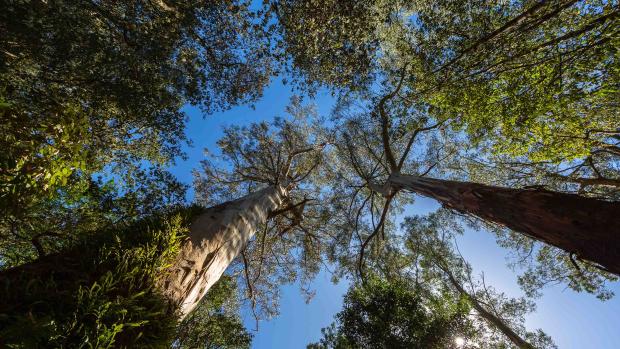
Eucalyptus trees.
Eucalyptus trees, laden with flammable oils, could spread into Portugal's south-central region by 2060 if changing climate conditions make the area more hospitable to their growth, creating wildfire hotspots that would evade detection by conventional prevention approaches.
The gap exists because most wildfire models account for climate change but treat forests as static, missing how vegetation itself will evolve and alter fire risk.
A new study from NYU Tandon School of Engineering fills this gap by modeling both climate and vegetation changes together. Published in the International Journal of Wildland Fire, the research projects how forests will evolve through 2060 and reveals that ignoring vegetation dynamics produces fundamentally incomplete fire risk projections.
"If you only consider the impact of climate but ignore vegetation, you're going to miss wildfire patterns that will happen," said Augustin Guibaud, the NYU Tandon assistant professor who led the research team. "Vegetation works on a timescale that's different from climate or weather."
Testing the model in Portugal revealed a striking paradox: local fire risk doesn't always track with global warming trends. Some higher-emission scenarios actually showed decreased fire risk in Portugal, with medium emissions projecting a 12% decrease when vegetation responses were included. In the low-emission scenario, projections without vegetation changes predicted a 59% increase in burned area by 2060, but including how forests would actually adapt reduced that to just 3%.
"The climate scenario which is more drastic from a temperature perspective may not be the one associated with highest risk at the local level," Guibaud explained. The counterintuitive results underscore that local climate conditions and vegetation responses can diverge significantly from global patterns.
The findings matter beyond Portugal. Wildfires are increasing in frequency, intensity and geographic scope across Mediterranean climates and western North America, with regions like California experiencing recurring large fires. Climate projections indicate these trends will continue, making long-term planning increasingly important. Guibaud anticipates working with federal agencies to apply the methodology in the United States, where the same dynamics of shifting vegetation and fire risk are playing out.
The team developed their approach using machine learning to analyze Portugal's wildfire patterns, correctly identifying 84% of historical wildfire locations in validation tests. They modeled how wildfires would change under three climate futures through 2060 — from low to high emissions — incorporating how seven dominant ecosystems characterized by the tree species would shift in response to changing temperature and precipitation.
The model has immediate practical implications. Planting strategies aimed at reducing wildfire risk can backfire if they don't account for future climate. Species that won't survive future conditions waste resources, while fire-prone species that will thrive "lock in elevated risk for decades," Guibaud said. Because forest ecosystems take about a century to fully restore, those mistakes reverberate for generations.
The team's model integrates data from NASA satellite systems, Portugal's National Forest Inventory, and IPCC climate projections, using Maximum Entropy modeling to project species shifts and a Graph Convolutional Network to assess fire risk based on surrounding vegetation and terrain. The researchers developed a method to decouple climate and vegetation effects by running projections twice: once holding vegetation constant and once allowing it to evolve.
The team plans to refine the vegetation modeling to include shrubs and grasses, not just tree species. In addition to Guibaud, who sits in Tandon's Mechanical and Aerospace Engineering Department and its Center for Urban Science + Progress, the paper's authors are Feiyang Ren, now at the University of Leeds; Noah Tobinsky, who worked on the project as a master's student at NYU Tandon; and Trisung Dorji of University College London.
Ren F, Tobinsky N, Dorji T, Guibaud A. (2025) On the importance of both climate and vegetation evolution when predicting long-term wildfire susceptibility. International Journal of Wildland Fire 34, WF25092. https://doi.org/10.1071/WF25092