
Ten NYU Tandon Students Named 2026 NSF Graduate Research Fellows
The prestigious fellowship recognizes future STEM leaders tackling some of the most pressing challenges of our time — from sustainability and artificial intelligence to the frontiers of quantum and biomedical science.
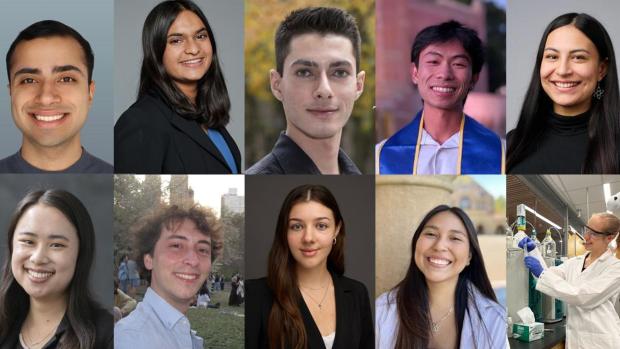
Ten NYU Tandon School of Engineering graduate students have been named 2026 National Science Foundation (NSF) Graduate Research Fellows, chosen from a pool of nearly 14,000 applicants for one of the most competitive and prestigious awards in American science.
Since its launch in 1952, the Graduate Research Fellowship Program (GRFP) has supported a long roster of scientists, engineers, and entrepreneurs who have gone on to shape entire fields, with more than 40 future Nobel laureates among them.
Tandon’s ten new fellows are ready to join that lineage. Their research interests span the defining challenges and opportunities of the decade ahead: building sustainable systems for a changing planet, advancing artificial intelligence that is trustworthy and useful, pushing forward quantum information science, and applying engineering insight to human health and national priorities.
“The Graduate Research Fellowship Program is the country’s longest-running, sustained investment in developing the United States domestic STEM workforce,” said Brian Stone, performing the duties of the NSF director, in announcing the cohort. “GRFP fellows have driven remarkable progress across the STEM landscape, from pioneering basic research and transformative technologies to unlocking critical advances in national security and other key areas, to founding some of the Nation’s most innovative companies.”
That arc from curiosity-driven discovery to real-world impact is precisely what Tandon’s newest fellows are setting out to trace. The students honored this year are working at the edges of their fields, pursuing questions whose answers will matter far beyond the lab bench: How do we design infrastructure, materials, and energy systems that can sustain a growing population on a warming planet? How do we build AI systems we can understand, trust, and deploy responsibly? How do we translate the strange, powerful physics of the quantum world into practical tools? How do we keep people healthier, longer?
These are the kinds of questions NSF created the GRFP to pursue, and the kinds of questions Tandon was built to take on. The 2026 cohort joins a growing Tandon community of GRFP awardees and honorable mentions whose work is already reshaping their disciplines.
Meet the 2026 NYU Tandon NSF Graduate Research Fellows:
Vatsal Baherwani: Teaching AI to Think Like a Scientist
Today’s most impressive AI models have a limitation: they’re only as smart as the data we feed them. That works fine when you want a chatbot to draft an email or debug a line of code — but it falls short exactly where humanity needs AI most, like helping doctors find treatments for rare diseases where data is scarce. Vatsal Baherwani wants to change that. His research aims to train AI agents that can develop a genuine scientific understanding of the world by forming and testing their own hypotheses, rather than leaning on what humans have already written down.
The motivation is deeply personal. Baherwani’s younger brother Jay was diagnosed with a brain tumor at age six. Jay survived but the experimental nature of his treatment, and the lasting side effects he still lives with, left their mark. “In the time I spent with Jay at multiple hospitals, I realized thousands of other children are battling various kinds of understudied diseases,” Baherwani, who will be advised by Tandon’s Pavel Izmailov and Courant’s Andrew Gordon Wilson, says. That experience sharpened a purpose he’d begun to find during his undergraduate studies at the University of Maryland, when an intriguing quantitative finance course with Professor Pete Kyle showed him that rigorous scientific thinking could shape high-stakes, real-world decisions—and sparked his curiosity about how AI might do the same.
Baherwani, who has worked as a visiting researcher at UC Berkeley’s Center for Human-Compatible AI and will intern at Q Labs in San Francisco this coming summer, is also clear-eyed about the broader impacts of his field. Public anxiety about AI is real, and he hopes his work can help tell a different story: one in which AI accelerates discovery rather than replacing the humans doing it. He points to the long history of “impractical” basic research that reshaped the world: the frog-leg experiments that led to the battery, or the decades of quiet mRNA research that made COVID-19 vaccines possible almost overnight. Giving AI the ability to ask its own questions, he believes, could be the next entry on that list, as well as a step toward treatments that help kids like Jay.
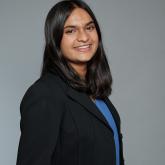
Anvita Bansal: A More Resilient Supply Chain
Anvita Bansal is one of three 2026 fellows who will work with Miguel Modestino and Justin Bui on electrifying chemical production — a research area that sits at the center of the push to decarbonize heavy industry. Her own angle on the problem is scale: how the electrochemical reactors that could one day replace fossil-fueled chemical plants can be engineered to work not just in the lab, but out in the world, at volumes that actually matter.
For Bansal, one of the most compelling arguments for electrified chemical manufacturing is the state of today’s supply chains, which are long, fragile, and sometimes involve overseas facilities — a vulnerability the last several years have made impossible to ignore. Reactors that run on clean electricity, and that can be built smaller and closer to where their products are needed, offer a path to a more resilient domestic industrial base. Her five-year horizon reflects that practical bent: she is less interested in producing elegant models than in seeing pilot systems deployed in the real world, where their assumptions can be tested against the messiness of actual operation.
She arrived at that vision by a route that was anything but straight, though she is careful not to characterize its turns as obstacles. Earlier research detours into biomedical engineering and microbiology shaped how she thinks about reactive systems and deepened her instinct for working across disciplines — an instinct she expects to draw on often in a field that sits at the intersection of chemistry, materials, and electrical engineering. What pulled her to NYU Tandon was the entrepreneurial culture she found there, embodied for her in Modestino's own record of translating academic research into startups. She wanted an environment that took seriously the question of how good ideas actually leave the lab.
Bansal comes to the fellowship from Columbia, where she served as co-leader of the university's Chem-E Car team — the student competition in which undergraduates design small, chemically powered vehicles to travel a precise distance and stop on cue. (In a happy coincidence, a friend and fellow Columbia student, Alexandria Lam, also won a GRFP this year, chose Tandon, and will be working in the same lab here in Brooklyn.)
Away from the lab, Bansal plays clarinet and spends time outdoors whenever she can — a habit shaped by a Wisconsin childhood full of hiking. She suspects the perspective she brings back from a trail or a music session makes her a better engineer when she returns to the work.

Evan Brody: The Quiet Power of Provable Algorithms
In a computer science landscape dominated by deep learning and ever-larger models, Evan Brody is making the case for a different kind of work — one grounded in mathematical rigor and the timeless satisfaction of being able to prove that something will always work. A current senior at Tandon and an incoming Ph.D. student in theoretical computer science at the Courant Institute School of Mathematics, Computing, and Data Science, Brody designs and analyzes algorithms, with a particular focus on problems where the order of operations matters and outcomes are uncertain. Imagine a doctor with a battery of possible tests to run on a patient: some may render others unnecessary, and choosing the right sequence can mean the difference between a quick, affordable diagnosis and a drawn-out, costly one. Brody's work is about finding provably optimal or near-optimal ways to make those kinds of decisions, in settings that extend well beyond medicine.
What drew him to the field was a quality he found hard to articulate at first, but which he now describes as a sense of activeness in the work. Algorithm design, he points out, is fundamentally mathematical — but unlike most mathematics, it produces something that does things. An algorithm is a process, a set of instructions that transforms messy input into something useful, and a well-designed one comes with a proof that it will always succeed. For someone drawn to both engineering and mathematics, he says, it is the rare discipline that offers the satisfactions of each.
Brody is candid that theory has lost some of its cultural cachet in computer science, as the field has tilted toward empirical methods and the spectacular results of deep learning. He sees that shift as incomplete, however. Algorithms with provable guarantees, he argues, remain broadly applicable across computing, and — less obviously — their development frequently ends up accelerating the very empirical methods that have eclipsed them in public attention. Theoretical advances, in other words, often quietly underwrite the breakthroughs that make headlines.
For Brody, who will study primarily under Professors Aaron Bernstein, Anupam Gupta, and Lisa Hellerstein, the NSF fellowship is an endorsement not just of his own trajectory, but of the continuing importance of a kind of computer science that works slowly, carefully, and with the confidence that comes from being able to prove what you have built.
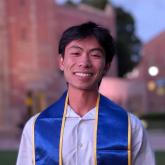
Jason Chan: Robots That Listen
The robots of popular imagination tend to be either fully obedient or fully autonomous. Jason Chan is drawn to the space in between — what researchers call shared autonomy, where a robot pursues a goal intelligently while remaining responsive to what the human beside it actually wants.
Chan came to robotics by an unexpected route. He planned to go into biology and medicine. Then COVID arrived, the wet lab he had been set to join closed its doors, and he spent quarantine teaching himself to code. What began as a workaround became a vocation. He arrived at UCLA intending to analyze biological data from home; he ended up falling in love with computer science (he will earn his B.S. in the field in June), and eventually with robotics, which he describes as a perfect intersection of theory and building things.
At the Neural Engineering and Computation Lab at UCLA, where he works under Dr. Jonathan Kao, Chan has been translating that vision into practice. His work focuses on decoding intent from neural signals — the electrical activity muscles produce when they move or try to — and using those signals to direct machines.
A clear demonstration of that approach happens at the UCLA Medical Center, where Kao's lab partners with clinicians to work with patients who are partially or fully paralyzed, using residual neural signals to guide a robotic arm through household tasks they could not otherwise perform.
"It makes me feel as though I'm using tech for an inherently good purpose," Chan says, "to restore independence and help people improve their daily lives." That sensibility shapes how he thinks about the field more broadly: to build a robot that genuinely helps someone, you have to think carefully about what they actually want, not just what the task requires.
At Tandon, he will be advised by Professor Farshad Khorrami in the Department of Electrical and Computer Engineering. Chan plans to push further into questions of how to best represent human intent and robotic perception together, with an eye toward robots that can assist people with the tasks of daily life on the person's own terms. He is eager to conduct work in Tandon's Center for Robotics and Embodied Intelligence, which he sees as exactly the kind of environment where those questions can be taken seriously.
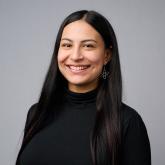
Valeria Diaz Moreno: Scaling the Quantum Future
Quantum computing has been "almost ready" for decades. Valeria Diaz Moreno wants to be part of the generation that finally delivers it. A new Ph.D. student in the Department of Electrical and Computer Engineering, Diaz Moreno worked during her undergraduate years at the University of Wisconsin-Madison on what is arguably the central engineering bottleneck of the field: scaling. Today's quantum processors can hold only a small number of qubits (the quantum analog of the classical bit) before noise, error, and the sheer difficulty of wiring them together overwhelm the system. Her research focused on packing enough qubits into a working processor to enable the kinds of computations that quantum machines have long promised but rarely delivered, particularly in domains like aviation, where complex optimization problems strain even the most powerful classical computers, and drug discovery, where simulating molecular interactions at the quantum level could compress timelines that today stretch over decades.
Here in Brooklyn, Diaz Moreno will work with Assistant Professor Aziza Almanakly to generate remote entanglement between distant superconducting giant atoms interacting through a waveguide. (This will allow qubits in different quantum processing units to be linked to one another.)
She hopes that by the time she defends her dissertation, quantum computing will have crossed the threshold from laboratory curiosity to a technology that engineers and scientists can actually deploy. It is an ambitious horizon, but one that aligns with the rapid pace of progress in the field and with the growing investment in quantum information science at NYU Tandon and beyond.
The trajectory that brought her to Brooklyn is its own kind of proof of what determination can accomplish. Born and raised mainly in Colombia, Diaz Moreno did not settle in the United States for good until 11th grade, arriving as a high-school junior with a new culture and new educational system to navigate at once. She began her higher education at a community college — a path that took her, step by step, from introductory coursework to the frontier of quantum engineering at one of the country's most competitive graduate programs. The NSF Fellowship, in her case, recognizes not only a promising research agenda but a remarkable arc.
That she ended up in Almanakly's lab is kismet. The two met at a quantum conference at a moment when Diaz Moreno was searching for the right doctoral program and Almanakly, newly arrived at Tandon, was looking to build her lab. In a field where particles are famous for being in two places at once, it seems fitting that Diaz Moreno and Almanakly found each other in exactly the right one.
Alexandria Lam: Rebuilding the Chemical Plant From the Ground Up
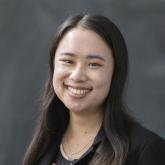
Chemical manufacturing is one of the largest industrial sources of carbon emissions in the world, and redesigning it for a cleaner era is among the most stubborn engineering problems on the planet. Alexandria Lam is taking it on at the level of the hardware itself. A Ph.D. student who will also be advised by Modestino and Bui, Lam specializes in the electrochemical cells that sit at the heart of electrified chemical production: the physical reactors with the potential to replace today’s fossil-fuel-driven processes with electricity-driven ones. Her work focuses on a precursor to nylon, a high-volume commodity chemical whose production is notoriously energy-intensive, but she sees the project as a testbed as much as a target. The design principles she uncovers, she hopes, will carry over into a much wider range of industrial reactions.
Her timeline is honest. A fully clean chemical plant, she says, is likely more than five years away. But within that window she expects meaningful progress, particularly if companies can be persuaded to invest in the infrastructure that electrified processes require. One of the shifts she finds most promising is a move away from today’s sprawling, centralized refineries toward smaller, modular plants that can be distributed more equitably across regions, reducing the transportation footprint of chemical goods and giving communities that have long lived next to the worst of heavy industry a genuine alternative.
Lam traces her motivation to growing up in California, where drought and wildfire seasons turned the abstract language of climate change into something visible from her own window. She says she never imagined she would actually win the GRFP; the application itself was almost a thought experiment, a chance to lay out her dream project in full. The notice that she had been selected left her stunned and, she says, deeply honored.
Outside the lab, Lam is a committed mentor and co-president of a student chapter of the American Institute of Chemical Engineers (AIChE), roles she sees as inseparable from her research ambitions: the transition she wants to help engineer will require a generation of chemical engineers who see sustainability as core to the discipline rather than as an add-on.
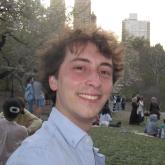
Cooper Sanders: Designing a Greener Generation of Computers
The data centers powering today's AI boom require enormous amounts of energy. Cooper Sanders wants to mitigate that situation. A Ph.D. candidate in electrical engineering at NYU Tandon, Sanders is designing computer hardware that deliberately trades a sliver of accuracy for dramatic gains in energy efficiency, an approach known as approximate computing. His insight is that many of the workloads driving data-center growth, particularly machine learning, are already probabilistic at their core, meaning that small, carefully managed errors at the hardware level can slash power consumption without meaningfully degrading results.
The approach has its skeptics. Some researchers balk at the idea of building chips that are intentionally imprecise, and Sanders knows that, through rigorous experimentation, he will have to prove that the quality cost is negligible compared to the environmental payoff. But he sees the broader trajectory of his field moving in his direction. Energy efficiency, once an afterthought in hardware design, has become unavoidable, first because chips kept overheating, and now because warehouse-scale computing is reshaping the planet's energy demands. As data centers continue to scale, he argues, designing for efficiency will shift from a constraint to a central goal.
Sanders, also the recent recipient of a Department of Defense National Defense Science and Engineering Graduate Fellowship, came to that conviction via a winding route. He loved math and physics early on, but his path to his current research was anything but linear — a stretch working on data compression, a detour into a humanities collaboration, a string of conference rejections that nearly pushed him out of academia altogether. He took a job in industry after graduation, only to find himself drawn back to the fundamental questions still nagging at him. That experience shaped a philosophy he now shares freely with younger students: rejection is not a signal to stop, but often a sign to keep going. "Dealing with failures is part of being a successful researcher," he says. “The researchers who go the furthest are the ones who learn from the setbacks rather than allow themselves to be defined by them.”
Winning the NSF Graduate Research and National Defense Science and Engineering Graduate Fellowships, he says, is "the greatest accomplishment of my academic career." Beyond the funding independence they provide, the fellowships offer something harder to quantify: validation that he belongs in this work, and that his ideas are worth taking seriously. He is quick to credit the environment around him at NYU Tandon, and especially his advisor, Professor Ramesh Karri, whose guidance helped sharpen his proposals and whose stature in the field he finds genuinely energizing. He also points to the depth of computer architecture expertise around him, including Associate Professor Brandon Reagen, as a defining advantage of his Ph.D. experience. Being surrounded by accomplished scientists who take his questions seriously, he says, is exactly the kind of community he hoped to find when he decided to return to research — and exactly the kind of place where a greener generation of computing might actually get built.
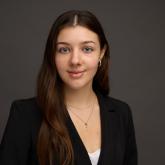
Maya Schuchert: Making Chemical Reactors Smarter
Maya Schuchert is working in the same research orbit as Lam and Bansal — she, too, will be advised by Modestino and Bui, and she, too, is focused on electrifying chemical production — but her angle is different. Where Lam, for example, is designing the physical cells in which reactions happen, Schuchert is working on the intelligence that runs them: optimizing the chemical reactors themselves to be faster, more automated, and more adaptive. Her goal is a generation of reactors that can monitor their own behavior, adjust on the fly, and squeeze far more productivity out of every kilowatt-hour of renewable electricity they consume.
The broader impacts she points to extend beyond emissions. Smarter, more responsive reactors promise real economic benefits and stronger supply-chain resilience — a lesson the chemical industry absorbed the hard way during the pandemic and subsequent global disruptions. Producing key chemicals closer to where they are used, with equipment that can adapt quickly to variability, is as much an industrial-policy question as an environmental one.
Schuchert’s path to the fellowship has not been a totally straight line. After undergraduate research at Columbia — where she won the same award Bui once garnered — she took a job at a startup that ultimately failed, caught in a broader pullback from industrial investment in ESG-aligned technology. The layoff was a hard moment, but it sharpened her focus; by the time she arrived at Tandon, she knew she wanted a Ph.D. oriented squarely toward industrial R&D. The fellowship, she says, arrived at exactly the right time. It confirmed that the direction she had chosen after the startup experience was the right one, and that the work she wants to do has a place in the field. She credits Tandon’s strong industry connections and a departmental culture that actively encourages student innovation as decisive advantages in getting her to where she is now –and where she wants to ultimately go.
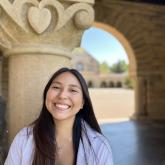
Danna Soriano: Chemistry as a Form of Resistance
For Danna Soriano, a Ph.D. student in chemical and biomolecular engineering who will work with Assistant Professor Pavel Kots, the NSF fellowship is more than a research grant. It is, she says plainly, a form of resistance. A native New Yorker and the daughter of Mexican immigrants, she is the first in her family to pursue a graduate degree, and at a moment when science is under pressure from multiple directions, she sees the honor of federal research support as inseparable from the communities the research is meant to serve. “Science is important not just to my work but to my life,” she says. “I want to spearhead actionable change and speak for communities that are often overlooked.”
Her research focuses on polymers — the long-chain molecules that make up everything from packaging to medical devices — and on the chemistry needed to understand and eventually redesign them for a more sustainable materials economy. Chemistry drew her in, she says, because it is always pressing toward fundamental questions: why molecules behave the way they do, and what that behavior makes possible. Combining that intellectual pull with her commitment to underserved communities is what drew her to chemical engineering in the first place, and what shapes the questions she plans to ask in graduate school.
Soriano returned to New York for her doctorate after undergraduate studies on the West Coast, and she is glad to be home. Family is central to her, and proximity to her parents, who instilled in her the conviction that education is a road to a better life, matters both personally and professionally. Their support, she says, is part of why winning the GRFP feels like a victory that belongs to more than one generation.
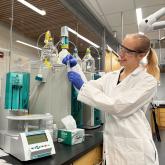
Sasha Visek: Forever Chemicals and a Maine Family's Long Memory
For Sasha Visek, PFAS (the "forever chemicals" now showing up in drinking water, soil, and human blood across the country) are not an abstract environmental problem. They are a story that runs straight through her own family. Her great-grandfather worked in one of Maine's paper mills, the kind of industrial operation that for decades turned out glossy sheets and, in the process, helped seed the state with compounds that will outlast everyone alive today. Maine has since become one of the country's most closely watched PFAS hotspots, in part because wastewater sludge laced with the chemicals was spread for years on farmland as fertilizer, a practice regulators believed at the time was safe. It was not. The chemicals are still there, working their way into crops, livestock, and the groundwater beneath them.
Visek, a Ph.D. student in civil and urban engineering, will pursue that problem with Assistant Professor Bridger Ruyle, whose lab at NYU Tandon focuses squarely on tracking PFAS and other contaminants through water systems. She came across Ruyle's work before applying and knew almost immediately that she wanted to join him; his research spoke directly to the questions she had been carrying since she first began reading about the Maine contamination crisis. Much of the existing scientific literature, she notes, has concentrated on PFAS in water. What is far less understood is how the chemicals move from sludge-fertilized fields into the food supply — the leafy greens, the milk, the meat — and ultimately into the people who eat them. That is where she wants to focus. There are new regulations in Maine now, some of the strictest in the country, but as Visek is quick to point out, regulations cannot unwrite what is already in the soil.
Visek is also eager to give credit where it is due. She points to Ruyle as a reason she chose Tandon, but she is equally emphatic about Clinical Professor Abby Rabinowitz and Tandon's writing program, which she says helped her find the voice she needed to translate her scientific interests into an application compelling enough to win one of the country's most competitive fellowships. Good science, she says, is inseparable from the ability to explain why it matters: to funders, to policymakers, and, not least, to the families living on the land her research is meant to help protect.