
Alma Rocha Honored with an American Association of University Women (AAUW) Doctoral Fellowship
The Ph.D. student's work in the Silverman Lab tackles an emerging public-health threat that current regulations don't yet address.
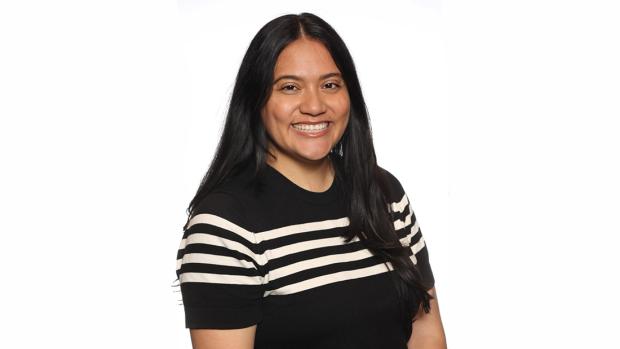
Alma Rocha, a Ph.D. student in environmental engineering at NYU Tandon School of Engineering, has been awarded a prestigious American Association of University Women (AAUW) Doctoral Fellowship, in recognition of her research on one of the quieter but more consequential public-health problems of the decade: the antibiotic resistance genes flowing, largely unmonitored, from wastewater treatment plants into the nation's rivers, lakes, and coastal waters.
Rocha works in the lab of Associate Professor Andrea Silverman, whose research group focuses on the fate of waterborne pathogens and contaminants in the environment. Her own project centers on the photodegradation of antibiotic resistance genes — the bits of bacterial DNA that encode resistance to antibiotic treatment — in wastewater effluent. The question is deceptively simple: when sunlight strikes treated wastewater released into a river or a bay, how much of the genetic machinery of antibiotic resistance is broken down, and how much survives to spread?
The stakes are considerable. Antibiotic resistance is widely regarded as one of the most serious long-term threats to global public health, and wastewater treatment plants have emerged as a critical control point in its transmission. Conventional treatment processes are effective at killing bacteria but much less effective at degrading the resistance genes those bacteria carry, meaning that intact genetic material regularly enters the environment, where it may be taken up by new bacterial populations. In the United States, there are currently no federal regulations governing the release of antibiotic resistance genes into surface waters — a gap that research like Rocha's aims to help close by providing the scientific foundation on which future monitoring and control standards could be built.
Rocha came to NYU Tandon with an unusually applied background for a doctoral student. She holds an M.S. in environmental engineering from San Diego State University (SDSU) and a B.S. in chemical engineering from the University of Rochester, and before beginning her Ph.D. she served as project manager and head laboratory technician for SDSU's dormitory wastewater COVID-19 surveillance study during the 2021–2022 academic year — an experience that gave her hands-on familiarity with the operational realities of wastewater-based public-health monitoring.
Alongside her research, Rocha has built a sustained commitment to mentorship, one that was recognized last summer with a Mentor of the Year award for her work in Tandon’s Undergraduate Summer Research Program. She is wrapping up her 6th year as a program assistant for the Water Environment Federation's InFLOW scholar program, which supports students with unique perspectives and backgrounds, as well as local green-infrastructure trainees, in building careers in the water sector. In that role she helps design programming to connect scholars with industry professionals and serves as a networking guide during WEFTEC, the federation's annual technical conference — work she sees as inseparable from the research itself, since the field's ability to tackle problems like antibiotic resistance will depend on the diversity and depth of the workforce trained to take them on.
For Rocha, the new honor recognizes a body of work that bridges careful laboratory science and a clear-eyed sense of why the science matters. The genes she studies may be microscopic, but their implications for how water is treated, regulated, and ultimately shared reach as far as the rivers themselves.
“It's wonderful that Alma received this recognition from AAUW,” Silverman says. “Between her scholarship, her dedication to mentoring, and her work in capacity building in the water and wastewater sector, I could not imagine a better recipient of this award."