

Protected Bike Lanes Causally Increase NYC Bikeshare Ridership, But Benefits Are Not Distributed Equally
Researchers at NYU Tandon analyzed 72 million Citi Bike trips and found that protected bike lanes increased ridership after accounting for confounding factors, while painted lanes and sharrows showed no detectable causal effect.
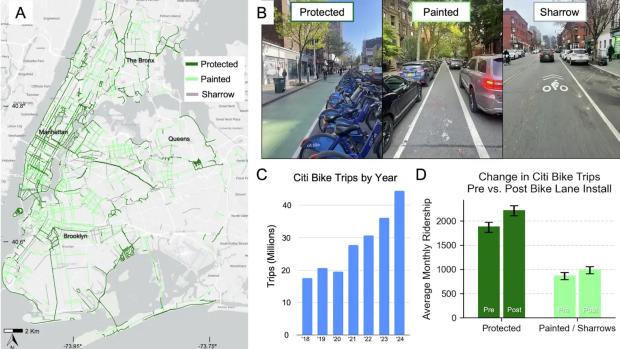
The image shows A: The distribution of all three bike lane types across New York City. B: Street-level photos of each lane type. C: Citi Bike trips by year, 2018–2024. D: Average monthly ridership at stations before and after each lane type was installed — both appear associated with ridership gains, but further analysis shows only protected lanes caused the increase.
Protected bike lanes increase Citi Bike ridership in New York City, but painted bike lanes and sharrows do not show a statistically significant causal effect on ridership after accounting for confounding factors, according to a new study from researchers at NYU's Tandon School of Engineering published this week in npj Sustainable Mobility and Transport.
The findings address a longstanding question in transportation planning: if and to what extent do different types of bicycle infrastructure actually encourage more people to ride.
Protected bike lanes physically separate cyclists from vehicle traffic using barriers such as curbs, parked cars, or flexible posts. Painted bike lanes provide only a painted stripe between cyclists and cars, while sharrows are bicycle symbols painted onto shared traffic lanes.
Using approximately 72 million Citi Bike trips recorded between 2013 and 2024 (a period of significant ridership growth), the researchers linked trip data to bicycle infrastructure located near stations across New York City.
Initial results suggested that both protected and painted facilities were associated with increased ridership. Stations near newly-installed protected bike lanes saw an average increase in trips of 18%, while stations near painted bike lanes and sharrows experienced an average increase of about 14%.
However, those initial before-and-after comparisons do not account for the fact that bike lanes are often installed in areas where cycling activity is already increasing.To isolate the effects of the infrastructure itself, the researchers used propensity score matching and difference-in-differences analysis, statistical methods designed to compare similar locations while controlling for pre-existing neighborhood characteristics and ridership trends.
After applying those methods, only protected bike lanes showed a statistically significant causal effect on Citi Bike ridership. The researchers estimated an average increase of approximately 379 additional rides per station per month following installation of protected lanes. In contrast, painted bike lanes and sharrows did not show a statistically significant causal effect on ridership.
"Not all bike lanes are created equal," said Takahiro Yabe, Assistant Professor in the Department of Technology Management and Innovation (TMI) and the Center for Urban Science + Progress (CUSP) at NYU Tandon School of Engineering. "When cities invest in cycling infrastructure, the design details can determine whether a lane simply exists on a map or actually changes how people travel. That matters for transportation, public health, and sustainability, especially when cities are making difficult choices about how to invest limited resources."
"Painted bike lanes and sharrows may cost less and face less political pushback, but we now have evidence at a massive scale that protected bike lanes are really what can move the needle on ridership," said Marcel Moran, the lead author of the paper. Moran is currently an Assistant Professor at San José State University, and was a Faculty Fellow at CUSP during this project.
The study also examined whether the effects of protected bike lanes differed across neighborhoods. The researchers found that the positive ridership effect was statistically significant only in Census block groups with the lowest share of Black residents. In neighborhoods with higher shares of Black residents, they did not detect a statistically significant causal effect on Citi Bike ridership.
"Protected bike lanes seem to work best where cycling was already a realistic option for people,” said Malik Salman, a paper co-author. Salman is an NYU CUSP alumni and currently a CUSP Research Scholar in Yabe’s lab. “In communities where residents face other barriers — cost, discriminatory policing, a history of being left out of the planning process — the infrastructure alone may not be enough to change behavior. That's not an argument against building protected lanes. It's an argument for doing more alongside them."
The results were more encouraging for older adults. In Census block groups with the highest share of residents between ages 60 and 79, protected bike lanes produced particularly strong ridership gains. The researchers suggest that older adults may be especially responsive to infrastructure that reduces perceived traffic-safety risks. This aligns with evidence from cities like Copenhagen, which feature an expansive network of protected bike lanes, as well as high ridership among older adults.
The study comes as New York City's bicycle network has expanded from roughly 900 miles of bike lanes in 2014 to approximately 1,500 miles by 2024, while Citi Bike recorded a system-high of roughly 45 million trips in 2024. The authors say their methodology could be applied to other cities with publicly available bikeshare and bike-lane data, including Chicago, Boston, San Francisco, and Washington, D.C.
Moran, M., Salman, M. & Yabe, T. Heterogeneous impacts of protected bike lanes on bikeshare behavior across demographic groups in New York. npj. Sustain. Mobil. Transp. 3, 39 (2026). https://doi.org/10.1038/s44333-026-00107-2