
NYU Tandon’s Quantum Minor, As Experienced By Michelle Li and Irene Yang
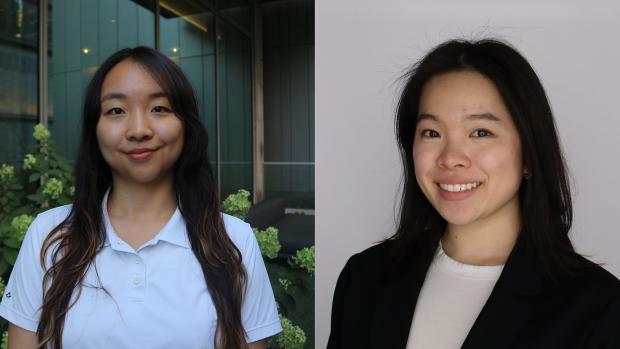
Irene Yang (left) and Michelle Li
In 2023, NYU Tandon announced the launch of a new minor in Quantum Technologies, aimed at giving students a quick introduction to an emerging technology that is poised to revolutionize finance, medicine, cybersecurity, and many other fields. This month, Michelle Li and Irene Yang will be among the first students to graduate from Tandon having completed the minor. Li and Yang, both Applied Physics majors, discussed what brought them to quantum technologies, what they took out of their studies, and what excites them about the current state of the field.
What brought you to NYU Tandon?
Michelle Li: My father attended NYU Tandon, and he played a huge role in inspiring my interest in physics. Growing up here in Brooklyn, he taught me about astronomy, the Milky Way, stars, and planets. I attended Brooklyn Technical High School right around the corner, where I majored in physics because I loved astronomy. NYU Tandon felt like a natural fit because it was close to home and already meaningful to my family. Once I got here, I found a really supportive environment and a lot of opportunities to explore different areas of physics.
Irene Yang: I initially came to NYU as a chemical engineering major because I was interested in chemistry and atomic-scale science. But after taking physics courses during my first year, I realized physics was answering the deeper questions I cared about most, like why atoms behave the way they do. That curiosity naturally led me toward quantum science. Switching into physics ended up being one of the best decisions I made.
What drew each of you specifically to applied physics and quantum science?
Li: Astronomy first sparked my interest in physics, but once I started studying at Tandon, I became fascinated by optics, solid-state physics, and eventually quantum science. I joined projects like the AI for Scientific Research VIP team, which had a solid-state physics group, and that exposed me to a lot of new research areas. Irene and I also participated in Tandon quantum computing hackathons, which really pushed me to learn more.
The quantum technology minor itself became exciting after I took part in a hackathon in 2023. I didn’t fully understand everything at first, but I knew it was fascinating and I wanted to keep learning. Around that time, Professor Chatterjee had just joined the department and introduced an Intro to Quantum Science course. That class completely changed how I thought about math and physics. Quantum science brought together concepts I’d learned separately in other classes and showed how interconnected they all were. Professor Chatterjee was also incredibly supportive and thorough, which made a huge difference.
Yang: My interest in chemistry eventually evolved into an interest in quantum systems and atomic-scale physics. Around the same time I switched to physics, the department launched the quantum technology minor. I attended an event where Professor DiBartolo explained the basics of quantum computing and qubits, and I remember being completely fascinated. I had heard the word “quantum” before, but I’d never really understood it.
What attracted me was that the field combines deep physics with practical applications. Quantum technology is still growing rapidly, and it offers many potential career paths. The introductory course was especially approachable because it was only two credits, which made it easy to explore without feeling overwhelmed. Once I took it, I was hooked.
What excites you most about the quantum field right now?
Yang: For me, one of the most exciting areas is quantum simulation, which is also the focus of my research. I work with Professor Andre Vrajitoarea at NYU CAS Physics, where we study engineered quantum systems that can simulate complicated physical phenomena. The idea that we can precisely control individual quantum systems and use them to study many-body physics is incredible. These are problems that become extraordinarily difficult to model with classical approaches.
More broadly, I’m excited by the possibility of fully functional quantum computers someday solving problems that classical computers either can’t solve or would take far too long to handle.
Li: I agree with Irene. Quantum computing has the potential to solve extremely complex problems beyond the reach of classical computers. What also excites me is how the field is already expanding into industries like healthcare and finance. Companies like JPMorgan are building quantum computing divisions, and researchers are exploring how quantum systems could work alongside advances in AI and machine learning.
I think quantum technology represents a new direction for solving problems and advancing technology. The potential applications in healthcare especially stand out to me because they could have such a direct impact on people’s lives.
What comes next for each of you after graduation?
Li: I completed the quantum technology minor last year, and although I still follow the field closely, I’m pursuing a slightly different direction now. I’ll be attending the University of Pennsylvania for a master’s degree in medical physics. There’s still a strong connection to quantum mechanics through technologies like MRI machines, PET scanners, and linear accelerators, so the background I gained through the minor will definitely continue to be relevant.
Yang: I’ll be starting a physics PhD program at Yale this fall. Yale has major strengths in quantum computing, especially superconducting qubits, along with strong theory and atomic physics programs. I’m excited to continue contributing to the field during my doctoral research.
What would you say to students considering the quantum technology minor?
Li: I’d encourage students not to be intimidated by the subject. Quantum science sounds full of complicated buzzwords, but the field has enormous potential, and there are so many opportunities emerging in industry and research. The minor also strengthens skills in math, physics, and programming, which are valuable no matter what direction you go.
I always tell students to take advantage of office hours and faculty support. Quantum science is challenging, and asking questions is essential. Professor Chatterjee was incredibly helpful throughout my experience, and I learned so much by simply going to office hours and engaging deeply with the material.
I also want to emphasize the importance of representation. Irene and I are among the first female students to complete the minor, and physics still has relatively few women. I’d especially encourage female students not to feel discouraged if they’re one of the only women in the classroom. If you’re interested in the subject, pursue it. Quantum technology is a growing field with the potential to shape the future, and we need more diverse voices involved.
Yang: I’d tell students that the field is broader than many people realize. Quantum computing gets most of the attention, but there are many related areas, including quantum sensing, quantum communication, and quantum simulation. There are opportunities in both theory and experiment, and the field is evolving very quickly.
The department is also launching a master’s program in Quantum Science and Technology, which creates even more opportunities for students who want to continue into industry or research. Beyond coursework, there are hackathons, seminars, research talks, and student organizations that make it easy to get involved. The community around quantum science is very active right now, both at NYU and throughout the New York area.