

NYU Tandon and NEC Put a Price Tag on Flood Protection in the Rockaways
Partnership formalized with Memorandum of Understanding to continue urban flood resilience research
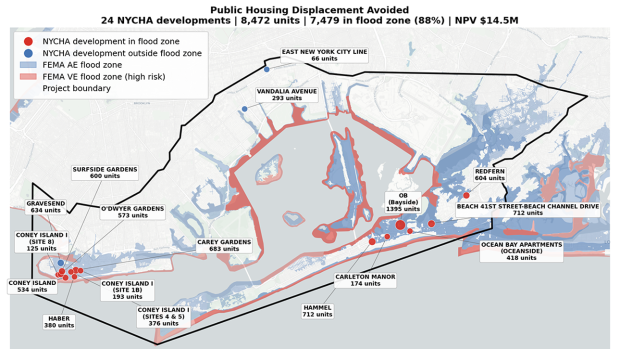
Map showing that 88% of public housing units in the Rockaways are at risk of inundation without flood countermeasures
In the Rockaways, a peninsula neighborhood in Queens, New York City, decisions about where to invest in flood barriers, beach nourishment, or shoreline reinforcement could soon be backed by something that has long been missing from the conversation. A clear accounting of what those investments are actually worth.
A research project from NYU Tandon School of Engineering's Center for Urban Science and Progress (CUSP), developed in partnership with NEC Corporation, used geospatial analysis and economic modeling to do exactly that.
But the more disruptive question the project raises is not just what flood resilience is worth, but who is receiving that value, and why they are not yet part of the funding conversation.
Developed through CUSP's Capstone Program, a two-semester initiative in which students work with external partners to address real-world urban challenges, the project was presented on May 1 at the Urban Data Science Showcase at NYU Tandon’s Brooklyn campus.
NEC and NYU have subsequently signed a Memorandum of Understanding (MOU) committing both organizations to further studies in urban disaster prevention, resilience, and advanced technology.
At the core of the project is a value chain framework that maps how a single flood protection investment generates ripple effects across transportation, housing, public health, and community wellbeing. Rather than treating these benefits as abstract, the team built five quantitative models that convert avoided damages into dollar figures.
"The central insight here is that flood resilience creates enormous economic value for stakeholders who have never been asked to contribute to its cost — transit operators, insurers, healthcare systems, tourism economies,” said the project’s Faculty Mentor Yuki Miura, assistant professor at CUSP and Tandon’s Department of Mechanical and Aerospace Engineering, and a member of the New York City Panel on Climate Change. “These are not passive bystanders to flood risk. They are material beneficiaries. Quantifying that stake is the first step to bringing them into the investment conversation."
The numbers are striking. Avoiding traffic disruption from roadway flooding amounts to an estimated $105 million over ten years. Mental health costs linked to flood-triggered trauma, drawing on post-Sandy PTSD rates three times the national average among Rockaway Peninsula residents, reach $501 million per major flood event.
Emergency shelter costs for the 15,932 public housing residents living in the flood zone approach $16.5 million per event. Protecting beachfront tourism preserves an estimated $170 million in revenue over a decade. A fifth model accounts for the health burden that construction noise places on the roughly 44,000 residents living near active worksites.
Taken together, the analysis suggests losses of up to approximately $800 million could potentially be avoided through flood protection measures currently underway under the Greater Rockaway Resilience Plan.
The models were built using ArcGIS and Excel, integrating spatial flood hazard data with socioeconomic indicators, including land use, tax records, and demographics. Findings were validated through prior research comparisons and direct interviews with Rockaway residents, community organizations, and representatives from the public and private sectors.
"When we can show a health system that a flood barrier reduces its emergency admissions by a measurable margin, or show a transit authority the precise cost of service disruption it avoids, the question of who should fund resilience infrastructure starts to have a different answer," said Miura. "That is not only a Rockaways question. It is a question every city with a coastline is facing."
For NEC, whose expertise lies in value chain modeling and digital technologies, the project reflects a broader strategic priority.
"While strengthening resilience is urgent, public and private sector efforts often remain fragmented, and for individual projects, ROI is often unclear," said Ryutaro Adachi, Executive Professional at NEC's GX Business Development Division. "This research presents a basic framework for evaluating the economic impact of projects with ambiguous effects and suggests the potential for expanding future funding methods."
Eighty-eight percent of public housing units on the peninsula sit within the flood zone, and waitlists stretch beyond five years, meaning displaced residents have almost nowhere to go when flooding strikes.
While the Rockaways served as the test case, the framework is designed to generalize across geographies and infrastructure contexts. Under the MOU, NEC and NYU Tandon will explore opportunities for social implementation of the findings, including engagement with financial institutions on new financing methods made possible by technologies such as satellite image analysis, AI, and remote sensing.
The project was led by CUSP graduate students Christian Humann, Kamili Afra, and Ziming Xiong, with Miura as faculty mentor and Adachi and Takuo Shioda of NEC Corporation as project sponsors.


