

New Method of Data Center Cooling Could Dramatically Decrease Electricity Use
By using a porous material and the waste heat rejected by local industrial facilities, researchers propose a thermal battery for enabling electricity-free cooling data centers.
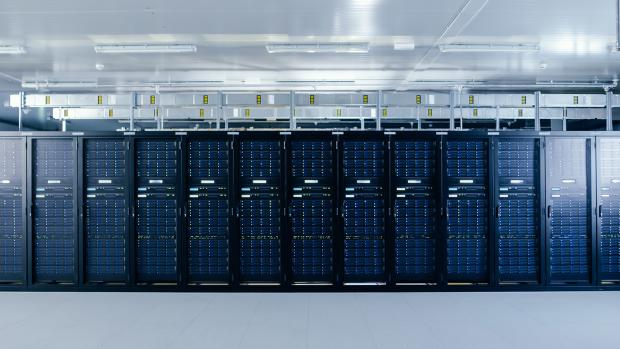
Data centers — the warehouse-sized buildings that store our photos, stream our movies and train artificial intelligence — are voracious consumers of electricity. A surprisingly large share of that power never reaches a microchip. Instead, it is spent on cooling, hauling away the heat generated by millions of tightly packed servers.
As data centers proliferate thanks to the AI boom, their electricity needs are colliding with a grid already under strain. One solution is to rethink the basics of cooling. In a new study, researchers at NYU Tandon explore an alternative solution: use waste heat from nearby factories to cool data centers, by storing that heat in a material that can later deliver cooling on demand.
“While the electricity needs for data centers are still a small slice of the total U.S. electricity market, it is rapidly growing,” says Dharik Mallapragada, Assistant Professor of Chemical and Biomolecular Engineering and lead author of the paper. “This is an opportunity to ‘bend the curve’ and aim for a much more sustainable future, in a way that is beneficial to everyone involved.”
Thermal batteries
At the heart of the concept are minerals called zeolite. Zeolites are crystalline materials riddled with microscopic pores, giving them a remarkable ability to soak up water vapor. When a dry zeolite encounters water vapor, it adsorbs the vapor and releases heat. When the zeolite is heated to sufficiently high temperatures, it releases the water again, resetting the cycle.
Importantly, zeolites are inexpensive materials that are already in use for a wide range of applications, including water treatment and oil refining. “Zeolite and its interaction with water can be used for storing thermal energy”, says Assistant Professor Pavel Kots, a co-author on the study and an expert in zeolite synthesis and characterization. At an industrial facility — such as a chemical plant or refinery — low- to medium-temperature waste heat (below about 200 degrees Celsius) is used to “charge” the thermal battery by drying the zeolite. The water driven off is condensed and recovered. The charged zeolite is then transported, by truck or rail, to a data center.
Once on site, the process runs in reverse. Warm air or other coolants (e.g., water) from the server room help evaporate water, producing a cooling effect. The water vapor is adsorbed by the dried zeolite, which effectively acts as a heat sink. Crucially, this adsorption process can replace the electricity-hungry compression chillers that dominate today’s data center cooling systems.
Unlike typical heat storage methods, zeolite-based storage does not slowly lose its energy over time. The thermal energy remains locked in the material until the water is reintroduced. That makes it suitable not only for long-duration storage but also for transport over tens of kilometers.
Big energy savings, modest trade-offs
Using detailed thermodynamic modeling, the NYU team, which included Kots, Mallapragada, and postdoctoral researcher Gilvan Farias Neto, compared their proposed system with a conventional setup: a data center cooled by a compression chiller and an industrial facility rejecting waste heat through cooling towers.
The results are striking. Across a range of operating conditions, the team estimated that the proposed approach can reduce total electricity used by the data center for cooling and the industrial facility by more than 75 percent. For the data center alone, electricity consumption for cooling can be reduced by as much as 86 percent. In energy efficiency terms, this translates into a 12% improvement in power usage effectiveness, a key metric in the data center industry.
Water use tells a more nuanced story. The combined system consumes somewhat more water overall — roughly 15 to 25 percent more — because evaporation is central to the cooling process. But this increase masks an important detail: the industrial facility itself sees a dramatic reduction in water use, since much of its waste heat is diverted into charging the thermal batteries rather than being dumped through cooling towers. Water released during zeolite charging can also be reused on site, partially closing the loop. The analysis did not consider the changes in indirect water use, i.e. associated with electricity generation, for the facility, which could partially or fully offset increases in direct water use, depending on the make-up of the electricity supply.
In order for this set up to work, data centers need to be fairly close to industrial facilities. To assess the scalability of their approach, the researchers conducted a geospatial analysis of U.S. facilities. The median distance between data centers and the 10 nearest industrial sites turned out to be just 57 kilometers.
Even after accounting for the energy needed to haul tons of zeolite back and forth — assuming modern electric trucks — the system still delivers net electricity savings in many scenarios, sometimes exceeding 40 percent. Rail transport could reduce the energy penalty further.
The proposed system is still at the modeling stage, and many engineering challenges remain. Zeolite beds must be designed for durability, rapid heat transfer and repeated cycling. Coordinating operations between data centers and industrial partners will require new business models. The research team has begun speaking with several industry leaders about the possibility of scaling this solution up.
Still, the idea highlights an under-appreciated truth: in an energy-hungry digital economy, waste heat can be monetized as a valuable resource. By reimagining cooling as a problem of thermal logistics rather than electrical demand, zeolite-based thermal batteries could help data centers grow without overheating the grid.
Farias, Kots, Mallapragada(2026) Zeolite Based Thermal Energy Storage to Leverage Industrial Waste Heat for Data Center Cooling, Chem Rxiv https://doi.org/10.26434/chemrxiv-2026-28wv2.