
From Lunar Rovers to Plastic-Eating Microbes, the 2026 Research Excellence Exhibit Showcased the Breadth of Tandon
More than three dozen projects spanning outer space to the urban soil beneath our feet drew a crowd to the Brooklyn Commons

Six teams were honored at the 2026 Research Excellence Exhibit for the strength of their work and the clarity with which they communicated it.
When the 2026 NYU Tandon Research Excellence kicked off on the afternoon of April 24, visitors stepped into something closer to a tech playground than a traditional academic showcase. A humanoid robot greeted guests. A lunar rover trundled past tables of bioplastics, microbial bioreactors, and an autonomous underwater vehicle paddling in an inflatable pool. An adaptive mountain bike, a quantum-secure communications demo, and a flexible robotic endoscope navigating a model kidney gave visitors a sense of just how wide a swath of the engineering universe Tandon's labs cover.
That breadth — from outer space to the soil beneath our feet, as opening remarks given by Linda Boyle, Tandon’s vice dean for research, put it — has been a fixture of the academic year since 2013. The event is open to families, neighbors, students from across the region, and curious minds of all ages, on the principle that innovation and discovery belong to everyone, not to an ivory tower. Behind every poster and prototype on display, as attendees were reminded, are months and often years of rigorous, dedicated work: not hypothetical ideas, but solutions in progress.
By the end of the afternoon, multiple projects had been recognized in the two competition categories — Research Excellence and Vertically Integrated Projects (VIP) — for the strength of their technical work and the clarity with which they communicated it to non-specialists.
And the Winners Are . . .
Research Excellence: First Place
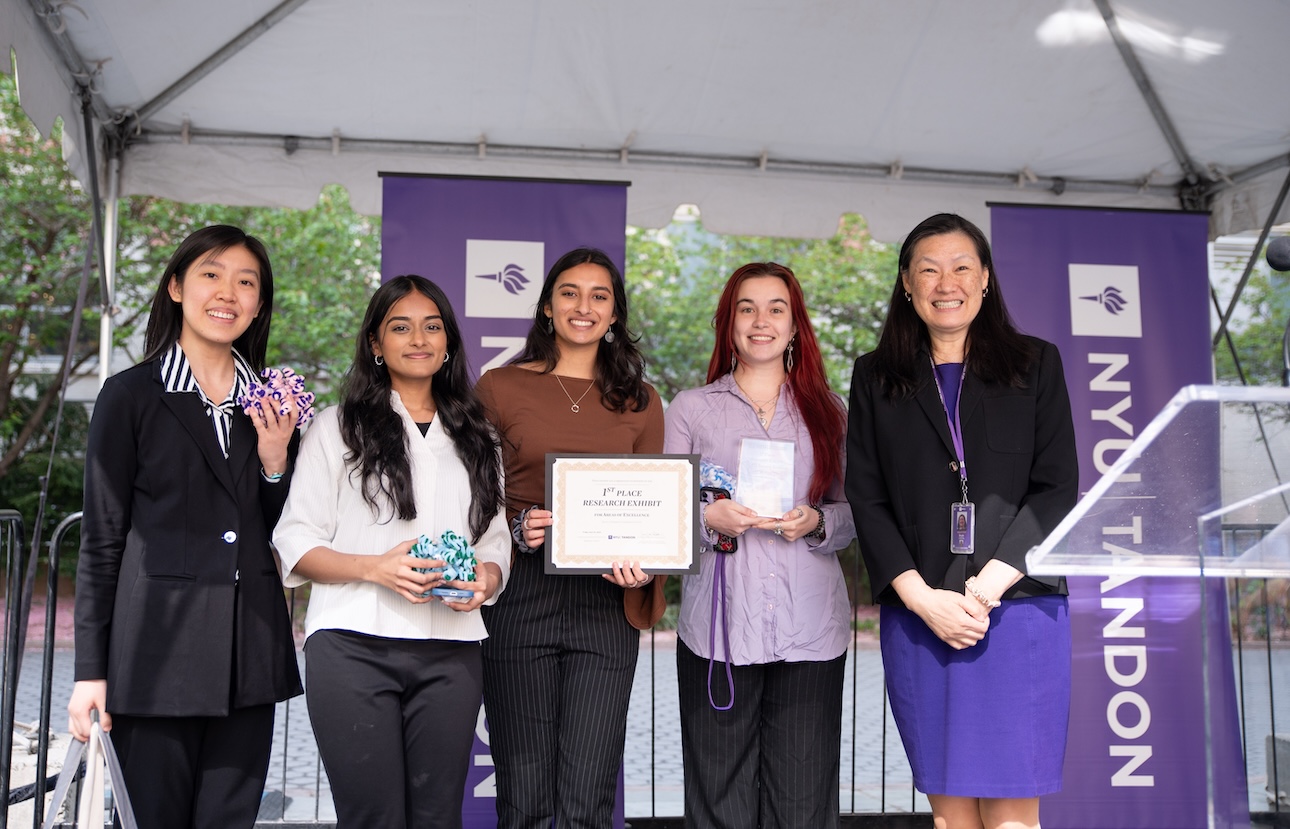
You've Got Mail! A Special Delivery of Gene Therapies via Nanovehicles took top honors in the Engineering Health track. Created by Isabella Huang, Pooja Shah, Kat Milas, and Smriti Thosani in the Montclare Lab, the exhibit invited visitors to assemble an interactive model of the Lipoproteoplex — a three-component nanovehicle, built from a liposome, a coiled-coil supercharged protein, and a therapeutic siRNA, that the lab has engineered to ferry gene therapies into cells. Posters explained the self-assembly chemistry; videos illustrated protein structure and nucleic-acid binding; and a custom video game let visitors design their own "nanovehicle" character and see whether it could overcome the obstacles that confront real-world gene delivery.
Research Excellence: Second Place
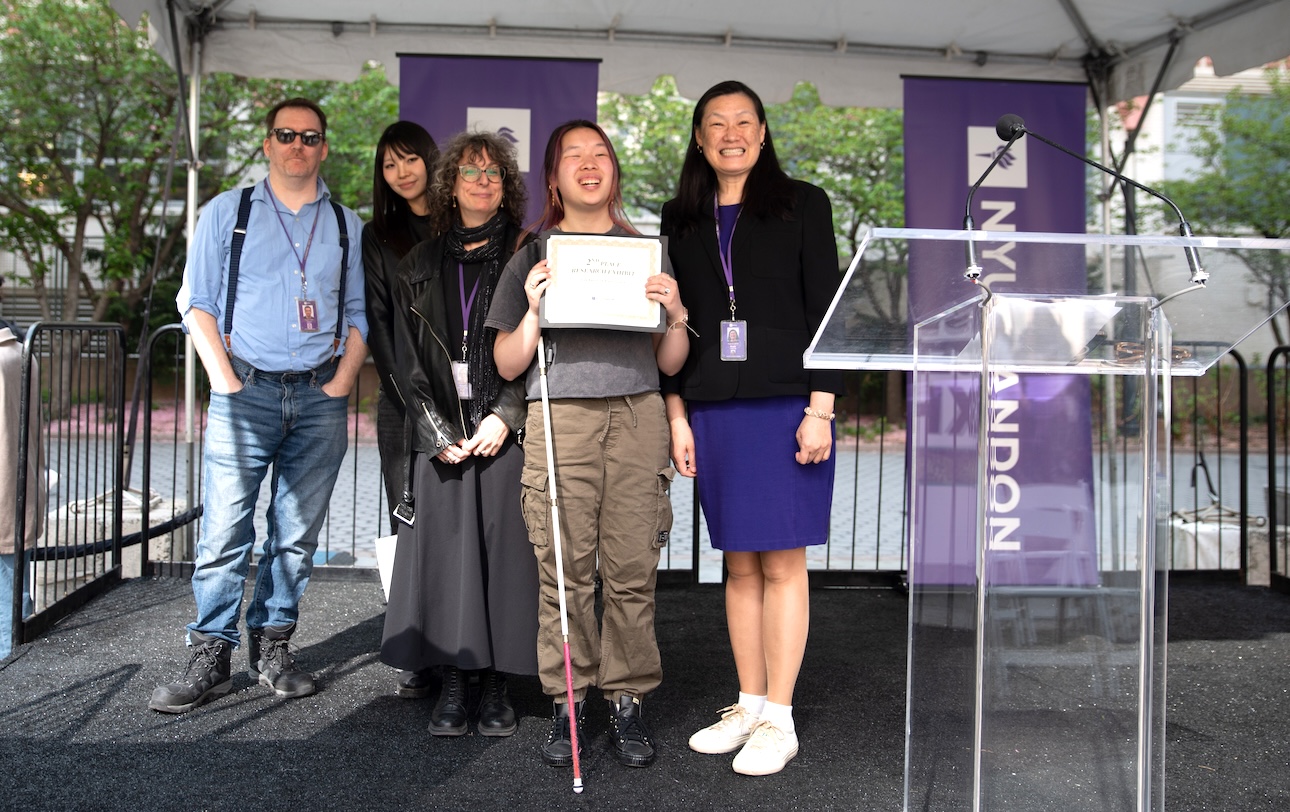
SynthAccess was honored for its open-source approach to making electronic music gear usable by blind and low-vision musicians. Led by R. Luke DuBois(who co-chairs NYU Tandon’s Department of Technology, Culture, and Society; co-directs the school’s Integrated Design & Media program; and serves on the faculty of the NYU Ability Project), Stefanie Koseff, Ciarra Black, and Moira (Fan) Zhang, and developed in collaboration with musicians from the Filomen M. D'Agostino Greenberg Music School and several industry partners, the project encompasses Braille labeling standards and tactile guides, software that speaks affordances aloud as controls are moved, haptic devices that replace blinking lights and 7-segment displays, and 3D-printed knobs and jacks distinguishable by feel.
Research Excellence: Third Place
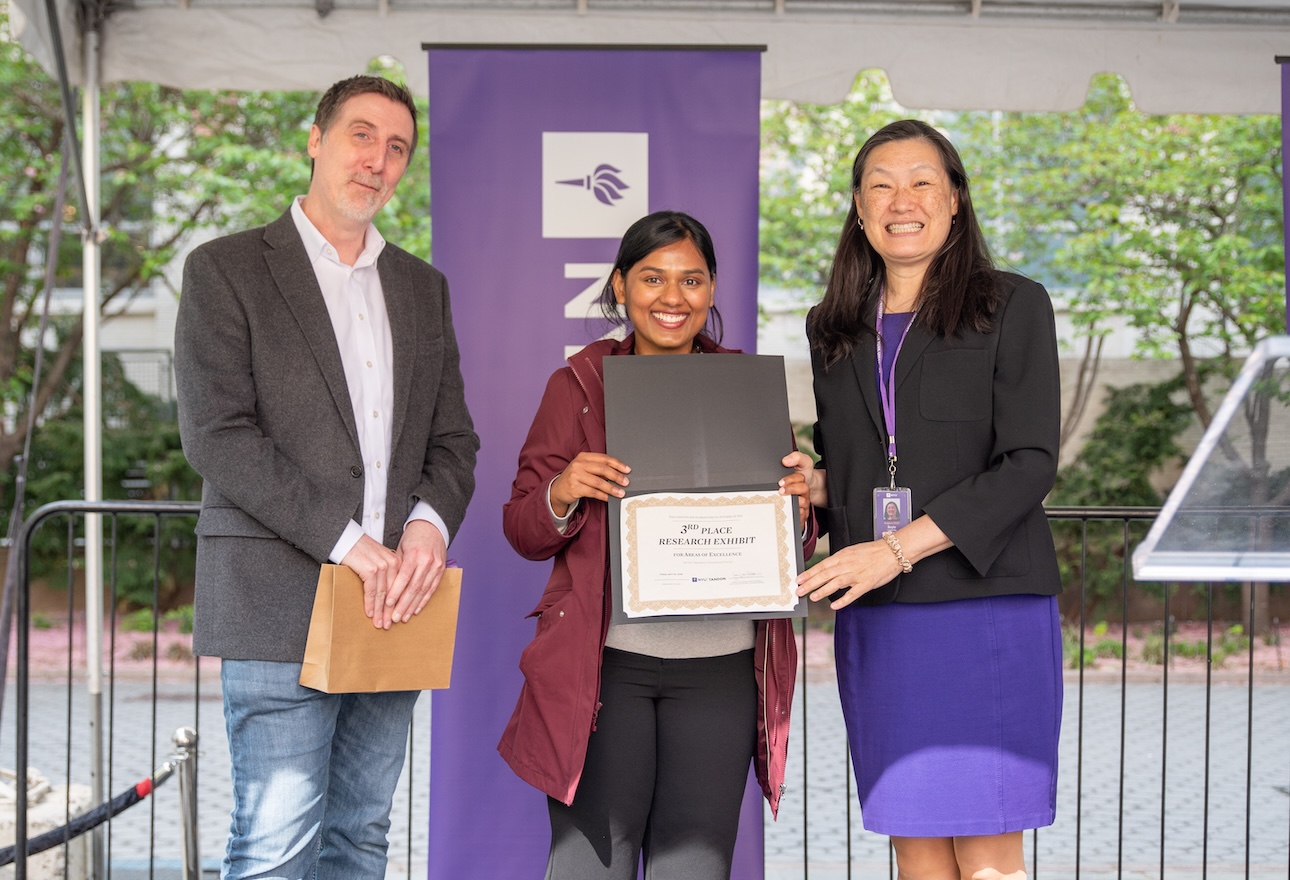
Behavioral Agent Graph as Conditioning Signal for Adversarial Generation, by Rea Ara, addressed a fast-emerging problem in AI safety: how to stress-test autonomous AI agents in ways that go beyond random fuzzing or prompt-based red-teaming. Ara's approach learns from how agents actually behave under adversarial conditions and uses behavioral graphs to guide the generation of new attacks — a more principled way to probe agent security than current standard practice.
VIP: First Place
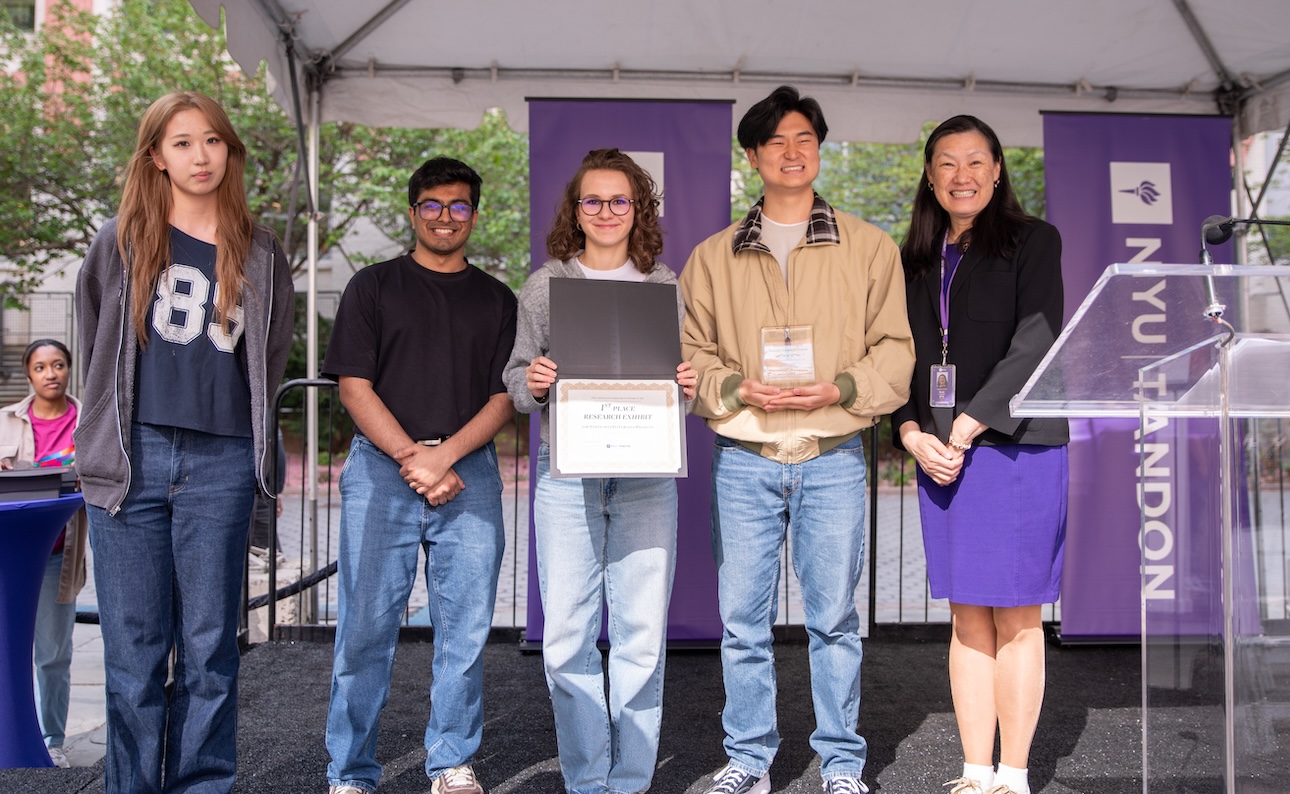
Desire Path: A Community-building Game, by Giselle Shan, Irmak Caglar, Daniel Chung, and Sydney Weng, won the top prize in a category that encompassed projects from Tandon’s VIP initiative. The team brought two original games to the floor: a narrative tabletop role-playing game in which players customize characters and navigate scenarios drawn from real NYC subway, campus, and neighborhood maps, and a rapid-fire card game aimed at incoming students preparing for life at NYU and in the city. Both are grounded in the team's literature review on gaming mechanics in qualitative research and on theories of belonging, using play as a way to surface stories, strategies, and a sense of community among Tandon students.
VIP: Second Place
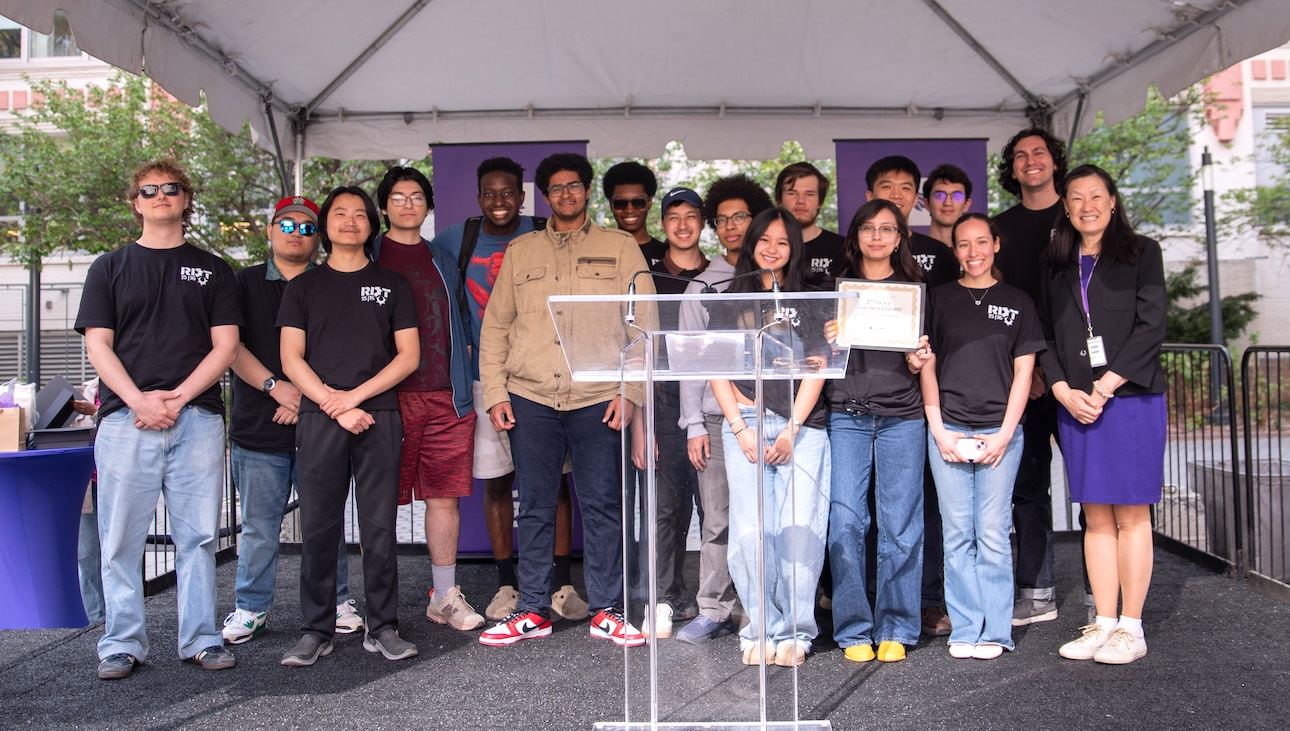
The NYU Robotics Design Team's Luna Rover, presented by Gabriela Merino, William Zhang, Eric Wang, and Jasir Zakaria on behalf of a 50-plus-student team, showed a fully operational prototype built for the NASA Lunabotics challenge. Visitors could teleoperate the rover around the Commons while team members walked them through wheel iterations, custom PCBs, autonomous navigation software, and the systems-engineering choices that go into designing for off-world conditions.
VIP: Third Place
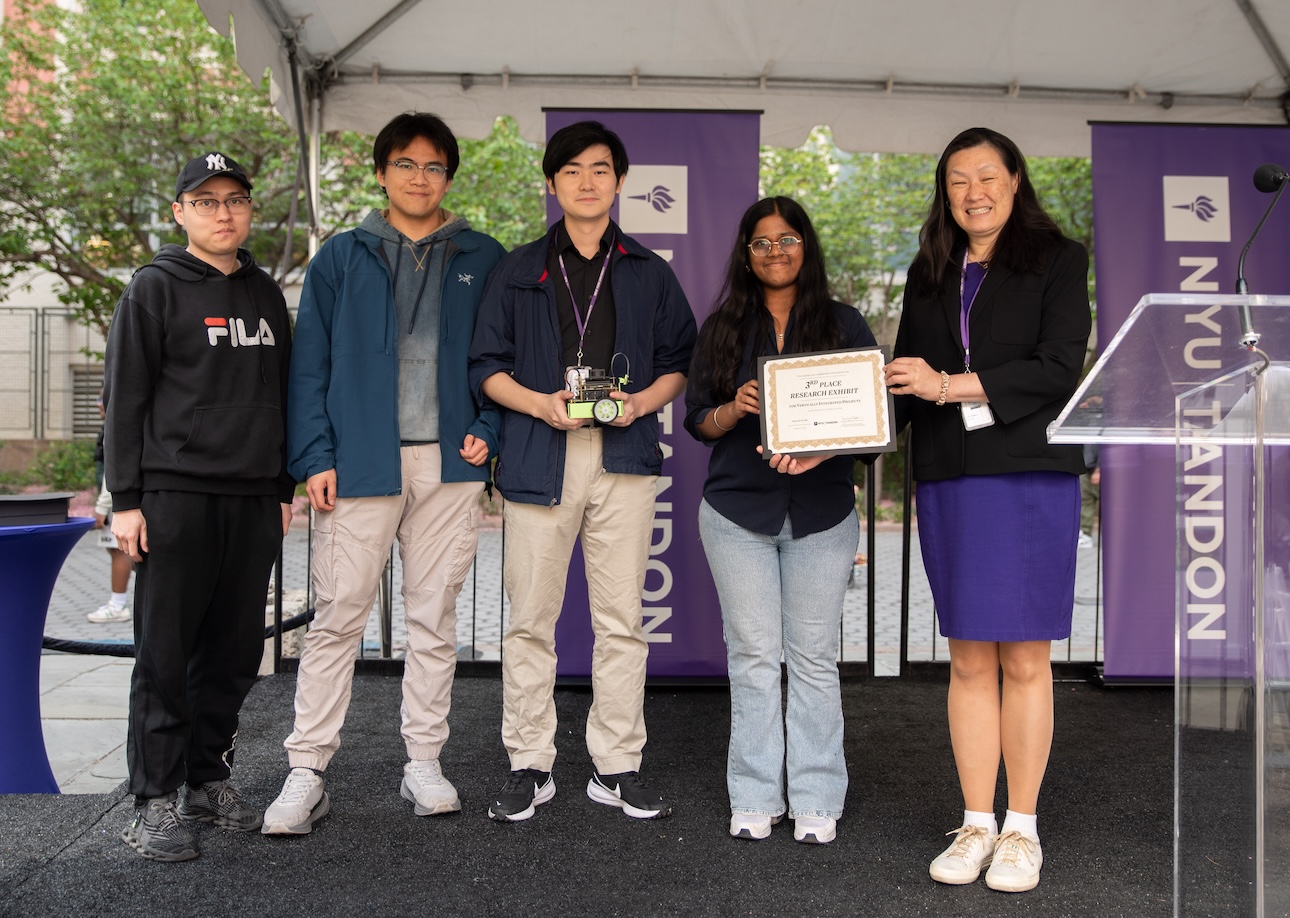
Smart Chemical Emission Navigation Tracker (SCENT), by William Mao, Terry Mu, Abirami Palaniappan Sirsabesan, and Heng Pu, demonstrated an Internet-of-Things platform of small sensor-equipped robotic cars that detect gas leaks and map their spatial distribution across a laboratory environment — with obvious applications for safer and more sustainable chemistry operations.
A Jam-Packed Commons
Beyond the prizewinners, the range of projects on display reflected the full reach of Tandon's research enterprise. Visitors who wandered the floor could:
-
Watch a biped humanoid robot in development, alongside the simulation results from its policy-training process, and compare it to earlier prototypes of the team's design.
-
Try on a VR headset for a gaze-driven embodied AI demo, in which the system tracks a user's eye movements and combines that signal with their spoken question to focus a vision-language model on whatever they're looking at.
-
Pilot Kelpie, an autonomous underwater vehicle built by the Robosub VIP team, around an inflatable pool while watching its computer-vision and depth-mapping feeds in real time.
-
Test a wearable EMG-based decoder that estimates neuromuscular fatigue during bicep curls (a step toward at-home tools for physical-therapy and rehabilitation monitoring).
-
Steer a flexible robotic endoscope through a model kidney to a simulated kidney stone, replicating the surgeon's view in a minimally invasive ureteroscopy.
-
Manipulate 3D-printed stellarator coils and plasma surfaces from a fusion-energy research project, and see how stochastic optimization keeps magnetic confinement robust to manufacturing imperfections.
-
Query a robotic dog for a specific object, then watch as it navigates safely through the crowd to retrieve it using a new semantic-memory representation.
-
Examine an anatomically accurate surrogate head model — scalp, skull, dura, cerebrospinal fluid, brain — that researchers are using to test whether the Valsalva maneuver (a breathing technique) might reduce brain displacement during traumatic impact.
K-12 outreach was on the floor, too, with a marshmallow-in-a-syringe lesson on Boyle's law, a card game that teaches about gas laws, and a suite of biology, chemistry, and physics simulations the program brings into local NYC classrooms.
Threaded through everything — lunar rovers and robotic dogs, bioreactors and gene-therapy nanovehicles — was the through-line Linda Boyle had articulated at the start of the day: solutions in progress, made by students and faculty whose work has spent months or years in the lab before earning a place at this table. By late afternoon, when the prize announcements wrapped up and visitors began filtering out, the Brooklyn Commons had once again turned Tandon’s research enterprise, briefly, into something the public could walk through, touch, and marvel at.