

From Theory to Practice: How Elza Erkip Is Helping Build the Wireless Networks of the Future
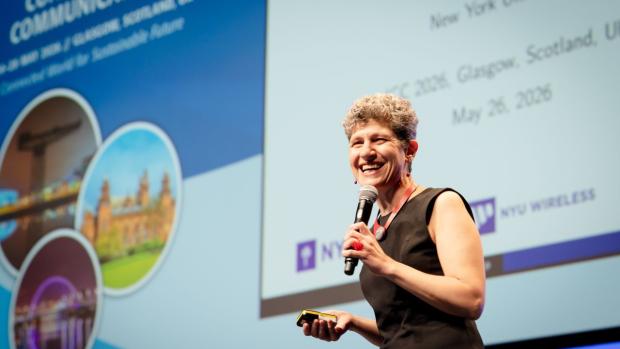
Elza Erkip delivering a keynote address at the 2026 IEEE International Conference on Communications in Glasgow, Scotland.
When you stream a video, send a message, or ask a question to an AI assistant on your phone, you're benefiting from decades of invisible mathematical work. Elza Erkip has spent her career doing exactly that, and her research has helped lay the theoretical foundation for the wireless technology billions of people use today.
Erkip, an Institute Professor of Electrical and Computer Engineering at NYU Tandon and a faculty member of NYU WIRELESS, delivered a keynote address at the IEEE International Conference on Communications in Glasgow in May. It is one of the most prestigious gatherings in her field, and academic keynote speakers are rare. She was one of only two.
The invitation reflects a body of work that has made her among the most cited researchers in information theory and wireless communications. She has earned some of the field's highest honors, including the 2021 IEEE Communications Society's Edwin Howard Armstrong Achievement Award and, in 2025, the IEEE Communications Society Award for Advances in Communication, an honor she also received in 2013.
Her May keynote, "Learning Task-Oriented Compression for Wireless Networking," captured something that has defined her research philosophy for years: that the most powerful advances in wireless don't always come from chasing the newest tools, but from pairing deep theoretical knowledge with the right modern techniques.
"It may be time to go back, read the old literature, and figure out which modern tools are appropriate for which problems," she said. "Not every modern technique is suitable for every problem. That requires domain expertise."
She presented two pieces of research that put that philosophy into practice, both developed by her former students and both rooted in theoretical work she had done ten to twenty years earlier.
The first tackles a problem at the heart of how cell towers communicate with your phone. For a tower to serve you efficiently, it needs a constantly updated picture of the signal conditions between you and it, information that your phone has to measure and send back. That reporting process consumes bandwidth, which is a finite resource. Erkip's team used machine learning to compress that information more efficiently, sending less data without losing what matters.
The work, led by PhD student Fabrizio Carpi, was published last year in the IEEE Transactions on Wireless Communications.
The second revisits cooperative communications, an area where Erkip did some of her most celebrated early work. Rather than routing a signal directly from tower to device, cooperative communications uses relay points such as a drone, a satellite, or a ground station to pass a signal along in hops, extending range and reliability in ways a single direct connection cannot.
"We knew from our theoretical work what good or optimal strategies should look like," she explained. "But some of them are very hard to implement in practice. What machine learning allowed us to do was develop practical, implementable techniques that mimic what we know is optimal from theory. The techniques that came out of that were genuinely new, not something we knew how to do before."
That work, led by Ph.D. students Ezgi Özyilkan and Carpi, appeared in the IEEE Journal on Selected Areas in Communications in 2025.
The gap between theoretical promise and practical reality is where much of Erkip's current energy is focused, and it extends well beyond wireless. For several years she has been building a research thread around learning and compression, using machine learning to find smarter ways to compress all kinds of data, from wireless signals to images.
She is co-organizing the annual "Learn to Compress & Compress to Learn" workshop at this year’s IEEE International Symposium on Information Theory. It held its second edition last year in Ann Arbor and is heading to Guangzhou for its third.
Her first-year Ph.D. student Parker Huggins joined Tandon with a 2025 NSF Graduate Research Fellowship, one of roughly 1,000 students nationally to receive the honor in a year when the program significantly reduced the size of its cohort.
Wireless networks are also about to face a new kind of demand that makes all of this work increasingly urgent. The driver is AI.
"Traditionally in wireless, the bottleneck has been the downlink, meaning data flowing from the base station to users," she said. "But with AI interactions, where users are constantly sending prompts and uploading data, the uplink becomes much more important. That requires rethinking how we design and organize networks."
A lot of the foundational research to address this already exists, she argued, but was never put into practice. "We need to go back and ask why, and figure out how to make it work for the traffic we're going to see."
For students considering the field, Erkip is direct. "Wireless is everywhere, and the demand for it is not going away. If anything, it's increasing. And even though we take it for granted, it's far from a perfect or solved problem."
The discipline, she added, rewards both rigorous thinking and hands-on creativity. "Wireless brings together physics, mathematics, and modern tools like machine learning. You're really exploring the full depth of engineering. There's a lot of room for creativity, and it's genuinely satisfying work."
For Erkip, it always comes back to the same question: given the constraints of the real world, how good can we actually make this? Then how do we get there?