
New Model Shows Small NY Mobility Hubs Are Cutting Car Trips and Boosting Transit, Even With Sparse Data
C2SMART researchers built a model to measure the impact of two Capital District mobility hubs, and found the pilot sites weren't necessarily where they'd do the most good
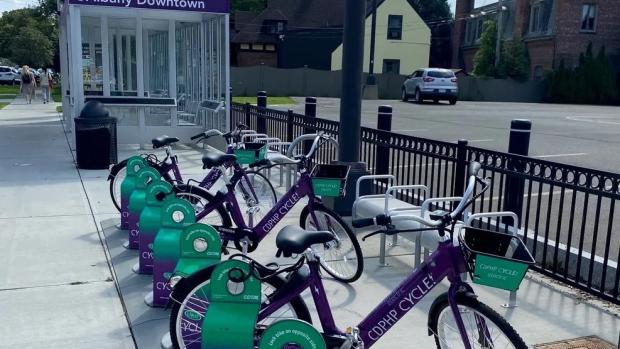
University of Albany Downtown Campus pilot mobility hub Image credit: CDTA
Two pilot mobility hubs in New York's Capital District are nudging commuters out of their cars and onto buses, bikes, and car-share vehicles, according to a new analysis from NYU Tandon's C2SMART transportation research center.
But the same model suggests these demonstration hubs aren't necessarily located where they’d do the most good.
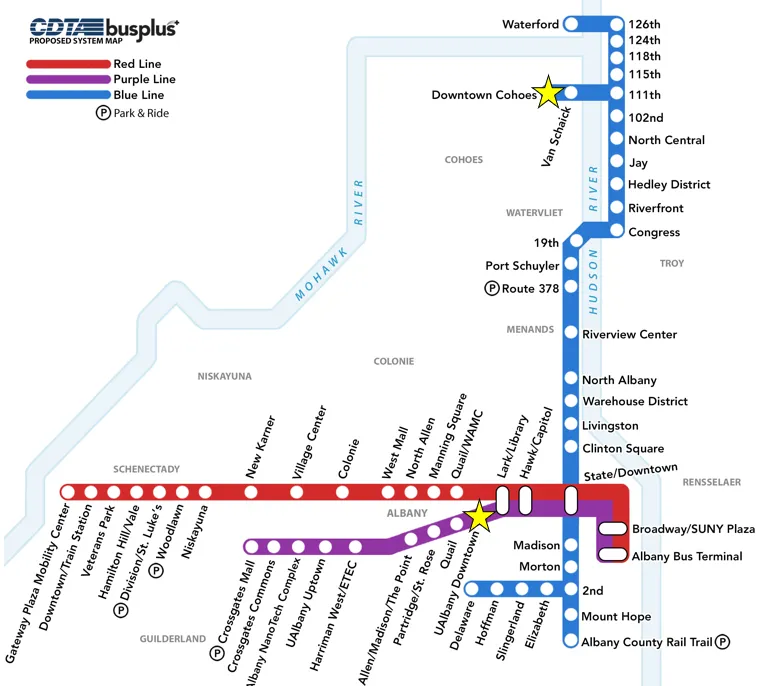
The hubs, one near UAlbany's downtown campus and the other in downtown Cohoes, work like transfer points, providing a bus stop paired with a shared bike dock that lets riders switch modes mid-trip instead of driving door to door. The Cohoes hub also offers car-share parking, a service not available at the UAlbany site.
The Tandon researchers estimate the hubs are cutting more than 75 vehicle miles driven each day and about 11 metric tons of carbon a year, roughly what two households produce annually. Riders pair two modes per trip, often combining a bus, bike-share, or walking leg with another mode, rather than driving or carpooling the whole way.
The hubs generate more than $5,000 a day in added value across both sites, a way of measuring how much better off travelers are with the extra option available, even if they never use it themselves, according to the researchers. It's not money changing hands, but a dollar figure economists use to capture things like time saved or an easier trip.
The researchers who led the study, C2SMART Deputy Director Joseph Chow, an NYU Tandon Institute Associate Professor, and Xiyuan Ren, a C2SMART postdoctoral fellow, published their findings in Transportation Research Part A.
Chow and Ren started with an existing model that predicts how New Yorkers get around, built from more than 50 million simulated trips across the state. That model can guess whether someone will drive, take transit, bike, or walk for a given trip. Mobility hubs were not reflected in the simulation because they did not exist when the underlying data was put together.
The researchers then taught the model something new: that hub trips, like driving to a bus stop then biking the rest of the way, are also an option. To make that addition realistic rather than a guess, they tuned it using real information, a 40-response survey of hub users and actual ridership numbers from the Capital District Transportation Authority (CDTA), the region's public transit agency.
They then reran that tuning process a thousand times on slightly different versions of the same small dataset, a standard statistical check to make sure their results weren't just a fluke of having so little real-world data to work with.
"You don't have enough real-world data to evaluate a pilot like this, but you also can't wait years to find out if it's working," Chow said. "Our approach borrows strength from a much larger travel model and uses the small amount of real data we have to calibrate it."
The team used the model to estimate outcomes at 1,100 locations across the region, using existing CDTA bus stops as hypothetical hub sites, not real pilots. Among all 1,100, the two actual hubs CDTA built, as part of a demonstration project that ran from April 2022 to June 2024, ranked only in the middle, roughly the 20th to 40th percentile, on measures like how many drivers they'd pull off the road and how much value riders would get.
The model suggests, in other words, that the two pilot sites weren't necessarily where a hub would have the biggest impact, likely because they were chosen for practical reasons, such as available land or existing partnerships, rather than for maximum benefit.
"It was a little surprising the two hubs CDTA built landed in the middle of the pack," Ren said. "That's not a criticism; pilots get chosen for practical reasons. But it suggests real value in running this kind of analysis before committing to a location."
The authors say the same approach, pairing a small on-site sample with a large behavioral model, could extend to other emerging services, such as autonomous shuttles or microtransit, before enough ridership data accumulates to build a model from scratch. Chow said the underlying statewide model isn't specific to mobility hubs, the team has previously used it to evaluate other mobility service programs, and since it draws on data available nationwide, the same approach could extend beyond New York.
Support for the research was provided by the New York State Energy Research and Development Authority (NYSERDA).
Xiyuan Ren, Joseph Y.J. Chow, A data fusion approach for mobility hub impact assessment and location selection: Integrating hub usage data into a large-scale mode choice model, Transportation Research Part A: Policy and Practice, Volume 211, 2026