

Rose Faghih Is Building Algorithms That Can See What the Human Body Hides
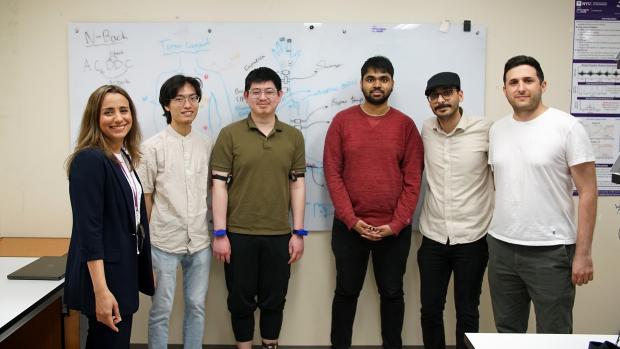
Rose Faghih (left) with members of her lab.
Many of the most important signals about human health are invisible. Depression can deepen long before symptoms become obvious. Chronic inflammation can quietly damage the body before disease is diagnosed. Fatigue, stress, and metabolic changes often unfold beneath the surface, escaping even the notice of physicians until they become serious problems.
For NYU Tandon Associate Professor and Associate Chair of Biomedical Engineering Rose Faghih, those hidden biological and mental states have become the focus of an ambitious research agenda that combines engineering, signal processing, physiology, and wearable sensing. Her long-term goal is deceptively simple: create technologies capable of measuring what today cannot easily be measured, enabling earlier intervention for conditions ranging from mental illness to chronic disease.
That vision has propelled Faghih onto increasingly prominent stages over the past year, including international keynotes and invited lectures. She delivered keynotes at the 2025 IEEE Conference on Computational Intelligence in Bioinformatics and Computational Biology in Taiwan and at the 2026 Global Congress on Biomedical Engineering and Bioengineering Innovations in Boston. Moreover, she gave a named lecture at the third annual Christine Mona Khademi lecture at Stanford University. The U.S. National Academy of Engineering (NAE) invited Faghih to speak at the 2026 China-America Frontiers of Engineering (CAFOE) Symposium. She was one of only two U.S. speakers featured at the session titled “Fusion of Engineering Science and Traditional Medicine.” At each event, she highlighted two complementary research programs that define her laboratory's current direction: MINDWATCH and HEALTHWATCH.
Additionally, Faghih has had multiple engagements with the National Academies over the past years. The NAE had earlier chosen her to take part in its 2019 U.S. Frontiers of Engineering and 2023 E.U.-U.S. Frontiers of Engineering programs. Because her work spans engineering, medicine, and the sciences, the U.S. National Academies of Sciences, Engineering, and Medicine also selected her for the 2024 U.S.–Africa Frontiers of Science, Engineering, and Medicine and the 2025 Connections to Sustain Science in Latin America Programs. She is also on the editorial board of PNAS Nexus, a journal issued by the National Academy of Sciences together with Oxford University Press.
Together, her HEALTHWATCH and MINDWATCH research directions represent an effort to transform everyday sensors into "virtual sensors" capable of decoding hidden physiological and psychological states.
MINDWATCH grew from an experience early in Faghih's career while she was a postdoctoral researcher studying deep brain stimulation for patients with severe, treatment-resistant depression.
Watching patients require implanted electrodes raised a question that has guided much of her subsequent work: could mental health deterioration be detected much earlier, before such invasive treatments become necessary?
Rather than waiting until symptoms become severe, Faghih envisions wearable devices and algorithms that continuously estimate a person's internal mental state. Her laboratory has explored physiological signals such as skin conductance and, more recently, eye-tracking data to estimate interoceptive awareness — the brain's perception of the body's internal condition under a research direction she calls MINDCAM.
The objective is not simply to monitor mental health, but to create opportunities for timely intervention using safe, non-invasive approaches such as music-based therapies or lifestyle changes. Quantitative measurements could also help physicians evaluate whether medications are working before patients become resistant to treatment.
"Basically, we can build a navigation system for the brain," Faghih says.
If MINDWATCH focuses on the mind, HEALTHWATCH extends the same philosophy to the rest of the body.
Supported by an NIH MIRA award, the project seeks to infer hidden health conditions from biochemical signals collected by next-generation wearable sensors. While most of today's commercially available continuous glucose monitors track a single molecule, glucose, Faghih anticipates a future in which wearable devices measure a much broader range of biomarkers.
Her laboratory is preparing for that future by developing algorithms capable of translating those biochemical measurements into clinically meaningful information.
One major thrust focuses on cognitive fatigue. Using biomarkers including cortisol, her group is developing methods to estimate fatigue in both healthy individuals and patients with chronic fatigue syndrome or fibromyalgia. The work could eventually benefit people experiencing persistent fatigue associated with conditions such as long COVID.
Another direction investigates inflammation, one of the body's most important — and difficult to monitor — physiological responses. Using cytokine data, Faghih's group is developing computational methods to estimate inflammation levels over time.
The motivation emerged in part from the COVID-19 pandemic, when overwhelmed hospitals often lacked objective ways to determine which patients would deteriorate most rapidly. More broadly, she believes continuous inflammation monitoring could someday aid in detecting diseases such as cancer far earlier than is currently possible.
A third research area examines metabolism and satiety by decoding signals related to hormones such as leptin. The work aims to better understand hidden metabolic states associated with obesity and overall health.
Across these seemingly different projects runs a common scientific philosophy: important biological states often cannot be measured directly, but they leave subtle signatures in physiological data. Advanced signal processing can uncover those signatures and transform them into actionable health information.
The implications extend well beyond major academic medical centers.
Faghih frequently speaks about the potential impact for people living in rural communities or regions with limited access to physicians. Virtual sensing technologies could provide meaningful health information even where healthcare resources are scarce. But she emphasizes that everyone stands to benefit from earlier detection of diseases that remain hidden until symptoms appear.
"Health states that go unnoticed cause problems later on," she says. "If we can help improve the quality of life for people, that's the goal."
As her laboratory continues expanding both MINDWATCH and HEALTHWATCH, Faghih sees the projects not as separate initiatives but as complementary pieces of a larger vision: transforming wearable sensors and computational physiology into tools that reveal the body's hidden signals before they become medical crises.
For Faghih, the future of medicine is not simply collecting more data. It is learning how to interpret the signals that have always been there, but until now have remained beyond our ability to see.
In addition to her research, Faghih has taken on significant leadership roles. In June 2026, she assumed the position of Associate Chair in NYU Tandon’s Biomedical Engineering Department. Since January 2023, she has led the design and development of NYU’s undergraduate biomedical engineering major, which the New York State Education Department approved in July 2026 to welcome its first cohort in Fall 2027. Externally, Faghih holds several leadership roles with the IEEE. She served on the IEEE Engineering in Medicine and Biology Society (EMBS) Administrative Committee as a Technical Representative from January 2024 to December 2026. She is also the IEEE EMBS Society Liaison to IEEE Press, a member of the IEEE EMBS Biomedical Signal Processing Technical Committee, and an Associate Editor of both IEEE Transactions on Biomedical Engineering and IEEE Transactions on Neural Systems and Rehabilitation Engineering. Additionally, she is an Advisory Board Member of the University of Maryland’s Department of Electrical and Computer Engineering.
Additionally, Faghih is an innovative educator, and her excellence in teaching was recognized with the 2025 NYU Tandon School of Engineering Jacobs Excellence in Education Innovation Award. She integrates her research into her teaching, which has enabled students to turn course research projects into peer-reviewed publications.