

New Research Explains How Far Will People Go for a Day At the Park
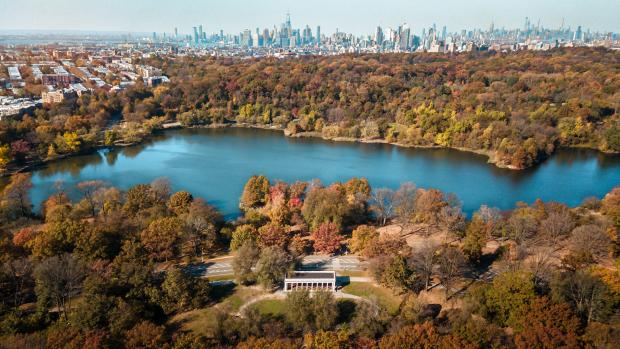
Prospect Park in Brooklyn, New York.
A park two miles from home might seem close enough for a Saturday outing. In metropolitan Detroit, though, park visits had already fallen to about half their modeled peak by that distance. In metropolitan Minneapolis, the same drop took nearly five miles. And in the New York metropolitan area, with its extensive transit network, visitation fell by half at about 2.3 miles. A park’s reach, it turns out, depends a great deal on where it is.
The findings come from an analysis of roughly 60 million park visits across 20 major U.S. metropolitan areas, published in Landscape and Urban Planning. In every region the researchers studied, park visitation followed the same mathematical pattern. Each additional mile reduced visits by a roughly constant percentage. What changed from one region to another was how steep that decline was. Visits dropped off more than twice as fast with distance in Detroit as in Minneapolis.
“Two parks can sit the same distance from two neighborhoods and have very different numbers of visitors from those neighborhoods,” says study co-author Hanxue Wei of the Center for Urban Science and Progress at NYU Tandon. “If you draw the same circle around every park, you miss how quickly visits fall away in some places.”
The team used aggregated, anonymized smartphone location records from 2018 and 2019. The data linked small census areas, where devices were estimated to be based, to more than 18,000 park sites. A device generally had to remain inside a park’s mapped boundaries for at least five minutes to register a visit. The researchers then grouped visits by the distance between the device’s estimated home area and the park.
The resulting curves followed what mathematicians call exponential decay. Imagine a region where visits fall by 10 percent with each additional mile. If 100 visits occur at one distance, the next mile would bring that number down to 90, and another mile would bring it down to 81. The percentage holds steady while the number of visits lost gets smaller. That gives each metropolitan area a characteristic “half-distance,” akin to a half-life measured in miles.
“What makes this finding interesting is the opportunity to connect a broad urban science question with a practical planning challenge,” says Yichun Zhou, a postdoc and first co-author on the paper. “Large-scale mobility data allow us to test ideas about how cities work against observed behavior, while also showing where the same general pattern varies across places. That combination can help us develop approaches to park accessibility that are grounded in both common patterns and local context.”
The metropolitan averages also concealed differences among neighborhoods. In neighborhoods with larger shares of households without a vehicle, and in those with larger shares of residents from racial and ethnic minority groups, park trips tended to be shorter and visits fell off more steeply with distance. That combination matters for a neighborhood with few nearby green spaces. A park farther away may appear to fill a gap on a map even though relatively few residents make the trip.
“A mile on a map tells you very little about what it takes to get to a park,” Wei says. “For some residents, that extra mile can mean a bus transfer or a long walk along a busy road. Those are the kinds of barriers a city can look for when it decides where to invest.”
The study measures direct distance. The smartphone records could show where a visit took place, but they could not tell researchers how someone got there. The analysis also lacked detailed measures of individual parks’ amenities or quality, and the phone data may underrepresent older and lower-income residents. Those limits leave open questions about why visits fall away faster in some places and whether the same patterns hold today.
“Park accessibility is not just about geographic proximity, but also about the mobility constraints people face,” says Xiao Huang of Emory University, another co-author. “Our findings show that neighborhoods with higher proportions of minority residents or households without vehicles tend to have shorter park travel distances and greater sensitivity to distance. This highlights the importance of considering both park locations and transportation barriers when planning more equitable access to urban green spaces.”
The researchers suggest that planners use locally measured visitation patterns to decide where a new park might serve the most people and where better connections could extend the reach of an existing one. A neighborhood where visits drop sharply with distance might benefit from green space closer to home. Elsewhere, a safer street crossing or a more direct bus route could make a park that already exists easier to reach. The first step is to check how far people actually go.