

New Wearable Patch Tracks Signs of Heart Injury
Tiny needles sample fluid just beneath the skin, giving an experimental wearable sensor a way to follow a protein that doctors usually measure with blood tests.
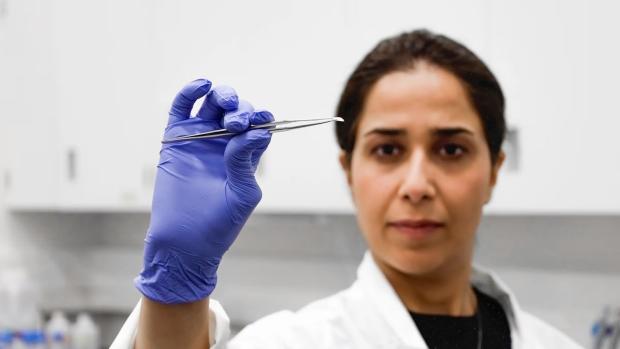
Mahla Poudineh holds up her Aptalyzer patch. Photo credit: BeGiant
When heart muscle is injured, it releases a protein called cardiac troponin I (cTnI). A series of blood tests can show whether levels are climbing or falling, a pattern that helps doctors assess whether the injury is recent. Now researchers have built a patch that can follow those changes through the skin. The device picked up both the rise and fall of troponin in mice after an injection and detected elevated levels in animals with coronary artery disease. The research was published today in Science Advances.
The patch, called the Differential Aptalyzer, builds on an idea familiar to anyone who has worn a continuous glucose monitor. Just beneath the skin lies interstitial fluid, the liquid that bathes cells. It contains glucose, as well as proteins that can offer clues to what is happening elsewhere in the body. Some of those proteins are present in vanishingly small amounts, though, and the antibodies that can fish them out tend to hold on tight. That can leave a sensor registering protein that it caught earlier, even after levels have fallen.
“A single measurement gives you one point in time,” says Mahla Poudineh, lead author on the study. “We wanted a sensor that could tell us whether a protein was still rising, had leveled off or was starting to fall.”
Poudineh, Associate Professor of Chemical and Biomolecular Engineering at NYU Tandon, conducted the research with colleagues at the University of Waterloo and McMaster University. Their patch uses tiny needles made of a water-absorbing gel. The needles swell as they take up interstitial fluid, allowing molecules to move through the gel to two electrodes.
The researchers chose to monitor cTnI, which is released into the bloodstream after heart injury. Measuring these proteins quickly and repeatedly can help doctors spot heart damage in the emergency room, in intensive care and during recovery from surgery. Heart damage can occur even after an operation that doesn’t involve the heart, and it often causes no obvious symptoms. In a large international study of adults 45 and older, nearly all deaths within 30 days of surgery occurred after the operation, and about one in five was linked to heart muscle injury. A blood test for cTnI can help doctors detect damage that might otherwise go unnoticed.
“In mice, the patch followed the same rise and fall we saw in blood samples,” says co-author Leyla Soleymani, Professor of Engineering Physics at McMaster University. “One of the next questions is how quickly a change in the blood shows up in the fluid under the skin. That timing will help us understand what a reading from the patch could tell a clinician.”
“After surgery, a patient can feel fine even when the heart muscle has been injured,” says co-author Bernardo Trigatti, professor in the Department of Biochemistry and Biomedical Sciences, and senior scientist in the Thrombosis and Atherosclerosis Research Institute of Hamilton Health Sciences and McMaster University. “We want to find out whether a patch could pick up a rise in troponin between blood draws and give the care team an earlier reason to investigate.
Over two hours, the patch tracked the rise and fall of troponin in mice given the protein, following the same general pattern as lab tests on blood drawn during the experiment. In a separate test, the patch detected higher troponin levels in mice with coronary artery disease than in controls. Those animals had elevated troponin from heart muscle damage, giving the researchers a chance to see how the patch performed when the protein came from the body itself.
“The antibody gives us a way to pick out troponin from a mixture of proteins,” Prodineh says. “The electrical pulse helps it let go, so the next reading can reflect what is in the fluid at that moment.”
One possible use is monitoring patients after major surgery, when heart muscle injury can occur without obvious symptoms. First, researchers will need to establish how closely troponin levels just beneath the skin follow those in the bloodstream, including whether changes in one show up later in the other. How early the patch could flag an injury in people remains an open question.
Aptec Health, a startup co-founded by Poudineh and Soleymani, is working to commercialize wearable sensing technology and is developing a cardiac troponin patch. The research team also plans to test whether the same design can track other proteins associated with heart attacks and heart failure. The research builds on a body of work produced by Poudineh at the intersection of personalized medicine and advanced sensor technology. It uses the microneedle patches that her research group pioneered for wearable sensing. Podineh stresses that while this paper highlights its use for tracking heart injury, its potential applications go far beyond that.
“This paper only represents one application of this technology,” she says. “We are exploring its potential applications for other biomarkers, from insulin to c-peptides, in order to create monitoring systems that give researchers, physicians and patients access to the data they need to build safer, healthier lives.”