

NYU Tandon, Partner Institutions to Turn Plant Waste Into Chemicals for Nylon Manufacturing in New Project
Electricity-driven process aims to reduce dependence on petroleum and make chemical production adaptable to domestic resources.
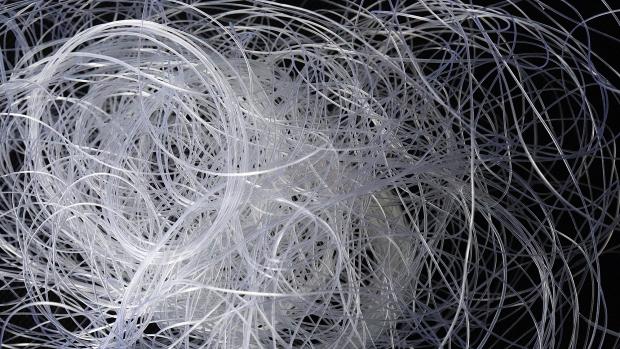
Close up of nylon threads.
NYU Tandon will lead a $3.8 million project supported by the Defense Advanced Research Projects Agency (DARPA) to develop a process that converts plant waste into industrial chemicals used to manufacture nylon. The research aims to provide an alternative to petroleum-based production while strengthening domestic chemical supply chains.
Led by Donald F. Othmer Professor of Chemical Engineering Miguel A. Modestino, the project brings together NYU Tandon, the University of Delaware, Amber Industrials, and RTX Technology Research Center. The team will focus on lignin, a complex component of plant biomass that contains chemical building blocks useful for manufacturing. Found in materials ranging from forestry residues to agricultural and food waste, lignin is an abundant resource. Yet turning it into chemicals that can compete economically with petroleum-derived products remains a challenge.
Breaking lignin apart typically produces a mixture of compounds. Separating those compounds to the purity needed for industrial use can consume enough energy and require enough equipment to undermine the financial benefits of using inexpensive plant material.
The project, called Reactive Deconstruction, Distillation, and Electrochemical Funneling of Biomass-to-Chemicals (ReDD-EF), aims to address that bottleneck by changing the order of operations. Rather than purifying each compound before further processing, researchers will use electricity to convert several compounds in the mixture into a common set of products, then separate the resulting chemicals.
“The challenge goes beyond finding a way to break down plant material. It is also making the entire process work economically,” says Modestino, who is also the Director of NYU Tandon’s Sustainable Engineering Initiative. “By converting mixtures of bio-derived molecules into the same useful products, we hope to reduce the burden of separation and make a wider range of biomass practical for chemical manufacturing of more sustainable plastics.”
The process begins with a technology developed in the lab of Thomas H. Epps, III, the Allan & Myra Ferguson Distinguished Professor of Chemical and Biomolecular Engineering at the University of Delaware, that combines chemical breakdown and separation to recover useful molecules from lignin. It uses glycerine as a liquid hydrogen donor, avoiding the need to store hydrogen gas for the biomass deconstruction.
“This process intensification approach improves the safety, scalability, and versatility of lignin valorization strategies potentially unlocking new routes to efficient domestic feedstock usage,” Epps says.
At NYU Tandon, Modestino’s and Assistant Professor Justin Bui’s group will develop an electrochemical flow reactor to upgrade the resulting mixture into cyclohexanol and cyclohexanone, chemicals collectively known as ketone/alcohol oil, or KA oil. These chemicals are important starting materials for nylon production and also have potential uses in solvents and fuel manufacturing. To achieve the project goals, the team will combine reactor modeling with machine learning to help the system respond to changing inputs from varying biomass streams. Different plants, and even seasonal changes in the same plant source, can yield different chemical mixtures. Robotic high-throughput experiments will map how those mixtures respond to electrical pulses, helping researchers identify operating conditions that favor the desired products.
LaShanda Korley, Professor and Chair of the Department of Chemical and Biomolecular Engineering, will contribute expertise in bio-derived materials and the relationships between molecular structure and material performance. Korley and Epps are longtime collaborators as co-directors of the Center for Plastics Innovation, housed at the University of Delaware.
Amber Industrials, a technology company on a mission to restore US chemical sovereignty and manufacturing leadership, will lead reactor scale-up and commercialization within their broader electrochemical manufacturing platform. “US chemical manufacturing is constrained by aging assets and a lack of investable innovation,” says Jordan Swisher, co-founder and Chief Science Officer at Amber Industrials. “We have built a small number of enormous chemical manufacturing plants, which have become supply chain vulnerabilities, and that can’t be deployed where we need them. Leveraging DARPA’s vision and support, we will pull forward a future where we produce key chemicals in a much more flexible manner, with process technology that is simpler, cheaper, and safer. We are thrilled to be part of this project.”
The RTX Technology Research Center will lead process integration and economic analysis for the project. The RTRC is a key innovation hub for RTX, one of the world’s largest aerospace and defense companies. The RTRC collaborates with RTX’s three businesses, universities, national laboratories and small businesses to transform cutting-edge research into technologies that connect and protect our world. "Strengthening and diversifying domestic supply chains is critical to reducing reliance on petroleum-based materials,” said Sean Emerson, Associate Director, Chemical Sciences at the RTRC. “This important work will help enable sustainable and resource-efficient chemical manufacturing processes in the U.S. and has the potential to support a wide-range of industries.”
The team envisions a modular system that could support local chemical production or larger facilities. Researchers will evaluate product purity, catalyst durability, energy use, and cost to determine whether the approach can provide a competitive alternative to petroleum-based supply chains.