

NYU Tandon researchers win IEEE award for millimeter wave cellular communications breakthrough
Groundbreaking 2014 study on mmWave channel modeling receives prestigious IEEE Communications Society Award for Advances in Communication
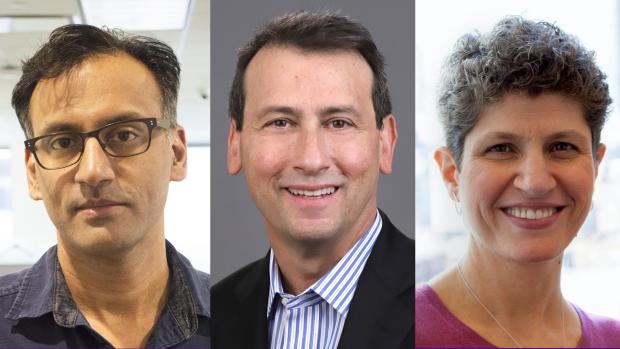
Left to right: Sundeep Rangan, Ted Rappaport and Elza Erkip
Researchers from NYU WIRELESS have received the 2025 IEEE Communications Society Award for Advances in Communication for their pioneering work on millimeter wave (mmWave) cellular networks that helped pave the way for 5G technology.
Sundeep Rangan, the current director of NYU WIRELESS, Theodore S. Rappaport, founding director of NYU WIRELESS, and Elza Erkip, NYU WIRELESS faculty member, were recognized alongside their former PhD students for their paper "Millimeter Wave Channel Modeling and Cellular Capacity Evaluation," published in the IEEE Journal on Selected Areas in Communications in 2014.
The IEEE Communications Society Award for Advances in Communication is a "test of time" that recognizes papers that "open new lines of work, envision bold approaches to communication, formulate new problems to solve, and essentially enlarge the field of communications engineering."
Given to an outstanding paper published in any IEEE Communications Society publication in the previous 15 years, the award recognizes exceptional contributions to the advancement of communications technology.
This marks the third time members of NYU WIRELESS — a research center at NYU Tandon School of Engineering — have won this prestigious award. It follows David Goodman's recognition in 2015 for "Efficient Power Control via Pricing in Wireless Data Networks" and Erkip's first award in 2013 for "User Cooperation Diversity—Part I: System Description.”
The award also follows the 2015 IEEE Donald G. Fink Prize for the year’s most outstanding survey, review, or tutorial paper in any IEEE publication, for the seminal 2013 paper "Millimeter Wave Mobile Communications for 5G Cellular: It Will Work!" by Rappaport and his student co-authors. That research launched the world's investigation of mmWave signals — extremely high-frequency radio waves that can carry vastly more data than traditional cellular frequencies — for 5G.
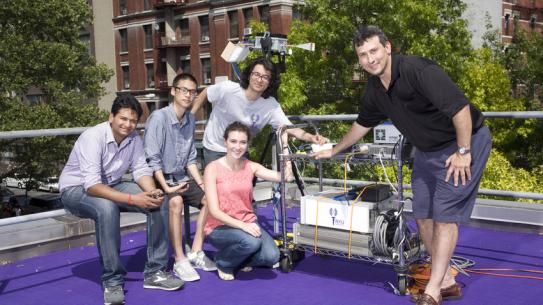
The 2014 award-winning paper provided the first detailed statistical models for mmWave based on extensive measurements in New York City at 28 GHz and 73 GHz frequencies. These frequencies, once considered impractical for mobile communications due to propagation challenges, are now central to 5G networks worldwide.
"The industry was initially skeptical about millimeter wave frequencies for cellular use," said Rappaport, the David Lee/Ernst Weber professor of Electrical and Computer Engineering (ECE) at NYU Tandon. Rappaport is also a professor of computer science at NYU Courant and a professor of radiology medicine at NYU Langone. "Our measurements and models provided the scientific foundation that gave engineers confidence to develop mmWave cellular systems. Today, mmWave chips are going into just about every high-end cellphone, creating a multi-billion dollar industry that is growing at nearly a 40% annual rate.”
The collaborative effort addressed critical questions about whether millimeter wave signals could travel effectively through dense urban environments. Through detailed measurements in Manhattan's challenging "urban canyon" environment, they showed that these high-frequency signals could indeed support cellular communications at distances of 100-200 meters, even without direct line-of-sight connections.
The research demonstrated that advanced antenna techniques could overcome the signal challenges at mmWave frequencies and discovered multiple signal paths that could enable faster data transmission, with system simulations showing potential for at least an order of magnitude increase in capacity over the 4G cellular networks that were state-of-the-art at the time.
"This work exemplified how fundamental research combining theory, experimentation, and system-level analysis can drive technological innovation with global impact," said Erkip, NYU Tandon ECE Institute Professor and a faculty member of the NYU Center for Advanced Technology in Telecommunications (CATT).
"This research fundamentally changed how the industry viewed millimeter wave frequencies for cellular communications," added Rangan, NYU Tandon ECE Professor and CATT faculty member. "By providing accurate channel models based on real-world measurements, we demonstrated that mmWave could deliver the massive capacity increases needed for future wireless systems."
The paper's co-authors, who were NYU WIRELESS PhD students during the research, have gone on to distinguished careers in academia and industry. Mustafa Riza Akdeniz is a Senior Researcher with Ericsson, Yuanpeng Liu serves as a Vice President in Goldman Sachs’ Multi-Asset Solutions Group, Mathew K. Samimi works for OneCart, an e-commerce company based in Singapore; and Shu Sun is an Associate Professor at Shanghai Jiao Tong University in China.
The award will be presented at IEEE Globecom 2025 in December 2025.