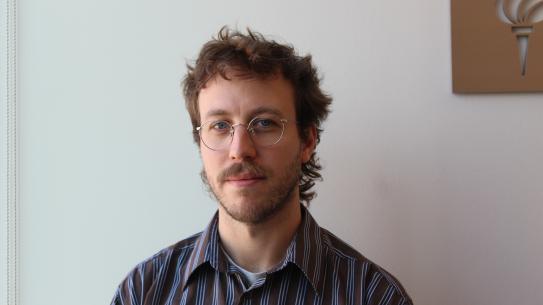

Meet graduate student Ezgi Ozyilkan

Q: Could you tell us a little about your background and why you chose Tandon?
A: I grew up in Turkey and attended a high school in Istanbul, where I was on a science-focused academic track. After I graduated in 2017 with a diploma equivalent to the French Baccalauréat, I wanted to study abroad.
I was accepted to Imperial College London, and that was my first Anglophone experience. I studied electrical and electronics engineering, and by coincidence, one of my professors, Deniz Gunduz, was a former student of Elza Erkip, an Institute Professor at NYU Tandon, who is renowned in the fields of communication and information theory. She’s a member of the Science Academy of Turkey and an IEEE fellow, and during our interview, I felt that we “clicked” right away. The chance to conduct my doctoral work under her supervision made Tandon a natural choice.
Q: Your research is highly technical; can it be explained so a layperson might grasp it?
A: Part of my work involves image compression, which is the process of reducing the size of image files, so they take up less space on a computer and can be downloaded or shared faster. Faster transmission speeds mean less traffic on the network and lower energy consumption.
Specifically, I’m especially interested in distributed compression, which becomes crucial when multiple devices are involved. Take the example of autonomous driving — there’s a tremendous amount of data generated. Multiple cameras capture the views of the environment from different angles, thermal sensors detect heat signatures, and Lidar systems use pulsed lasers to build 3D maps of the surroundings.
These heterogeneous sensors, although operating across different parts of the vehicle, observe the same physical scene — meaning that their outputs are often correlated. By jointly compressing these distributed data sources and leveraging their correlation, we can reduce the total communication load and significantly increase the system throughput. This is critical, as these devices must communicate with one another quickly and efficiently for autonomous vehicles to operate safely.
In addition to working with Professor Erkip, I regularly collaborate with Associate Professor Jona Ballé. We’re both interested in how machine learning can be leveraged to improve various aspects of data compression. Our collaboration on distributed data compression was recognized with a Google Research Award in the Fall of 2022, when Jona was working as a research scientist at Google, before joining the Tandon faculty.
Q: What have you been working on in recent months?
A: It was a busy academic year. I co-organized two workshops on compression: one at NeurIPS, a leading machine learning venue, and another one at the IEEE International Symposium on Information Theory (ISIT), which is a flagship conference for the information theory community. These venues continue the growing tradition of bringing together researchers from both the information theory and machine learning communities, which was a relatively rare combination when I began my Ph.D. I also gave an invited talk at the High-Beams Seminar, where I discussed my recent work on learning-based distributed data compression. Additionally, my co-authors and I recently had a journal paper, Learning-Based Compress-and-Forward Schemes for the Relay Channel, accepted for a special issue of the IEEE Journal on Selected Areas in Communications.
On a more personal note, I was recognized with an IEEE Signal Processing Society (SPS) Scholarship and selected as an iREDEFINE 2025 Fellow by the Electrical and Computer Engineering Department Heads Association (ECEDHA). iREDEFINE stands for Impact: Redefining Electrical and Computer Engineering Faculty, which is an effort to get more underrepresented groups into the field.
Within my own Tandon department, I received the David Goodman Leadership and Academic Excellence Award and the Dante Youla Award for Graduate Research Excellence. Those are named for NYU Tandon professors who made important contributions in areas like digital signal processing, wireless information networks, microwave systems, and control theory, so I felt extremely honored.
Q: You also recently took on the major undertaking of organizing a department-wide, end-of-semester poster session; why are events like this so important?
A: First, I want to stress that a fellow grad student, Grace McGrath, co-organized, and she was invaluable.
It was actually Fabrizio Carpi, a former student of Professor Erkip’s, who initially had the idea for an annual poster session. That was three years ago, and he’s now a Senior Research Engineer at Samsung, so we picked up the reins.
The temptation as a doctoral student is to keep your head down and focus on your own research, but sessions like these provide a valuable space within the department where Ph.D. students can find their voice, connect with one another, and learn about the diverse academic work happening around them. These gatherings offer a chance to discover what others are working on and open up new avenues for collaboration. Speaking for myself, I love collaborating and working with people from diverse backgrounds. That’s one of the major advantages of being at a place like NYU.
Q: Any plans for the summer?
A: I’m spending the summer in the Bay Area, working as a research intern at Apple in Cupertino. My internship focuses on the intersection of machine learning and video compression, and I’ve been applying many of the skills I developed during my Ph.D. One of the most exciting aspects has been working on problems at a much larger scale, where solutions need to be efficient and reliable in order to shape the video experience of millions of users. It’s been eye-opening to see how research translates into real-world applications.
Her professors weigh in:
“Ezgi's work sits at the intersection of machine learning and information theory and provides important advances on long-standing problems in distributed compression and communication. She is a true leader, both in research and service to the community – as well as being delightful to work with."
–Elza Erkip
“It has been a lot of fun to work with Ezgi on learned distributed compression! Her output on this exciting topic is remarkable.”
–Jona Ballé