

NYU Tandon’s Doctoral Program in Biomedical Engineering: Where Breakthroughs Begin
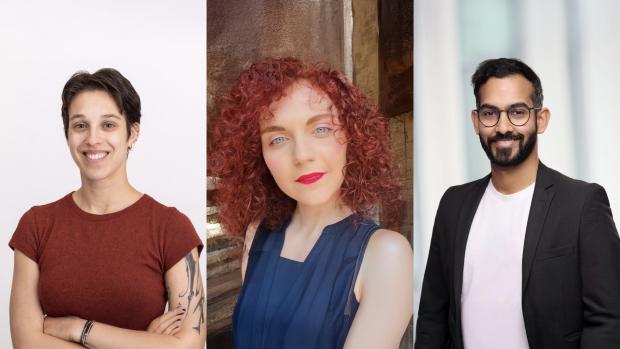
Left to right: Nisha Maheshwari, Fabianna Sofia Ricci, and Devjoy Dev
In the heart of Brooklyn, a new generation of biomedical engineers is rewriting the rules of healthcare innovation. The NYU Tandon School of Engineering's Biomedical Engineering Ph.D. program is producing graduates who aren't just writing dissertations — they're launching startups, winning national competitions, and developing technologies that will save lives.
This year, five years after its founding, the department's first three Ph.D. students graduated. Their paths tell a compelling story: three extraordinary graduates who transformed complex research into real-world solutions that address some of medicine's most pressing challenges. Their research reveals what makes this program exceptional: unprecedented collaboration, world-class mentorship, and a culture that empowers students to think beyond traditional academic boundaries.
From Ideation to FDA-Bound Innovation
Nisha Maheshwari's path exemplifies the remarkable speed, from concept to commercialization, that studying at NYU makes possible. Within just 30 days of identifying a clinical need, they and their colleagues at the Clinical Biophotonics Laboratory had created working hardware and software for a revolutionary stroke-monitoring device. Within one year, they had completed an observational study, presented at conferences, and filed a patent application — a breathtaking pace in healthcare research.
Today, Maheshwari is co-founder and CEO of CaroRhythm, which won both the Grand Prize and Audience Choice Awards in the Healthcare and BioMedical Ventures Category of the NYU Entrepreneurs Challenge. The company's non-invasive outpatient stroke monitoring system is currently pursuing FDA approval through the prestigious de novo pathway — reserved for truly groundbreaking devices with no existing predicates.
What made this extraordinary trajectory possible? "I learned to pivot!" Maheshwari explains. "When you face failure, you have to be willing to ask questions, learn, grow, and explore other directions." They credit their advisor, Department Chair Andreas Hielscher, with providing crucial guidance: "Good advisors will guide your research but not control it," they say.
The support extended far beyond the lab. Maheshwari praises NYU's entrepreneurial ecosystem, including the Entrepreneurial Institute, the Berkley Center for Entrepreneurship, and the Technology Opportunities & Ventures office, which helped accelerate their discovery to market. "You must get your lab on the radar of as many potential collaborators as possible," they advise, recalling how at one point, they cold-contacted every single NYU clinician they could find who was involved in vascular surgery.
Engineering Sleep Solutions for Earth and Beyond
While most Ph.D. students struggle to explain their research to friends and family, Devjoy Dev won multiple audience-favorite awards for his captivating presentations — at both NYU Abu Dhabi's GradSlam and NYU's University-wide Ph.D. Live! competition. His secret? Research that tackles a universal human need: sleep.
As a doctoral candidate, Dev helped develop an ingestible electrical device that stimulates gut neurons to modulate sleep through the gut-brain axis, a pathway that regulates everything from appetite to rest. The tiny device, swallowed like a pill, holds promise to improve sleep in ways never before possible, without drugs or invasive procedures. His initial focus? Astronauts spending increasingly long periods in space, where alertness is literally a matter of life and death. "Whether you're orbiting the Earth or at home safe in your bed, everyone wants to get a good night's sleep," he has said.
Working in Professor Khalil Ramadi's Laboratory for Advanced Neuroengineering and Translational Medicine (LANTRN), Dev's research tackled a critical health issue. "Poor sleep is believed to be a contributing factor in many inflammatory diseases," he emphasizes.
The doctoral program's multidisciplinary nature proved essential to Dev's success. "The LANTRN Lab works heavily in translational medicine, so we often have to be very multidisciplinary," he explains. "My research involved collaborating with a range of people, including mechanical engineers and biologists. The nice thing about biomedical engineers is that we're fortunate to be trained to speak the language of both disciplines pretty seamlessly."
Dev, who divided his time between Brooklyn and Abu Dhabi, credits two influential mentors with shaping his journey. His advisor, Professor Ramadi, "gave me his trust, guidance, and expertise throughout my degree," and Dipesh Chaudhury, an associate professor of biology, was patient, present, and continuously down to earth, qualities you don't always find in established professors."
Dev’s advice for prospective students reveals hard-won wisdom: "I think it's very important to find the right balance for your project — it will be your baby after all,” he says. “While it's tempting to want a niche and new research topic that promotes novelty and innovation, obtaining guidance here can be challenging. Find an advisor who matches your interests, not just the other way round."
Giving Sight to Navigation
During her doctoral studies, Fabiana Sofia Ricci helped engineer independence for millions. Her work addressed a stark reality: only 2 to 8 percent of Americans with visual impairments use mobility aids, because white canes detect objects only through contact, and guide dogs are expensive and require extensive training.
Ricci's solution was a discreet belt equipped with precision vibration motors that alert users to obstacles through haptic feedback, combined with audio cues that increase in frequency as they sense dangers. The system, tested using virtual reality simulations that accurately recreate advanced glaucoma symptoms, significantly reduced collisions while helping users move more smoothly through complex environments like subway stations.
Ricci's Ph.D. journey taught her self-reliance and practical problem-solving. "I discovered that I could be independent and chart my own research course," she reflects. Working with advisor Maurizio Porfiri, who remains her mentor as she continues as a post-doc in his lab, where she is now focused on Human-Computer Interaction, Ricci learned a crucial lesson: the importance of multidisciplinary exploration.
"Because of the proximity to NYU Langone and the high-level research conducted there, being at NYU is very conducive to collaboration,” she says. “But that can extend far beyond the expected. For example, because my work involved people with visual impairments, I needed to know how best to formulate questions for them and understand how they feel on a day-to-day basis, so I consulted with NYU psychologists.”
A Key Ingredient: Collaboration Without Borders
The program's extraordinary collaborative culture is a unifying theme of these success stories. At the crossroads of NYU Tandon's skyrocketing engineering reputation and NYU’s sprawling medical system, students have unprecedented access to clinical insights and unmet healthcare needs.
"There is now an understanding that technology coming from a biomedical engineering department can play a big role for a top-tier medical school," Hielscher has said. "At some point, every school needs to have a biomedical engineering department."
NYU’s new Translational Healthcare Initiative embodies this philosophy, pairing engineers with physicians to address specific clinical problems, providing funding to develop technologies to the point where they can attract investors. The proof is in the results: students working on breast cancer detection, peripheral artery disease monitoring, mental health wearables, synthetic biology, neurorehabilitation, and stroke prediction.
A Program Built for the Future
The biomedical engineering Ph.D. has become one of the most desired engineering degrees nationwide, and NYU Tandon's program exemplifies why. Students aren't just conducting research — they're being trained as the next generation of healthcare innovators, equipped with technical expertise, entrepreneurial skills, and the ability to communicate complex ideas to diverse audiences. "If you can't explain it simply enough, you probably don't understand it well enough yourself," Dev has said, capturing the program's emphasis on both depth and accessibility.
For prospective students, the message from this first cohort is clear: come ready to work across disciplines, embrace failure as a learning opportunity, and find advisors who will support your vision. "BME is a big field with a lot of possibilities," Maheshwari advises. "Try to pinpoint the contributions you want to make."
Hielscher has envisioned a future in which engineers and clinicians routinely work together to solve previously intractable healthcare problems. With graduates like Maheshwari, Dev, and Ricci leading the way, that future is already here — and it's saving lives, one breakthrough at a time.

