
Two Tandon students emerge as clear winners at Ph.D. Live!
The annual NYU competition gives doctoral students a chance to hype their research
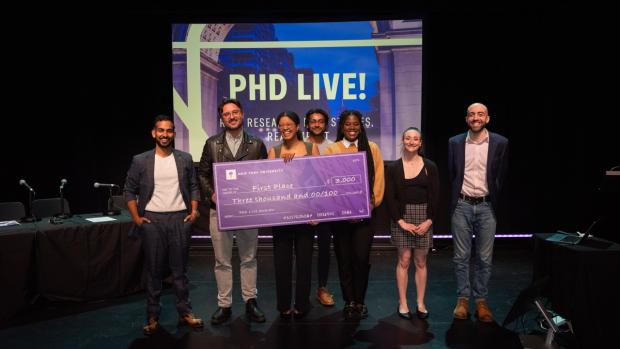
Luana de Brito Anton (holding the oversized check) took home first-place honors and Devjoy Dev (pictured far left) received the audience-favorite prize at Ph.D. Live!
Ken Jennings was not behind the microphone, but Ph.D. Live! — a University-wide competition that requires grad students to communicate their complex research clearly and compellingly — nonetheless generated the same excitement as Jeopardy!. Who needs glitzy Hollywood soundstages or smooth-talking gameshow hosts when the content being presented could change the world?
After the final presentation had been given on the stage of the African Grove Theater at NYU Tisch, two Tandon students emerged as clear winners.
Taking home first-place honors was Luana de Brito Anton, a doctoral student in Tandon’s Department of Civil and Urban Engineering. She works with Institute Associate Professor Andrea Silverman — whose eponymous lab explores water quality, wastewater treatment, and urban flooding, with an overarching goal to protect public health and environmental quality — and Dr. Jennifer Apell, an environmental chemist working for the U.S. Army Corps of Engineers. de Brito Anton studies the light-driven degradation (also known as photodegradation) of pesticides in water. It’s an important phenomenon since using pesticides benefits society by improving crop yields and ensuring food supply yet at the same time causes concerns when agricultural runoff leads to pesticides entering surface waters, where they may pose hazards to aquatic organisms and humans. She aims to better understand how pesticides photodegrade in a wide range of environmental and engineered systems and to ultimately harness the power of photodegradation to develop better water-treatment systems using artificial light.
Ph.D. Live! judges were impressed by the promise of that work — which had already brought her numerous honors, including a prestigious scholarship from the New York Water Environment Association — as well as by her riveting narrative: de Brito Anton had grown up in Brazil, the location of much of the Amazon Basin and some two-thirds of the river’s main stream, and she explained that it’s simply impossible to live in proximity to that storied body of water without absorbing a deep understanding of its importance to life on Earth.
She credits a workshop offered by the competition’s organizers that emphasized how to make oral presentations that resonate with general audiences for her success. “I realized, for example, that you shouldn’t be using too much technical jargon,” de Brito Anton, who is now headed to Stockholm University for postdoctoral research, explains. Those who’ve worked with her, however, would instead attribute her victory to hard work and devotion to scientific inquiry.
“All of the participating students did an incredible job presenting their research in an engaging and approachable way,” Silverman says. “It was a pleasure to hear about the diversity of research taking place across NYU, and exciting to have Luana represent our lab in that venue.”
Devjoy Dev, a Ph.D, student at NYU Abu Dhabi and Tandon who studies the intersection of the gut and the brain, and how it affects sleep, garnered the audience-favorite award – perhaps unsurprising given that he had taken home a similar audience-favorite prize recently at an Abu Dhabi competition called GradSlam, which required participants to present their work in under three minutes.
Dev, who is advised by Khalil Ramadi — Assistant Professor of Bioengineering at NYU Tandon and the Director of the Laboratory for Advanced Neuroengineering and Translational Medicine at NYU Abu Dhabi — admits that his work has a natural appeal for lay audiences. “We all have to sleep, and many of us have problems in that area,” he says. (He points out that humans are the only species on the planet that purposely deprives itself of rest, which is a grave problem since adequate sleep is directly connected to longevity.)
“Poor sleep is believed to be a contributing factor in many inflammatory diseases,” Ramadi emphasizes, “so Dev’s research seeks to fundamentally ask: “How might we tweak sleep?”
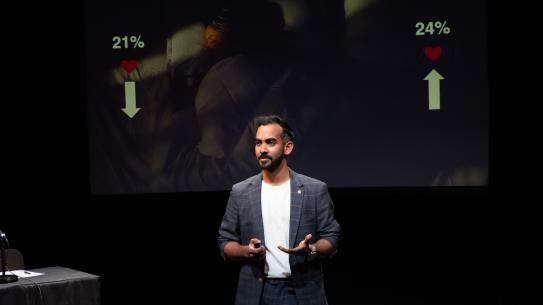
The research also encompasses another topic most people find fascinating: space travel.
Astronauts are now spending increasingly long periods in space, and for them, feeling alert and rested is a literal matter of life and death, he explains.
Dev, who has served as lead of the Sleep Medicine Working Group at the International Centre for Astronautical Development (ICAD), is developing a tiny device that can be swallowed and sent into the gut to stimulate the millions of neurons there: it holds promise to be able to modulate sleep in a way never before done. “Whether you’re orbiting the Earth or at home safe in your bed, everyone wants to get a good night’s sleep,” he says.
While he’s happy that his work resonates with general audiences, Dev, who intends to seek a job in industry after defending his dissertation, thinks it’s important for all scientists and engineers to be able to communicate their work effectively, no matter how complicated or seemingly impenetrable. “If you can’t explain it, you probably don’t understand it well enough yourself,” he quips.
"Watching Luana and Dev present their research with such confidence and pride was a particularly joyful experience,” says Jamie Lloyd, the Assistant Director of Tandon’s Ph.D. Hub. “That’s something every higher ed professional can appreciate in these challenging times!"