

CaroRhythm, a start-up launched by students, takes the next steps towards market
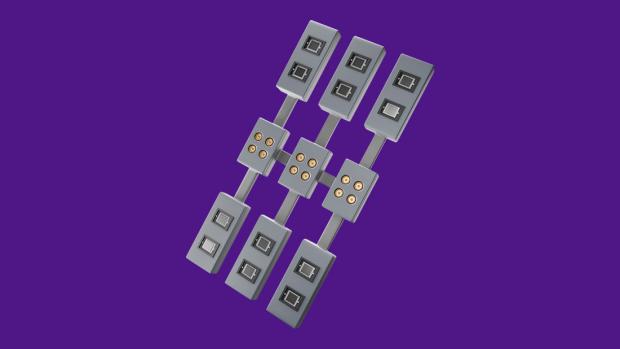
Prototype of the CaroRhhythmn device.
NYU Tandon students have a strong track record of launching successful start-ups even before graduating. Consider, for example, Sunthetics, whose founders, Myriam Sbeiti and Daniela Blanco, discovered a way to harness energy from sunlight to fuel the electrochemical and thermochemical reactions necessary to transform plant waste into important precursor materials. Then there’s Cresilon CEO Joe Landolina, who came up with an idea in his dorm room for a revolutionary plant-based gel that stops bleeding instantly.
Now, CaroRhythm has joined that list. Based on research conducted by Nisha Maheshwari while a doctoral candidate in Tandon’s Department of Biomedical Engineering, the startup has developed a non-invasive medical device that provides point-of-care carotid artery monitoring to improve the outcome and quality of life for stroke survivors through early detection.
CaroRhythm had its genesis in 2022, when Dr. Albert Favate, Division Chief of Vascular Neurology at NYU Langone, conceived of a new stent able to directly monitor and control blood flow to the brain. It was an exciting idea, but one that would require engineering know-how to bring to life. Luckily, Professor Andreas Hielscher, the chair of Tandon’s Department of Biomedical Engineering, was well-known for developing new medical imaging technologies to provide information about the blood and oxygen supply in various tissues — work that had proved especially useful in the care of diabetic patients with peripheral artery disease (PAD). He and his team, which included Maheshwari, whom he had recruited as a master’s student, determined that they could apply the existing technology — which was being used to measure hemodynamics in a patient’s extremities — to monitor oxygenation in the carotid artery. Within 30 days, they had created a version of both the hardware and software elements of a system capable of providing real-time readouts of oxygenation in both of the carotid arteries, and they invited the neurologist to try it for himself. The demonstration was an unmitigated success, and within just one year, Maheshwari and master’s student Lokesh Sharma, who had been hired to help, had completed an initial observational study, presented their work at a conference, and submitted a new patent application — an exceptionally speedy process in the world of healthcare discoveries.

Now the two co-founders, who won the Grand Prize and the Audience Choice Award in the hotly contested Healthcare and BioMedical Ventures Category of the 2023-24 NYU Entrepreneurs Challenge, are being called upon to exhibit extraordinary patience as they seek FDA approval for their system.
“We have to go through what’s known as a de novo process — from the Latin word meaning ‘from scratch’ — which the FDA uses in the case of novel medical devices for which there are no legally marketed predicate devices,” Maheshwari explains. “On one hand, the amount of time it will take is frustrating, since we’d like to see the system being widely used. On the other hand, the very fact that there are no predicates means that we’ve come up with something truly groundbreaking.” (While there are other stroke-monitoring devices that are also currently pursuing FDA approval, because CaroRhythm involves vascular imaging, the data produced is richer and more actionable.)
They’ve already gotten promising feedback from NYU — in 2023, CaroRhythm garnered the year’s sole Technology Acceleration & Commercialization (TAC) Award from the office of the provost — and the preliminary FDA panel of experts assigned to them has been equally laudatory.
Maheshwari and Sharma are quick to share the credit. It would have been nearly impossible to make the leap from student to founder, they say, without the encouragement of Professor Hielscher, the advice of clinicians who helped them refine their prototype, and the practical help of personnel from NYU’s Entrepreneurial Institute and the Berkley Center for Entrepreneurship, who guided them on everything from grant writing to customer discovery. They also have high praise for NYU’s Technology Opportunities & Ventures (TOV) office, which helps speed discoveries to market.
Speed is the operative word: with strokes now a leading cause of death and disability in the nation, the sooner patients and their doctors have access to the CaroRhythm system, the more lives will be saved.