
NYU Tandon Researchers Win Microsoft Fellowship to Plan Cleaner, Smarter Data Centers
Maurizio Porfiri and Camilla Ancona lead study that will use AI to help site next-generation data centers without straining the grid
NYU Tandon researchers Professor Maurizio Porfiri and Postdoctoral Researcher Camilla Ancona, a member of Porfiri’s Dynamical Systems lab, have been named among the 2026 Microsoft Research Fellows for their work on AI-driven clean electricity planning for next-generation data centers.
The Microsoft Research Fellowship brings together leading academics from around the world to collaborate with Microsoft researchers on challenges at the frontier of technology and society. This year's cohort addresses topics from multimodal AI to biological modeling and human-computer interaction.
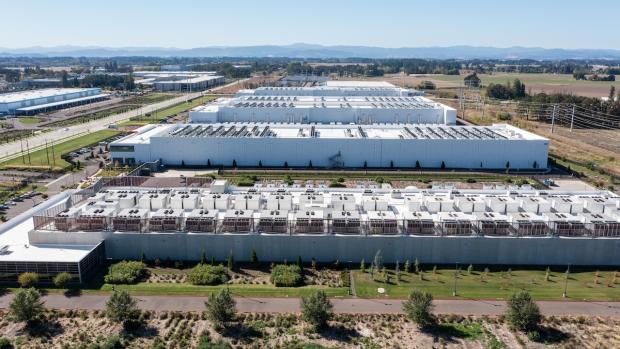
Porfiri and Ancona's selection places NYU Tandon at the forefront of a challenge with far-reaching consequences, as the rapid proliferation of data centers strains electricity grids across the US and the infrastructure demands of AI growth risk outpacing the clean energy transition. The US currently hosts over 5,000 data centers, a figure projected to approach 7,500 by 2030.
"We are at an inflection point," said Porfiri, who serves as the director of NYU Tandon’s Center for Urban Science + Progress (CUSP), the director of NYU’s Urban Institute, and interim chair of the Civil, Urban, and Environmental Engineering Department. "The digital economy is growing faster than our ability to power it cleanly, and right now planning decisions are being made without the quantitative tools needed to understand their long-term consequences for cities and grids."
The NYU team's study takes a multi-pronged approach to filling that gap. Using spatial modeling, network analysis, and exponential random graph models, Porfiri and Ancona will investigate the socioeconomic, environmental, and infrastructural factors — from state-level energy markets and tax incentives to local broadband quality, water stress, and natural hazard exposure — that drive data center siting decisions across geographic scales.
Their preliminary findings already indicate that population density, broadband infrastructure, energy vulnerability, and natural hazard risk are strong predictors of where data centers cluster.
The research will then develop reinforcement learning–based simulations to evaluate alternative siting and operational strategies.
"We want to give planners a way to run the experiment before they break ground," said Ancona, "to see how co-locating a data center with renewable generation or a transmission upgrade actually changes emissions and reliability outcomes across the grid."
The goal is a practical decision-support tool for utilities, regulators, and operators navigating the infrastructure demands of AI growth.
Porfiri, who serves as Fellowship Advisor on the project, brings deep expertise in complex systems, control theory, and network science. Ancona, named as the 2026 Microsoft Research Fellow, brings a complementary background in automation engineering, energy management systems, and reinforcement learning. Together, they will collaborate with a Microsoft Research team that includes Karin Strauss, Kate Lytvynets, Bichlien Nguyen, Jake Smith, and Danrong Zhang.
The fellowship is the latest example of NYU Tandon's deepening focus on research that helps solve the data center energy problem. This year, researchers at the school showed that zeolite-based thermal batteries could cut cooling electricity use by more than 75 percent, and that the fate of the grid depends as much on incentive structures and individual adoption decisions as on the technologies themselves. Porfiri and Ancona's work ties those threads together, asking not how to run data centers more efficiently, but where to build them so the grid can keep up.