
How Policy, People, and Power Interact to Determine the Future of the Electric Grid
When energy researchers talk about the future of the grid, they often focus on individual pieces: solar panels, batteries, nuclear plants, or new transmission lines. But in a recent study, urban systems researcher Anton Rozhkov takes a different approach — treating the energy system itself as a complex, evolving organism shaped as much by policy and human behavior as by technology.
Rozhkov’s research, recently published in PLOS Complex Systems, models the electricity system of Northern Illinois, focusing on the service territory of Commonwealth Edison (ComEd). Rather than trying to predict exactly how much electricity the region will generate or consume decades from now, the model explores how the system’s overall behavior changes under different long-term scenarios.
“This work is not intended as a deterministic prediction,” Rozhkov, Industry Assistant Professor in the Center for Urban Science + Progress, explains. “What’s important for complex systems is the general trend, the system’s trajectory, whether something is increasing or decreasing under various scenarios, and how steep and fast that change is.”
The study uses a system dynamics framework, a method designed to capture feedback loops and interactions over time. Rozhkov modeled both electricity generation — reflecting Illinois’s current distinctive mix, including a significant share of nuclear power — and demand, then explored how the balance shifts across a 50-year horizon. Illinois is an especially interesting test case, he notes, because few U.S. states rely as heavily on nuclear energy, making the transition to low-carbon systems more nuanced than a simple fossil-fuel-to-renewables swap.
From this baseline, Rozhkov examined five broad scenarios. Some focused on technology, such as a future dominated by renewable energy, with or without the development of large-scale battery storage. Others reflected policy goals, including a scenario aligned with Illinois’s Climate and Equitable Jobs Act, which sets a target of economy-wide climate neutrality by 2040. Still others explored changes in how people live and consume energy, including denser urban development and widespread adoption of distributed energy resources by households and neighborhoods.
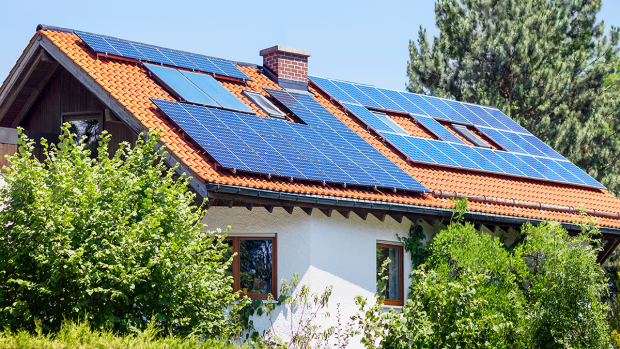
Across these scenarios, the model tracked economic costs and environmental outcomes, particularly greenhouse gas emissions. One striking pattern emerged when decentralized energy production — such as rooftop solar paired with the ability to sell excess power back to the grid — became widespread. In that case, demand for centralized electricity generation steadily declined, and there became a need to support that shift through policies: a clear example of an integrated approach. “We can clearly see that utilities would be needed to produce energy differently in the future, and the energy market should be ready for it,” Rozhkov says.
This is the central concept in the paper is which Rozhkov calls a “policy-driven transition.” Policy, in this context, is not a physical component of the grid but a force that shapes decisions. Incentives, tax credits, and regulations can push households and businesses toward clean energy even when natural conditions are less than ideal. He points to the northeastern states as an example: despite limited sunlight, strong solar policies have made rooftop installations attractive. “Policy can move someone from being on the fence about installing solar to actually doing it,” he says.
The research also highlights the growing role of decentralization, in which individual buildings or districts generate much of their own power. In Illinois’s deregulated electricity market, customers can sell excess energy back to the grid, blurring the line between consumer and producer. Beyond cost savings, decentralization can improve resilience during outages or extreme events, allowing communities to maintain power independently when the main grid fails.
Importantly, Rozhkov’s findings suggest that no single lever — technology, policy, or individual motivation — can drive a successful energy transition on its own. “Isolated single-solution approaches (technology-only, policy-only, planning-only) are rarely enough. The transition emerges from the interactions across all of them, and that’s something we need to consider as urban scientists,” he says. The scenarios that performed best combined strong policy frameworks, technological change, and shifts in behavior and urban design.
Although the model was developed for Northern Illinois, it is designed to be adaptable. With sufficient data, it could be applied to other regions, from New York City to Texas, allowing researchers to explore how different regulatory environments shape energy futures. Rozhkov’s next steps include comparing states with contrasting policies, exploring if policies or natural conditions are driving the transition to a more renewable-based energy profile, and digging deeper into behavioral factors about why people choose to adopt distributed energy in the first place.
Rozhkov, A. (2025). Decentralized Renewable Energy Integration in the urban energy markets: A system dynamics approach. PLOS Complex Systems, 2(12). https://doi.org/10.1371/journal.pcsy.0000083