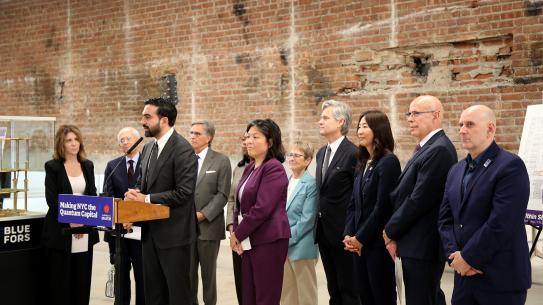

NYU Tandon Hosts Deep Tech Week Event Focused on Robotics and Embodied Intelligence
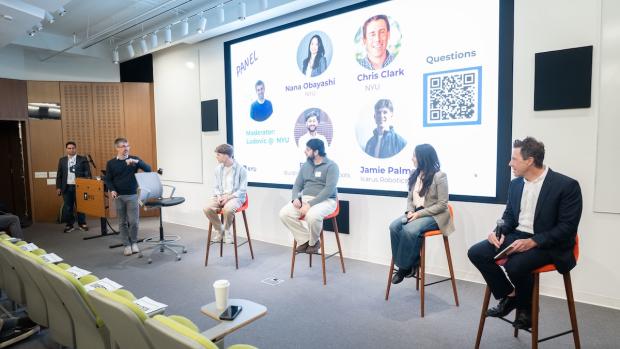
Ludovic Righetti (second from left), Center for Robotics and Embodied Intelligence co-director, moderated a panel featuring NYU faculty and startup founders. ©Creighton: Courtesy of NYU Photo Bureau
On April 3, as part of New York City’s 2026 Deep Tech Week, a crowd of roboticists, startup founders, industry leaders, and members of the general public gathered at NYU Tandon School of Engineering in Downtown Brooklyn to explore the key question driving the field’s most urgent work: what happens when cutting-edge academic research is ready to be applied outside the lab?
A New Hub for Embodied Intelligence
Juan de Pablo, Executive Vice President for Global Science and Technology at NYU and Executive Dean of NYU Tandon, opened the program by framing the moment as a genuine inflection point. “The convergence of AI, materials, and robotics is creating capabilities that simply did not exist five years ago,” he said, “and NYU is proud to be at the forefront.”
De Pablo highlighted the importance of robotics in addressing issues at the city level and beyond: autonomous systems that can navigate disaster zones too risky for humans, robots revolutionizing infrastructure construction, and surgical systems operating with unparalleled accuracy. New York City itself, as he explained, hosts some of the most complex systems on Earth — from transportation to public health to climate resilience — each presenting challenges that require AI capable of operating in the physical world.
The school’s new Center for Robotics and Embodied Intelligence (CREO) helped make Tandon an ideal location for the event. Bringing together over 70 faculty members, Ph.D. students, and postdoctoral researchers at a flagship 6,800-square-foot facility at 370 Jay Street, the multidisciplinary center recognizes that the biggest challenges in robotics require mechanical engineers, mathematicians, computer scientists, and others to work closely together.
Robots to Revenue: A Panel on Commercializing Academic Research
The program began with a panel moderated by CREO co-director Ludovic Righetti and featuring Christopher Clark; Assistant Professor Nana Obayashi; and startup founders Jamie Palmer and Bilal Sher.
The conversation ranged from what excited them most—lower barriers to entry and the merger of large language models with the physical world, among other developments — to the field’s thorniest challenges, including ensuring the quality of training data. Their collective breadth of experience made for a genuinely lively exchange.
Clark’s career, for example, serves as a kind of case study in what happens when academic robotics seriously engages with the world: before joining NYU Tandon, he was the first engineering hire at Kiva Systems, the warehouse robotics startup later acquired by Amazon for $775 million, whose robots now number more than a million in fulfillment centers worldwide. He has since deployed autonomous underwater vehicles to locate WWII shipwrecks in the Mediterranean, conducted robot navigation experiments in Arctic ice fields, and led robotics research teams at Apple. For her part, Obayashi offered a perspective rooted in soft robotics and embodied intelligence. An aerospace engineer by training, she has worked in both the automotive and aviation industries, and at CREO, she researches how physical form influences intelligence — the idea that cognition cannot be separated from the body that enacts it.
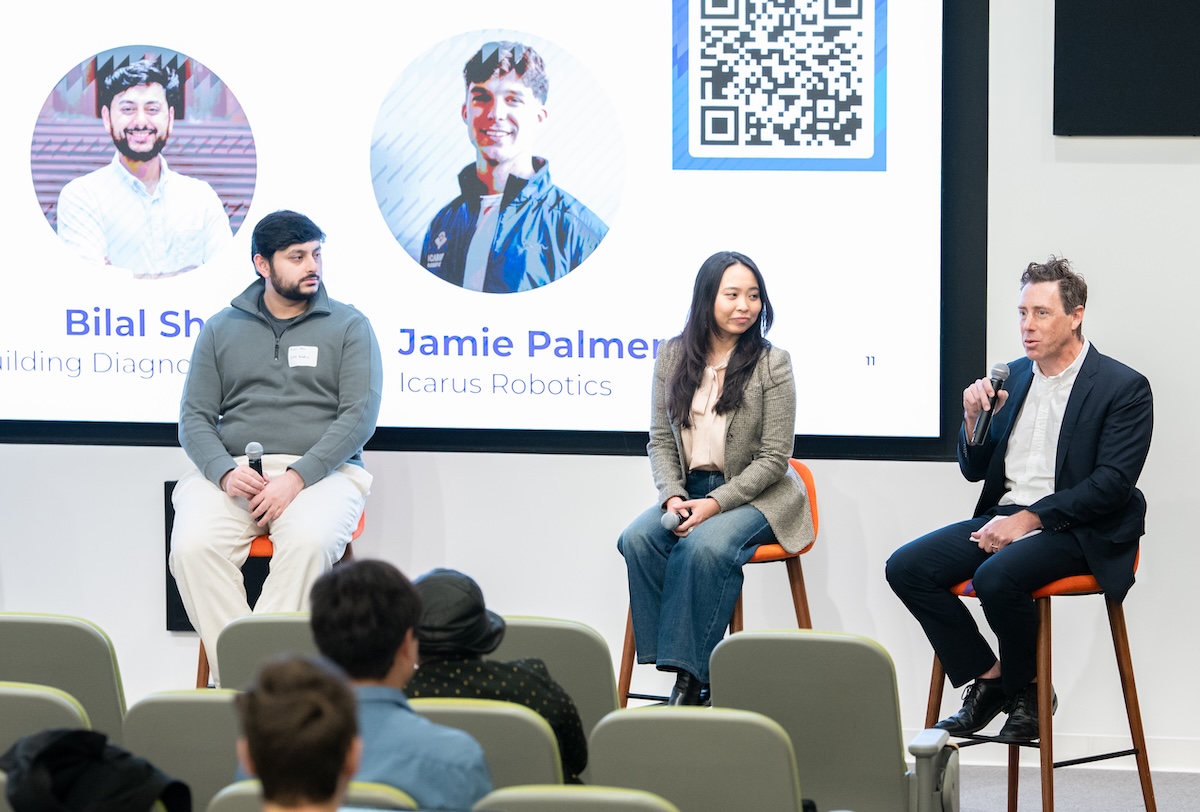
Palmer, the co-founder of Icarus Robotics, is developing free-flying robotic platforms for use aboard commercial space stations, and Sher helms the company Building Diagnostic Robotics, which was born at Tandon when he was a master’s student in Tandon’s AI4CE lab under the direction of Professor Chen Feng. (His company leverages robotic technology and AI to locate and identify damaging leaks and to provide a comprehensive evaluation of a building's physical condition, performance, and overall health.)
Lightning Talks: Rising Stars of CREO
Following the panel, three faculty members provided a lively overview of the research happening at CREO.
- Assistant Professor Eugene Vinitsky works on reinforcement learning and the coordination of multi-agent systems. His focus is practical: among the questions he is seeking to answer are how cooperative autonomous vehicles should operate to eliminate stop-and-go traffic, reduce energy consumption, and ease congestion.
- Assistant Professor Benjamin Rivière specializes in autonomous planning for robots functioning in complex and uncertain environments such as outer space. (His work gained significant recognition in 2024 when two papers were accepted by Science Robotics, the peer-reviewed journal published by the American Association for the Advancement of Science—one of which earned a cover spot.)
- Institute Associate Professor and CREO Founding Co-Director Chen Feng, whose AI4CE lab develops novel algorithms and systems for intelligent agents to accurately understand and efficiently interact with materials and humans in dynamic and unstructured environments such as construction zones.
Their industry counterparts — John Miller Schwartz of Ultra, builders of multi-purpose, industrial AI robots; Lily Kolfer of exoskeleton developers Wondercraft; and Tyler Habowski of Kyber Labs, which is building an elegantly simple robotics platform able to undertake assembly and manipulation tasks with minimal setup — offered a view from the other side of the lab door, discussing the specific challenges of scaling hardware, finding product-market fit, and pinpointing where academic partnerships add the most value. The conversation exemplified, in real time, the kind of exchange CREO was built to promote.
Inside the New Robotics Center
One of the afternoon’s highlights was a guided tour of CREO itself. Attendees moved through the facility in groups of 50, getting a firsthand look at the robots, hardware, and research environments at the heart of the Center’s daily work. The experience made the day’s conversations more concrete: the autonomous systems discussed on-stage were right there to be seen, touched, and marveled at by the people who might one day fund, deploy, or collaborate on them.
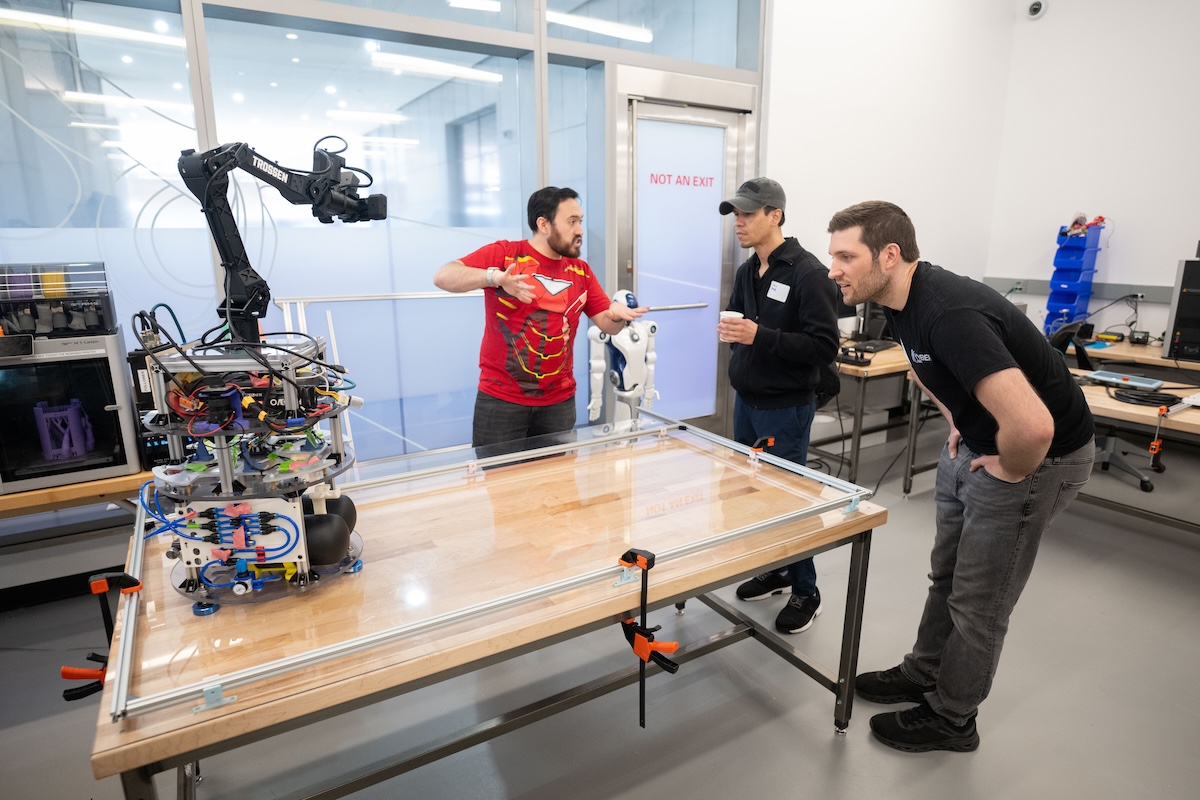
The energy in the space reflected what Dean de Pablo had described in his welcome: a field at a turning point, with New York City positioned as a crucial hub in the ecosystem that will shape what happens next.
Bringing the Event Together
The event was organized in partnership with the Deep Tech Week team, led by Andrew Cole, and made possible at NYU through the efforts of Adi Gottumukkala of the NYU Office of Corporate Engagement. Nina Gray, NYU’s Interim Vice Provost for Research, was also on hand to speak, emphasizing the University's overall dedication to robotics as a research focus with wide-ranging societal impacts.
Ultimately, the gathering highlighted the demand — in New York and across the deep tech ecosystem — for the kind of cross-sector exchange that CREO was created to promote. As embodied intelligence moves from research to practical application, NYU Tandon is working to ensure that the city’s researchers, founders, and industry leaders collaborate to shape that future.