

New Research Shows Chaos Shapes How Meandering Rivers Change Over Time
A new mathematical study shows that river cutoffs alone can make channel evolution inherently unpredictable
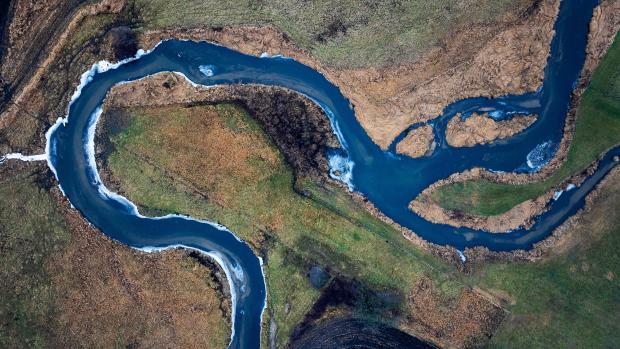
Rivers are rarely the calm, orderly streams we imagine on maps. Over time, their winding paths — called meanders — shift, bend, and occasionally snap off in sudden “cutoff” events that shorten loops and reshape the landscape. While scientists have long suspected that such cutoffs inject a dose of unpredictability into river evolution, a new study published in Communications Earth & Environment demonstrates that these abrupt events are, by themselves, enough to produce chaos in river channels.
Harvard Ph.D. candidate Brayden Noh and NYU Tandon Assistant Professor Omar Wani used a widely-used computational model to explore how meandering rivers evolve over time. This model isolates the essential dynamics: bends migrate laterally in proportion to curvature, and loops are occasionally severed through cutoffs. Other real-world complexities — like sediment transport, bank composition, and vegetation — are treated as secondary, allowing the researchers to focus squarely on the geometry-driven behavior of rivers.
To test the role of cutoffs, the team simulated rivers starting from nearly identical initial shapes, then introduced infinitesimally small perturbations to each of the multiple copies. They tracked how the channels diverged over time by mapping their evolving shapes onto a fixed grid and measuring differences cell by cell. In a striking counterfactual experiment, when cutoffs were disabled, the two channels stayed nearly identical over large time horizons. When cutoffs were allowed, even tiny initial differences grew exponentially, a hallmark of deterministic chaos.
The researchers quantified this sensitivity using the finite-time Lyapunov exponent, a metric from dynamical systems theory that measures how fast nearby trajectories diverge. They found that the rate of divergence depended primarily on the speed at which bends migrated, not on the specific cutoff threshold. In other words, faster meander migration amplifies chaos, while the geometric criteria for triggering a cutoff mostly determine how frequently the river “resets” its local shape.
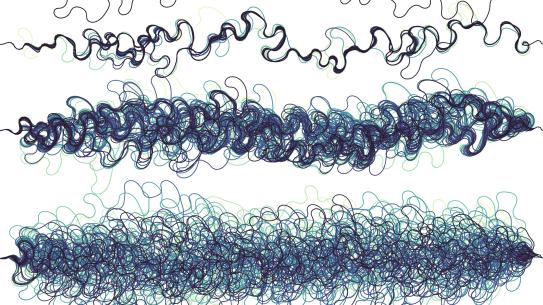
Importantly, this chaotic behavior was robust across a wide range of initial river geometries. Whether the model started with gentle or pronounced bends, the presence of cutoffs consistently created sensitive dependence on initial conditions. The team also showed that the predictability of a river’s course is bounded: beyond a certain horizon, roughly the number of cutoffs expected in one Lyapunov time, deterministic forecasts of channel position become unreliable.
The study highlights a subtle but powerful insight: continuous meander migration creates gradual stretching of the river planform, while cutoffs act as abrupt topological resets. Together, these processes produce a hybrid system that is both structured and inherently unpredictable. The finding resonates with broader observations of natural rivers, where cutoffs cluster or cascade, triggering sequences of rearrangements along the channel.
While the model is simplified — it does not include full fluid dynamics, sediment heterogeneity, or flood variability — it provides a clear counterfactual experiment: no real river can evolve without cutoffs, but simulations can, revealing the mechanism behind chaotic divergence. This approach connects geomorphology with fundamental concepts from chaos theory, offering a concrete way to quantify a river’s predictability horizon.
Ultimately, the research suggests that some limits to forecasting river evolution are intrinsic. Even in the absence of storms, landslides, or human intervention, the combination of smooth bend migration and occasional cutoffs ensures that lowland rivers retain a degree of inherent unpredictability. For engineers, ecologists, and planners, this work underscores the importance of probabilistic frameworks over deterministic predictions when assessing river migration and floodplain evolution.


