

Munity Games builds a Love Letter to Classic Arcade Shooters
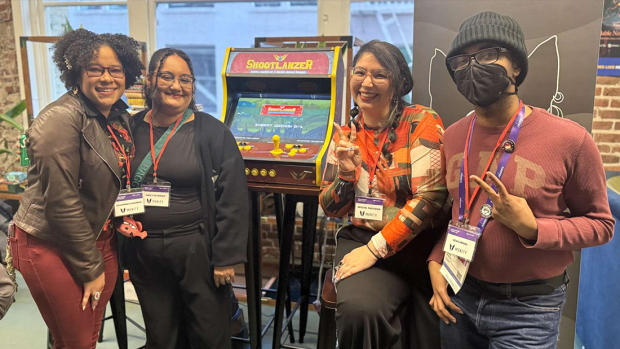
Munity Games is a member of the inaugural cohort of NYU Tandon's Game Design Future Lab (GDFL), a Brooklyn-based incubator supporting early-stage game-related companies with mentorship, investor access, and workspace. GDFL is part of the NYU Tandon Future Labs network.
Munity Games — co-founded by Krystel Theuvenin, Sean Heron, Darcelis Gutierrez, and Savannah Chapman — is a democratically led worker cooperative based in New York City. Their debut title is Shootlanzer, a fast-paced 2D shoot ‘em up that the team describes as a love letter to arcade classics like R-Type and Gradius. But the game has something those classics never had: an Afro-Latina heroine at its center.
Meow-tiny on the High Seas
The name Munity has several layers. It derives from an obsolete English word meaning freedom, immunity, and security – eminently suitable for a studio whose founding ethos is about liberating its members from the conventional power structures of the games industry. In practice, autocorrect kept changing “munity” to “mutiny,” which the team eventually took as a sign from, in their words, “the sea gods themselves.” Hence the pirate theme. And if you look closely at the logo, a pirate cat, another name punningly suggests itself: Meow-tiny.
The name also has a practical origin: the team was using the popular game engine Unity when they started out, and “Munity” captured that connection before they migrated to Godot. They’re clear-eyed about tools: they’ll use whatever makes the most sense for the game at hand.
Leona Almeida and the Magic Circle
In Shootlanzer: Battle Record of a Midair Mobile Soldier, players take on the character of Leona Almeida, a rookie pilot in powered armor who gets separated from her unit on her very first mission. Stranded behind enemy lines, Leona uncovers a plot against her country’s capital city and has to blast her way back in time to stop it. Leona, the team believes, might actually be the first Afro-Latina protagonist in a shoot ‘em up game.
Shootlanzer features multiple firing patterns, screen-clearing bombs, and evasive maneuvers in the tradition of the genre’s golden era. But Munity is also thinking about the physical experience of play. The team has floated the idea of partnering with Fun Co. to build custom arcade cabinets, harboring a vision of the game not just as a digital product but as a physical, communal space.
That communal dimension connects to something the team talks about with genuine feeling: the concept of the “magic circle.” In game studies, the term refers to the bounded space of play: the idea that when you step into a game, you enter a separate world with its own rules and its own logic, and you leave something of your everyday self behind. For Munity, making games that create that experience is the whole point.
Educators Who Make Games, and Vice Versa
All four co-founders are game design educators, and they describe that identity as foundational rather than incidental. Together, they bring a perspective on the games industry that is as much pedagogical as commercial. They care about the next generation of developers, and they are building Munity to be an example of what a studio can look like when it genuinely has its employees’ interests at heart. The major publishers and studios, they note, do not always manage that. Munity is an attempt at a different model: one where every member has an equal voice, decisions are made by vote, and the work belongs to everyone who does it.
A Co-op in an Incubator
A worker-owned cooperative is an unusual structure for a startup incubator, which typically assumes a founder hierarchy and an eventual equity event. Munity has no such hierarchy. All four members are equals. They take on various functions, but roles are fluid, and each is accountable to the group, not the other way around.
The GDFL’s willingness to support that model is itself meaningful. Munity joined the lab’s inaugural cohort with Shootlanzer already playable as a prototype: the game is being developed with direct player feedback through communities like Playcrafting NYC, which holds Indie Dev Nights, and they encourage everyone to join their Discord and become playtesters — another expression of the studio’s commitment to building with its audience rather than for it.
Their long-term vision is modest in the best sense: they want to employ young developers one day, give them genuine stakes in their work, and show by example that the industry can operate differently. The pirate cat on the logo isn’t just a mascot. It’s a manifesto.