
Bubble Trouble: New Research Highlights Outsized Impacts of Tiny Bubbles in Water Electrolysis
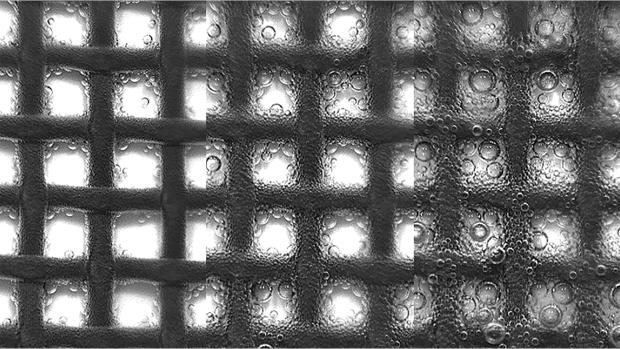
Snapshots of hydrogen bubble evolution immediately after water electrolysis starts.
Hydrogen is often described as the fuel of the future — a clean, energy-dense way to store renewable power and decarbonize industries from steelmaking to shipping. But inside the devices that produce it, a surprisingly small and familiar phenomenon is getting in the way: bubbles.
In water electrolysis, electricity splits water into hydrogen and oxygen gases. Those gases naturally form bubbles on the surfaces of electrodes. For decades, researchers have focused on improving catalysts and materials to make this process more efficient. Yet a new paper by postdoctoral researcher Darjan Podbevšek and Sustainable Engineering Initiative Director and Associate Professor of Chemical and Biomolecular Engineering Miguel A. Modestino published in the journal Joule argues that the real bottleneck may be far more mundane.
“Bubble dynamics represent a largely overlooked bottleneck that can account for significant efficiency losses.” says Podbevšek.
At first glance, bubbles might seem harmless, even expected. But their presence sets off a cascade of problems. As bubbles stick to electrode surfaces, they block the very sites where reactions are supposed to occur. They also disrupt the flow of charged particles in the liquid, increasing electrical resistance. As more bubbles accumulate, they can create uneven conditions across the electrode, further degrading performance.
In some cases, these effects are not trivial. The authors note that bubble-related losses can range from about 5 percent to as much as 25 percent of the total energy input, depending on operating conditions. In a technology where efficiency directly affects cost and scalability, that’s a major obstacle.
What makes the problem especially challenging is that bubbles behave in complex ways across multiple scales. At the smallest level, they begin as tiny nuclei, often forming at microscopic imperfections on the electrode surface. Their growth depends on subtle forces, including surface tension and gradients in temperature or concentration.
As bubbles grow and detach, they interact with one another, merging into larger bubbles or forming tiny bubble layers that blanket the electrode. These microscale “bubble carpets” can fundamentally alter electrode/electrolyte interactions and how reactants and products are transported in the system.
“It’s how and where they evolve, grow, detach, and interact that determines their impact,” the authors emphasize.
This multiscale complexity helps explain why the problem has been so difficult to tackle. Many experiments focus on single bubbles under highly controlled conditions, but real electrolyzers operate in messy, turbulent environments filled with countless interacting bubbles. Bridging that gap, the authors argue, is essential for making meaningful progress.
A typical electrolyzer is a tightly sealed, windowless box, operating at high pressure and temperatures (>30bar, >80°C), with highly alkaline or acidic conditions, making it difficult to observe bubbles directly. The authors suggest that it is at least part of the reason there are comparatively few bubble-related studies in the field.
The emerging view is that bubbles are not just a nuisance but an engineering challenge — one that can be managed, and perhaps even exploited. Researchers are exploring ways to design electrode surfaces that encourage bubbles to detach more quickly, preventing them from blocking reactions. Others are experimenting with flowing the liquid electrolyte more aggressively, using motion to sweep bubbles away.
Some of the most intriguing approaches involve changing how the electricity itself is applied. In “pulsed electrolysis,” the current is switched on and off rapidly. During the brief pauses, bubbles have time to dissipate, reducing their buildup and the associated energy losses. “Dynamic operation introduces additional control parameters,” the authors note, opening new possibilities for optimization.
Artificial intelligence is also beginning to play a role, helping scientists analyze complex bubble patterns and optimize operating conditions in ways that would be difficult by hand.
The implications extend far beyond the lab. Global demand for hydrogen is expected to grow dramatically in the coming decades, driven by efforts to cut carbon emissions. Making electrolysis more efficient — even by a small margin — could have an outsized impact on cost and energy use at scale.
“Connecting microscale bubble phenomena to macroscale electrolyzer performance” is therefore critical, the authors argue. In other words, understanding the physics of tiny bubbles could help unlock the full potential of hydrogen as a clean fuel and help improve other gas-evolving electrochemical reactions (or reactors).
Seen this way, the future of green hydrogen may hinge not just on breakthroughs in chemistry or materials science, but on something more fluid and elusive: the behavior of countless small bubbles rising, colliding, and disappearing inside a reactor. Managing them effectively could be the key to turning a promising technology into a practical one.