

Your Call Center Rep Is Emotionally Exhausted, Their Computer May Know When to Help
A study by South Korea’s KAIST and NYU Tandon School of Engineering finds that call center software logs outperform wearables in detecting worker stress
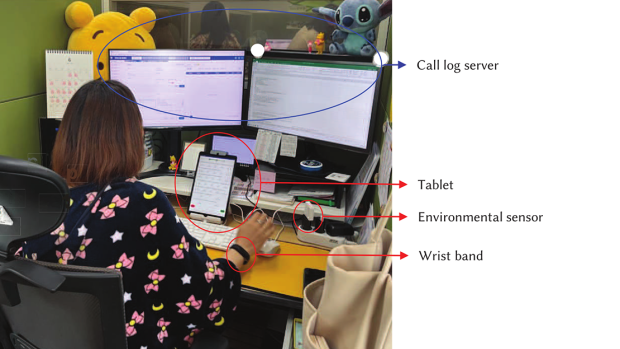
Data collection setup in the South Korean call center. Photo credit: Vedant Das Swain
When a customer calls to complain about a billing error or a delayed package, the person on the other end of the line is doing more than answering questions.
They are managing their emotions, suppressing frustration, projecting warmth, absorbing anger, often dozens of times a day.
Researchers at KAIST in South Korea and NYU Tandon School of Engineering say the routine logs generated by call center software may be the most powerful tool yet for detecting when that work is taking a serious toll.
Their study, being presented this month at the CHI Conference on Human Factors in Computing Systems, found that records of call duration, inquiry type, and the notes agents type during conversations ranked among the strongest predictors of post-call stress.
A Cornell University study revealed that 87 percent of call agents experience high levels of stress, contributing to depression, burnout, and turnover rates that plague an industry valued at nearly $30 billion globally. Most workplace stress research focuses on knowledge workers, leaving call agents largely unexamined.
To examine the problem, the researchers spent a month inside a South Korean city government call center. Eighteen agents wore Fitbit trackers, sat beside sensors monitoring CO2 and temperature, and used tablets that recorded the force and rhythm of their typing. After every call, agents rated their stress on a five-point scale, generating more than 7,400 records.
The study was designed around the job's natural rhythm, alternating between customer calls and brief intervals for notes and preparation.
The team fed data from the call center's own server into their models. Every modern call center logs details about each interaction: when a call started, how long it lasted, what the customer's issue was, whether it ended in a complaint. That information outperformed heart rate and movement data.
Long calls with unresolved problems were especially predictive of stress, as were calls requiring repeated explanations. "Even though it's stressful when the customer is unpleasant," one agent said, "it's even more challenging when they inquire without knowing their issue."
Vedant Das Swain, an assistant professor in NYU Tandon's Technology, Management and Innovation Department and a co-author of the study, said the findings reveal a blind spot in how workplaces think about stress. "Most stress research focuses on the worker's body, tracking heart rate, sleep, movement," he said. "But we found that the most revealing signal was the work itself. The call log tells you more about how someone is feeling than a wearable ever could."
Stress also looks different from person to person. Some agents went quiet and still after a hard call. Others typed harder, exhaled loudly, or left their desks. Models calibrated to individual workers outperformed general ones, though only after accumulating around 300 calls of personal history.
The researchers argue that any technology built from these findings should help workers, not surveil them. Stress predictions should go to the agent, not to managers. Aggregated data could help organizations identify systemic problems, but should never be used to evaluate individuals.
"Call centers already know a great deal about their workers," said Uichin Lee, a professor at KAIST's School of Computing and the study's corresponding author. "Our goal was to show that this data could be turned toward the worker's benefit, not used against them."
"In my own earlier research, I looked at designing tools to help call agents regulate their emotions in the moment," Das Swain added. "This paper answers the harder questions first: when to intervene, who to intervene on, and why."
Some agents said that tracking their own stress after each call made them more aware of their emotional state going into the next one. For a job defined by the feelings of others, that turned out to mean something.
The paper's first author is Duri Lee, a researcher in the School of Computing at KAIST. Co-authors are Heejeong Lim of KAIST's Graduate School of Data Science and Das Swain, who shares co-last authorship with Uichin Lee.
NYU and KAIST have built an expanding relationship in recent years, formalizing a partnership in 2022 and introducing a dual degree master's program with NYU Tandon in technology management in 2024. The current study did not originate as part of the NYU-KAIST Partnership, but Das Swain and Uichin Lee are now continuing to work together through this institution-to-institution collaboration.
Funding for the study was provided by the Institute of Information and Communications Technology Planning and Evaluation and the National Research Foundation of Korea, both funded by the Korean government, as well as Microsoft's Accelerating Foundation Models Research program and the National Institute on Drug Abuse, part of the National Institutes of Health.