
Remixing Reality: When the World Becomes Your Canvas
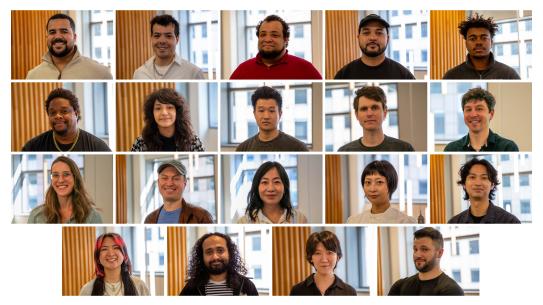
Remixing Reality is a member of the inaugural cohort of NYU Tandon's Game Design Future Lab (GDFL), a Brooklyn-based incubator supporting early-stage game-related companies with mentorship, investor access, and workspace. GDFL is part of the NYU Tandon Future Labs network.
Tom Ortega has a theory about how the future arrives. It doesn't show up as a slow, gradual improvement in the way things already work. It shows up as a platform shift, the kind that hands over the means of creation to ordinary people and watches what happens next. (Think of the move from mainframes to personal computers, for example, or from DOS to Windows.) The technology wasn't new so much as newly accessible. The tools moved from specialists to everyone.
Ortega, the founder of Remixing Reality, believes we are not too far from exactly this kind of shift: the moment when AR smart glasses stop being a “someday” thing and start being as common as the phone in your pocket. His company is building for the world on the other side of that transition.
But he's quick to clarify what he actually means by "augmented reality." "It's not the augmented part that matters," he says. "It's the reality part. Users’ reality. The world they live in, the people they love, and the spaces they know." Because only companies have been able to afford the power to create AR content thus far, we’ve seen a ton of focus on the augmented part. Ortega says, “That’s the main reason AR hasn’t taken off. Consumers don’t respond as strongly to what companies decide to put in their reality. Consumers care about what they want to put in their own reality, which, until now, they didn’t have any power to do.”
Play. Remix. Share. Repeat.
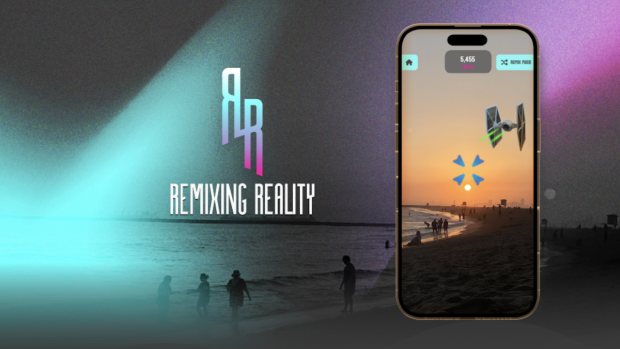
Remixing Reality is, at one level, a platform for location-based AR games. Its original experience dropped players into multiplayer space battles that unfold in the real world — parks, stadiums, living rooms, hospital rooms — using phones today and Snap Spectacles down the road. Multiple players can join a battle; everyone else can watch in Spectator Mode, which turns the whole thing into a live-action sci-fi movie starring people you actually know.
The thinking behind Spectator Mode has a specific origin story. At Disneyland one day, Ortega noticed something that stuck with him: older people who couldn't manage the rides were just as present, just as lit up, watching their grandchildren experience everything the park had to offer. The joy was real and complete even from the outside. That observation became a design principle. Not everyone needs to be in the game to be part of it: a platform that forgets that is leaving something important on the table.
But describing Remixing Reality as a game company undersells what Ortega is building. The deeper idea is the Remix: the feature that lets players modify anything within the platform themselves using nothing more than swipes and pinches on a mobile screen. No code or game-design credentials needed. Just the desire to make something yours and a platform designed to make that easy. You tweak it, share it, a friend builds on top of your version, and the whole thing snowballs outward.
The design philosophy behind Remix is something Ortega connects explicitly to childhood. "When I was young, my favorite toys shared adventures in the same universe — my living room," he writes on the platform's site. "Imagination knows no boundaries." The ambition is to give adults back that particular freedom to play inside a world they actually recognize and reshape.
When Ortega thinks about what makes a digital experience stick, he draws upon a well-documented phenomenon in which people place higher value on things they've had a hand in making. Remixing Reality is, structurally, a machine for generating that feeling. If you've modified the game, the characters, the ships, the rules — if the AR experience in your backyard is one you helped build — then it isn't just content you consumed. It's something you actually created.
That principle extends to the platform's approach to digital items. Anything earned, bought, or gifted inside one experience should carry over into others, Ortega insists. The story you tell with your collection of digital objects should be your story, not a story that ends when you close an app.
Back to the Basics
After building all the features above, Ortega noticed a fundamental issue with consumers and AR: They just didn’t understand how it all worked. He witnessed people playing a game that existed all around them, but played it standing still, holding their phone in place. There was very little turning and almost no walking around. The number one comment he heard was “The spaceships seem like they’re really here! They fly behind real world items like trees and people.” At that point, he realized he needed to help general consumers understand this technology that he took for granted.
Ortega hid all the features to expose and focus on one simple use case: Decorate your world and make a short video about it. This enables the user to see how an item is added to the world, how it exists there and how a video can show off what their mind perceives as reality. The videos can be informative (things are located here), funny (commentary about the world) or show off (look at what I ate). This has resonated with users because it goes right back to the main point above: It's something they created about reality as they see it.
Once users get more comfortable with AR technology, he’ll turn the other features back on to let them play and create games and other experiences. Ortega says, “The hard part isn’t making these advanced features. The hard part is making it as simple and as easy for everyone to use and understand.” He’s seen the fruits of his labors as little kids and older adults all make and show him videos. He’s heard some great feedback, including “This is sick!” (which is a good thing in modern parlance) and “I’ve waited my whole life for this app. I want to support this in any way I can.”
Why the GDFL
Remixing Reality joined the GDFL for the same reason most founders do: to get better at the parts of building a company that don't come naturally. Ortega knows programming, AR, and the audience he's chasing. The institutional support and mentorship are for the rest of it — the business architecture that turns a compelling platform into something that takes off and lasts.
When the glasses arrive — and Ortega is certain they're coming — he wants the platform to already be there for users: full of experiences that everyday people make on their smart phones, for the people they love, in the places they actually live.
That, he'd probably say, is the whole point of reality in the first place.