

NYU Tandon researchers are creating electrochemical reactors that take the unpredictable rhythm of renewable power in stride
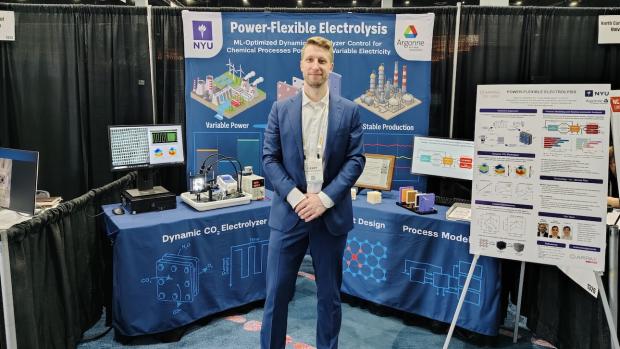
Postdoctoral researcher Casey Bloomquist at the ARPA-E Energy Innovation Summit
Most chemical plants require steady heat, stable pressure, and electricity flowing at exactly the rate they were designed to consume. Anything less predictable, and problems can ensue. Solar panels and wind turbines, of course, are different. The sun goes behind a cloud or the wind dies down at dusk. When renewable energy is abundant, there is sometimes so much of it that grid operators have nowhere to put it and pay to have it thrown away. When it is scarce, it is expensive. This mismatch — between how chemical manufacturing wants to run and how renewable electricity actually arrives — is one of the central puzzles of the energy transition.
A team led by NYU Tandon Professor Miguel Modestino is trying to solve that puzzle from an unusual direction. Instead of forcing renewable power to behave like fossil power, they are building a chemical reactor that learns to deal with it.
The Power of the Pulse
The device at the heart of the project is an electrolyzer: a reactor that uses electricity to drive chemical reactions, turning simple feedstocks, for example, into liquid fuels and useful chemicals. What makes this one different is that it does not run at a single, steady setting. It pulses.
Those pulses are not just a way to ramp power up when electricity is cheap and down when it is not. They function as a precision instrument. By carefully timing and tuning each pulse, the researchers can control what happens at the surface of the electrode, where the actual chemistry occurs (which molecules form, which do not, and in what proportions). The pulses, in other words, are how the reactor steers its own output.
Steering by hand would be impossible. There are simply too many variables, and the right pulse sequence today may be wrong tomorrow. So the team turned the job over to machine learning. Algorithms trained on experimental data build surrogate models of how the reactor behaves, then search for pulse patterns that keep the product stream clean and consistent even as the incoming power bounces around. The reactor is, in a real sense, learning on the job.
At the ARPA-E Energy Innovation Summit this April, the team brought a live version of the idea to the exhibit floor. A working electrolyzer bubbled away on the booth — water splitting into hydrogen and oxygen, the bubbles blinking on and off in time with the pulses — while screens showed the pulse sequences being applied in real time. It was, somewhat unusually for a chemistry demo, something people could watch “breathe.”
Two Labs, One Loop
The collaborative nature of the project is part of what makes it interesting.
Modestino's lab builds the hardware, runs the experiments, and develops the machine-learning control system that choreographs the pulses. Down the hall, the lab of Professor Dharik Mallapragada takes what comes out of Modestino's experiments and asks a different set of questions: what would this look like at industrial scale? Where does the money go? Which technical improvements would actually move the needle on cost, and which would be window dressing? (Complicating the answers is the fact that an electrolyzer does not stand alone. Around it sits a whole plant involving separations, purification, and storage, and most of that equipment also prefers steady, predictable inputs.)
Results from one lab feed the other. Mallapragada's models tell Modestino's team which products are worth chasing and what efficiencies would make the whole enterprise commercially viable. Modestino's data tell Mallapragada's models what is actually achievable. The modeling work has even turned up advantages of pulsed operation that were not obvious from the bench alone. The feedback loop tightens with every iteration.
A third partner, Di-Jia Liu's group at Argonne National Laboratory, rounds out the team by developing the advanced copper-based catalysts that live inside the electrolyzer: the materials that do the actual molecular matchmaking and that determine, at a very fundamental level, how selective and efficient the reactor can be.
The Importance of Flexibility
For any electrochemical fuel, electricity is the dominant cost (often the majority of the bill). That single fact shapes almost everything else. If you can tap into cheap renewable power, especially the curtailed kind that grids currently dump, the economics change dramatically. But you can do that only if your reactor is comfortable running on electricity that surges and wanes.
The bigger implication, though, is not really about cost. It is about geography. A chemical plant that depends on rock-steady grid power has to be located where that power is — often a long pipeline or transmission line away from where the sun and wind actually are. A reactor that welcomes variability can be placed where the energy is made. That opens the door to smaller, modular plants placed near solar farms, near wind farms, or in places where grid access is patchy or nonexistent.
That platform represents the team’s ultimate goal, and in the meantime, the fuel-making electrolyzer is the demonstration vehicle, the thing you can point to and say, look, it works. But the underlying approach — using intelligent pulsed control to make energy-intensive chemistry flex with its power source — could in principle be applied to a wide range of products. Anywhere you would want to make chemicals at the edge of the grid, or co-located with renewable generation, or simply as a flexible load that helps the grid balance itself, the same playbook applies.
It Takes a Village
The work at NYU has involved a cast of graduate students. Ricardo Mathison, who earned his Ph.D. in 2025 and is now a postdoc at Johns Hopkins, got the project off the ground in the Modestino lab. Dania Orfali, now in her third year, and Maya Schuchert, an NSF Graduate Research Fellow in her first, have picked up the experimental baton. Casey Bloomquist, who also completed his Ph.D. in 2025, led the design, execution, and presentation of the booth at the ARPA-E Summit — the piece of the project that most directly put the science in front of people who had never thought about electrochemistry before breakfast.
In the Mallapragada lab, Alexandre Cattry, Gilvan Wanderley, and Chaitanya Vuppanapalli handle the process modeling and techno-economic analysis that translates experimental progress into plant-scale insight.
The project is funded by ARPA-E under its OFFGRID program, which supports exactly this kind of bet: that the chemical industry's future may lie not in fighting against the variability of renewable energy, but in learning, at last, to move with it.
At the Summit's exhibit hall, where program managers invite peer teams to share their work with a commercialization-minded audience, the NYU–Argonne booth took first place in the OFFGRID group's friendly booth competition — a small but encouraging sign that the pitch lands not just with chemists, but with the people who think about where technologies go after the lab.
Which, in the end, is where this project is headed: out of the lab, onto the grid, and eventually to wherever the sun happens to be shining.