
NYU Tandon IDM Students Win "Most Innovative" Award at NYU SPS x MoMA Hackathon
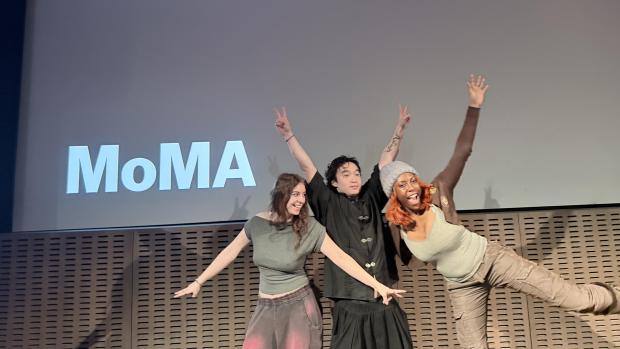
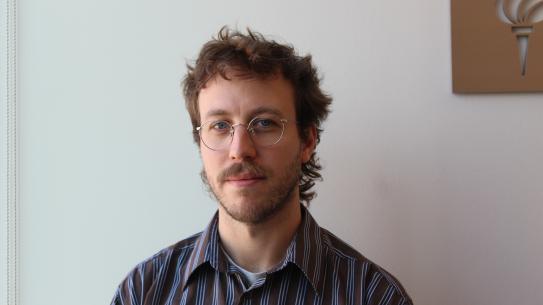
IDM students Zoë Waechter, Bryan Lai, and Alda Boyd (left to right).
What if you could reach into history and hold it in your hands?
That's the question three NYU Tandon Integrated Design and Media (IDM) students turned into a working reality on March 27, 2026, when Bryan Lai, Alda Boyd, and Zoë Waechter walked away with the "Most Innovative" award at the NYU SPS x MoMA Hackathon — having built, in a three hour window, a prototype that transformed flat archival photographs into multidimensional creations visitors could manipulate with their bare hands.
The hackathon, co-organized by NYU's School of Professional Studies and the Museum of Modern Art, challenged student teams to reimagine the museum experience from the inside out — finding new ways to help visitors navigate MoMA's nearly 200,000-work collection, discover art that resonates with them, and feel genuinely connected to what they're seeing. It's a challenge as old as museums themselves, and one that the IDM trio approached with the particular mindset of people who spend their days living at the edge of what technology can do.
Their solution: a digital time machine.
Working from MoMA's archival image database, the team used Gaussian splatting technology to convert two-dimensional historical photographs into multi-dimensional point clouds, essentially pulling depth and volume out of images that were never meant to have either. In the program TouchDesigner, they animated those volumetric forms with particle effects and built a hand-tracking interaction system that let a camera follow users' fingers in real time. The result was something that felt less like a museum exhibit and more like magic: visitors scrolling through decades of MoMA's exhibition history as if flipping through a physical archive, rotating century-old images in space, touching art that had never before been touchable.
It's exactly the kind of work that IDM — a program designed to dissolve the boundaries between art, engineering, and design — exists to produce. And it's no accident that the three students who built it arrived at the hackathon with skills that fit together like puzzle pieces.
Bryan Lai, a graduate assistant at the NYU Virtual Production Center, is fluent in the technical languages of virtual production, motion capture, and volumetric capture, with freelance credits that include creative and technical production for Nike campaigns, NYFW and Currents New Media Festival. He is the kind of creative technologist who thinks in dimensions most people don't bother to consider. Alda Boyd has spent her professional life building massive immersive environments at such venues as Mercer Labs and Inter IAM using TouchDesigner and Cinema 4D to turn raw space into experience. She is, by all accounts, someone you want in your corner when a complex system decides to misbehave at the worst possible moment. Zoë Waechter brings the third essential ingredient: the human one. With a background spanning art history, branding, graphic design, and web development, she is the team member who makes sure that whatever gets built is not just technically impressive but worth experiencing. Together, they created something in a strict three hour window that most teams would struggle to conceptualize in weeks.
The broader implications of their prototype extend well beyond a single hackathon prize. Single image 3D reconstruction and hand-tracked spatial interaction represent a genuine frontier in how cultural institutions can breathe new life into archival material, turning records that might otherwise gather digital dust into embodied, exploratory encounters. At a moment when museums everywhere are wrestling with questions of access, relevance, and the future of the physical visit, the IDM team offered one compelling answer: make the past something people can actually touch.
Ultimately, as realized by the judging panel that included MoMA’s Chief of Archives Michelle Elligott and Chief Curator Jodi Hauptman, the hackathon proved what IDM students bring when they're posed with a real problem: the technical depth to build it, the design instincts to make it beautiful, and the storytelling intelligence to make it matter.