
A new program helps NYU Tandon undergrads experience the rigors of high-level research
Participants in Next Gen Ph.D.s test their mettle in the lab
Anyone seriously considering devoting several years of their life to a STEM-focused doctoral program should know in advance what’s involved. As all Ph.D. students can attest, research sometimes means periods of frustration, failed experiments, dead ends, and slow progress, and it helps to be prepared for those eventualities. One way to gain an understanding is to become active in a faculty lab ahead of time.
At Tandon, students can take part in the Undergraduate Summer Research Program (UGSRP), which allows them to work on important projects in cutting-edge labs, be mentored by faculty and graduate researchers, attend scholarly seminars, and, at the end, present their own findings.
“It’s a wonderful, enriching program,” says Sara Lee Ramsawak, Assistant Dean of Undergraduate Academics & Global Engagement, “but it lasts only 10 weeks. Doctoral programs at Tandon and other schools generally expect you to be prepared with core competencies like designing experiments, interpreting scientific literature, evaluating methodology, and analyzing data, and truly mastering those things can, realistically, take much longer than that.”
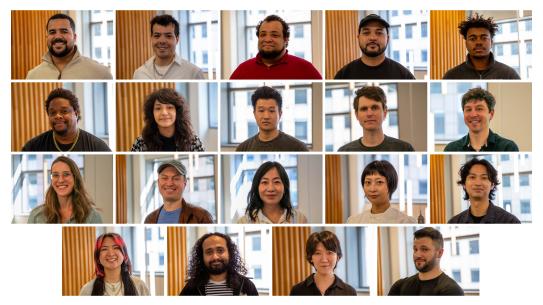
To leap that hurdle, this year, under Ramsawak’s leadership, Jen Piro and Kat Arredondo have launched an entirely new program aimed at exceptional rising juniors and seniors who have completed at least one session of the UGSRP. Next Gen Ph.D.s, as the program is called, will enable them to continue working throughout the school year on research projects assigned by their faculty supervisors, building upon the skills and experience they gained over the summer, while taking advantage of specialized seminars, workshops, training sessions, symposiums, and information sessions — all developed in collaboration with Jamie Lloyd from Tandon’s Ph.D. Hub. (The program also includes a stipend, meaning that students might be able to forgo a job in order to devote themselves more fully to research.)
“Next Gen Ph.D.s will help undergraduate students identify specific topics and subdisciplines that excite them and that they might want to pursue on a long-term basis,” Ramsawak says. “We also foresee it as a good way to demonstrate their work ethic, technical skills, and ability to persist through challenges — all things their faculty mentors will consider when it’s time to comment on grad-school applications.”
The program is highly competitive: UGSRP faculty must first nominate the student, who is then invited to submit a formal application that includes a video summation of why they would be a good fit for the program and what their ultimate goals are.
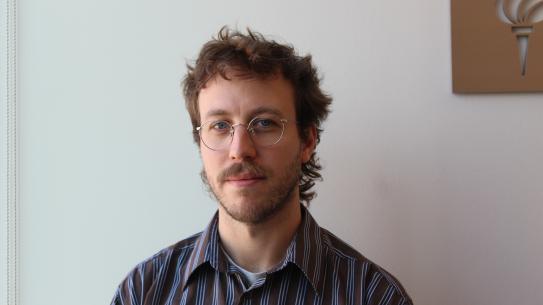
One successful applicant, Zaq Ponce, a junior majoring in Chemical and Biomolecular Engineering, had originally considered attending medical school until working with Assistant Professor Nathalie Pinkerton and Ph.D. Candidate Rachel Pollard on developing polymeric nanoparticles for targeted drug delivery and other biomedical applications. His work as part of the Pinkerton Research Group — which has already resulted in a published paper and won him a best-poster award at the national chemical engineering conference — involves improving the process for manufacturing nanoparticles and exploring how they affect sensory neurons, potentially resulting in better pain therapies. He has succinct ideas about what he will get from the program: “I want to continue making new discoveries and knowledge in the chemical engineering field,” he says, “and I’m looking forward to getting valuable feedback from my research mentors. Ultimately, I’m grateful that I’m getting the opportunity to combine medicine and engineering, because one of my ambitions is to one day head a translational nano-medicine lab or startup.”
Senior Evan Brody, another Next Gen Ph.D., was no stranger to undergraduate research when he began working with Professor Lisa Hellerstein of NYU’s Theoretical Computer Science Group; he had already completed stints at Boise State University, where he worked on cloud computing security and privacy, and at Worcester Polytechnic Institute, where he focused on applying dynamic graph algorithms to boost system reliability. Now, with Hellerstein, he is working on the design and analysis of algorithms for stochastic combinatorial optimization — specifically for optimally, or near-optimally, sequencing queries or probes. “It’s theoretical computer science,” he explains, “but the ultimate goal is to develop algorithmic tools that can be applied broadly to solve real-world decision-making problems in areas like transportation, health, and agriculture.”
Ramsawak, for one, has no doubt that Ponce, Brody, and the other participants will meet and exceed all of their goals. “We expect that they’re going to make meaningful scientific contributions, publish in peer-reviewed journals, present at conferences, and maybe even obtain patents,” she says. “We’re planning a Next Gen Ph.D. Research Symposium for the end of the academic year, so it will be exciting to see the results.”