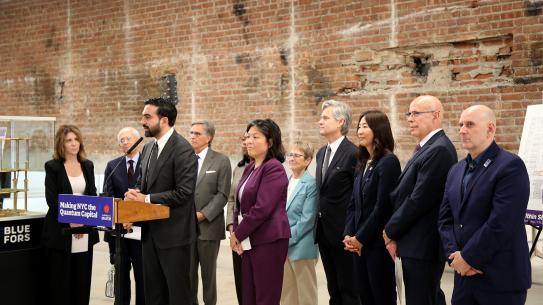

Meet Kenji Funaki: From boardroom to cybersecurity classroom
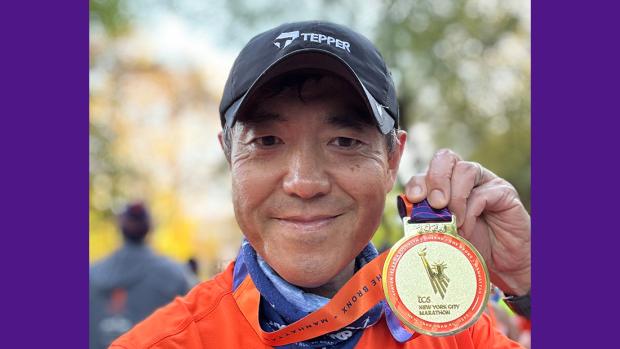
Kenji Funaki at the 2024 New York City Marathon
At 4:30 a.m. on a recent Saturday, Kenji Funaki finally cracked it. After more than 30 hours of hunting for two elusive crash cases in his Application Security course, taught by Professor Alon Hillel-Tuch, Funaki, the Chairman and Co-Chief Strategy Officer of PLM Fleet (a joint venture between two global companies), had his breakthrough. Many people in his position might have thrown in the towel hours earlier. Funaki leaned in harder. "It was intense but also enjoyable," he reflects. "I truly feel that it's a blessing to spend time learning something so valuable."
This might not be the mindset of a typical student — but then again, Funaki isn't typical. Last September, after a decade of leading that global venture, he entered a classroom for the first time since 1999 to pursue a master's degree in cybersecurity at NYU Tandon as part of the prestigious Cyber Fellows program, housed within the NYU Center for Cybersecurity.
A strategic pivot
The decision might seem surprising for someone who hadn't been a student since earning his MBA from Carnegie Mellon's Tepper School of Business in 1999, or his undergraduate degree in Electrical Engineering from Waseda University in Japan in 1990. But for Funaki, the choice was strategic. "I wanted my second master's degree to be tech-focused," he explains. "In researching specific disciplines, I became convinced that cybersecurity would be the right path. No matter what sector you work in, security is a concern. As a business leader, I want to be well-versed in the risks my company might face and how to fight them."
As a major technology hub, New York City was a natural choice, and he was already familiar with NYU: his daughter had been born at NYU’s Tisch Hospital and had graduated from Steinhardt in 2022, the lucky year that Taylor Swift spoke at the Yankee Stadium commencement. When he discovered the Cybersecurity M.S. at Tandon — a school that has been officially honored as a National Center of Academic Excellence in Cyber Operations, Information Assurance Education, and Information Assurance Research — everything clicked.
Learning on the front lines
Kenji was admitted into the Cyber Fellows program, which offers more than just a scholarship. Designed in collaboration with New York City Cyber Command, it connects students directly with industry advisors from major companies and agencies. The result? A curriculum grounded in the real-world challenges graduates will face on day one. "I really can't say enough about how well the program is run and how much I'm learning," Funaki says.
His enthusiasm led Hillel-Tuch to invite him to serve as a teaching assistant — an opportunity Funaki, who also serves as an alumni volunteer mentor to a full-time MBA student on the dean's list at Tepper, accepted, despite admitting he "didn't really understand what the duties of a TA were." "I think it's important, however, to try new things," he says, "and I also want to be of service whenever I can."
He figured it out quickly enough. What he didn't figure on was that it was a paid position. Funaki came up with an elegant solution to declining the salary: he donated the entire gross payment back to the OSIRIS Lab.
Finding community in OSIRIS
The Offensive Security, Incident Response, and Internet Security (OSIRIS) Lab has been training cyber professionals since Professor Nasir Memon founded it in 1999. "The OSIRIS Lab is a highly unique inverted lab," explains Hillel-Tuch, who is the current faculty director. "Students lead the lab themselves. They serve in appointed roles and take on key responsibilities. It's student-first: by students, for students."
This approach allows students to bring in their own research ideas and collaborate with peers without the traditional pressures of academia, while still maintaining rigorous learning standards. "I love this model because the students truly own the lab and the research; it's theirs," Hillel-Tuch adds. "It provides hands-on experiences and events driven purely by student interests. We have undergraduates in the lab who are already planning to apply to graduate school at NYU, specifically so they can continue working in OSIRIS. That tells you everything you need to know about the culture we've built here."
For Funaki, a seasoned professional surrounded by younger, traditional students, it could have been isolating. Instead, he found immediate acceptance. "I had to learn recent slang like 'pwn' and acronyms like 'CTF,' which stands for Capture the Flag," he laughs. "But that hasn't made a bit of difference."
Starting from scratch
When asked about his post-graduation plans, Funaki's answer defies every expectation for someone with his executive pedigree. "I have led a company for a long time, but in my next phase of life, I'm willing to start from scratch — learning the code, gaining hands-on experience at the helpdesk, whatever it takes. I want to keep working and learning for at least two or three more decades, so I'm happy to put in the effort."
It's the same mentality that drives him through 30-hour problem-solving marathons. And actual marathons, for that matter.
Running toward the finish line
Twenty years ago, Funaki took up running. The appeal was simple: no fancy equipment required, just a good pair of sneakers. After completing his first marathon in Honolulu, Hawaii, he thought he could check it off his bucket list and move on. "But later, sitting on the hotel sofa with beer in hand, staring out at Diamond Head, I changed my mind and realized one wasn't enough," he recalls.
To date, he's completed 34 marathons and four ultra-marathons. The New York City Marathon on November 2 will be his 14th time running that iconic course — and he's already qualified for his 15th next year. The parallel between his running and his return to school isn't lost on him. "Deadlines," he reflects, "can be one of the best tools for pushing us forward."
For others considering a return to academia, especially those who worry they've waited too long, Funaki's message is unequivocal: "Don't let age be a barrier. If you are interested in something, just go for it, and take advantage of any opportunities that are offered to you."
He stands as living proof that it's never too late to start a new race.
There is one quote that has inspired him deeply and that has become his mantra over the years:
Pain is inevitable. Suffering is optional.”
— Haruki Murakami, What I Talk About When I Talk About Running