
The 2025 NYU Sustainable Engineering Summit Brought Together Participants from All Disciplines and Sectors
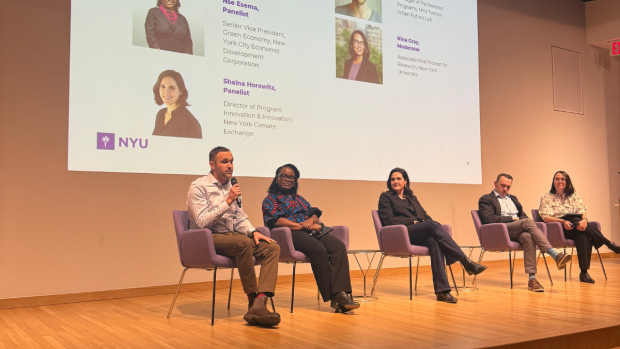
The Sustainable Engineering Summit held at NYU Tandon featured panel discussions, as well as series of talks, poster demonstrations, and a networking reception.
This December, the NYU Tandon School of Engineering hosted a Sustainable Engineering Summit, bringing together academic researchers, industry representatives, government officials, and students for talks, panel discussions, and networking focused on one of the most pressing challenges of our time: developing engineering solutions for climate change and other environmental concerns.
Held at the school's Brooklyn campus, the summit featured keynote addresses from Professor Meagan Mauter of Stanford University and Jamie Torres-Springer from the Metropolitan Transportation Authority (MTA), along with panel discussions featuring leaders from the financial industry, the NYC Economic Development Corporation, the New York City Department of Environmental Protection, BATWorks, the NY Climate Exchange, Arcadis, and the Mayor's Office of Climate and Environmental Justice.
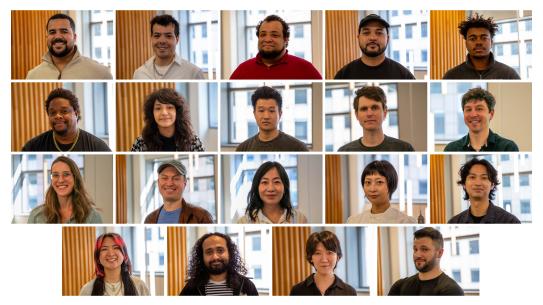
The event embodied a core principle articulated throughout the day: sustainability is not a spectator sport, and addressing climate challenges requires collaboration across disciplines, sectors, and institutions. Below, the organizers — Miguel Modestino, the Donald F. Othmer Associate Professor of Chemical Engineering and Director of Tandon's Sustainable Engineering Initiative; Assistant Professor of Mechanical and Aerospace Engineering Yuki Miura, who is also a faculty member at the Center for Urban Science and Progress (CUSP); and Institute Associate Professor of Civil and Urban Engineering Andrea Silverman (an affiliated faculty member at CUSP) — reflect on the summit's significance and the path forward.
What was the impetus for organizing the Summit, and what gaps were you hoping to fill in the sustainable engineering conversation?
At NYU Tandon, we've been doing groundbreaking work in sustainable engineering for years, and we wanted to create a forum that would bring together our diverse community of researchers, showcase the breadth of work happening across different engineering disciplines, and connect with industry partners and policymakers who are facing these challenges in the real world.
We wanted to highlight that sustainability cannot be treated as a niche concern within engineering — something that only environmental or chemical engineers need to worry about. The reality is that every sector of engineering must be concerned with sustainability. Whether you're designing computer systems, building infrastructure, developing new materials, or creating software, there are sustainability implications. We wanted the summit to emphasize that cross-disciplinary collaboration isn't just beneficial — it's essential.
How do you measure the success of the conference beyond attendance numbers — what kind of impact are you hoping to see in the months and years ahead?
Success for us isn't just about how many people showed up, although we were thrilled with the turnout. The real measure will be the collaborations and initiatives that emerge from the connections made at the summit. Are faculty from different departments working together on proposals they wouldn't have considered before? Are our students pursuing internships with the industry leaders they met? Are those industry partners identifying research capabilities at Tandon that can help solve their challenges?
Our long-term impact will be measured in projects launched, technologies deployed, and ultimately, measurable progress toward our climate goals.
What emerged as the most urgent or recurring themes from your speakers and attendees?
It's not enough to develop a brilliant new solar panel or a more efficient battery if you haven't considered how it will be manufactured, deployed, maintained, and eventually recycled or disposed of. We need to think about entire life cycles and interconnected systems. Tandon’s Executive Dean, Juan de Pablo, is making that type of systems thinking a priority.
Another major theme is the urgency of implementation. We have many of the technologies we need to address climate change — what we're often missing is the infrastructure, policy frameworks, and economic incentives to deploy them at scale. That's why having industry and government representatives at the summit was so valuable. They brought real-world constraints and opportunities that academic researchers need to understand.
There was also significant focus on mitigation and adaptation. While we must work to reduce emissions, we also need to build resilience for the climate impacts that are already here. This requires engineering solutions that help cities, infrastructure, and communities withstand heat waves, flooding, and other climate-related challenges.
If you had to list a few top takeaways, what would they be?
First, the talent and commitment in this space are amazing. We held a student poster session in connection to the summit that showcased innovative approaches to everything from water treatment to sustainable materials to clean energy systems. Our future engineers are deeply engaged with these challenges.
Second, New York City is an incredible living laboratory for sustainable engineering. The concentration of diverse stakeholders — world-class universities, innovative companies, progressive government agencies — creates unique opportunities for collaboration and rapid iteration.
Third, we need to do a better job of breaking down silos. Some of the most exciting conversations at the summit happened when, for example, someone working on transportation infrastructure started talking with someone developing new building materials, and they realized their work was interconnected in ways they hadn't previously considered.
Finally, we need sustained investment and long-term thinking. Climate change isn't a problem we'll solve with a single breakthrough invention. It requires persistent effort and commitment from all sectors of society.
What partnerships or collaborations were essential to pulling this together?
The summit wouldn't have been possible without strong partnerships across multiple dimensions. Within NYU, we had tremendous support from Dean de Pablo and other university leaders like Associate Vice Provost for Research Nina Gray, who moderated our panel on climate mitigation strategies. The involvement of agencies like the MTA, NYC Economic Development Corporation, and the Mayor's Office of Climate and Environmental Justice was crucial. These partnerships demonstrate that academia, industry, and the public sector can work together effectively.
As individual researchers, we are lucky to have forged strong connections with several agencies and companies, and that made it easy to find eager and engaged participants. The summit provided a great platform for knowledge-sharing, so it was a win-win for everyone who attended or spoke.
Why were New York City and Tandon the right location for the conference?
New York City is simultaneously one of the most challenging and most promising environments for sustainable engineering. It's one of the world's most densely populated urban areas, with aging infrastructure, significant emissions, and vulnerability to climate impacts. But it's also a city committed to aggressive climate goals, with a municipal government that's actively seeking innovative solutions.
NYU Tandon's location in Brooklyn puts us at the heart of this ecosystem. We're not in an isolated campus somewhere: we're embedded in the city, with direct connections to the urban challenges we're trying to solve. Our researchers study transportation systems on the streets outside our door. Our civil engineers work on structures throughout the five boroughs. Our water quality researchers can walk or subway to the waterways they're trying to protect.
Beyond location, Tandon has the multidisciplinary depth this work requires. We have faculty working on everything from advanced materials and electrochemistry to civil infrastructure and artificial intelligence. Our Sustainable Engineering Initiative brings together experts across these fields and beyond. That breadth is essential because sustainable solutions require integrated approaches.
Have you already seen any concrete collaborations, projects, or initiatives emerge from connections made at the conference?
We want to give credit here to Industry Assistant Professor Ingrid Paredes, who directs our General Engineering program. In connection to the summit, she convened a meeting that drew faculty from every department to discuss effective ways to incorporate sustainability into all aspects of our curriculum. That’s exactly the type of discussion we hope to catalyze.
We're thinking about how to maintain the momentum and connections throughout the year. The challenge of building a sustainable future requires ongoing effort and collaboration, so while the summit was one important step, the real work continues.