
When Science Jams: NYU Professor Draws on Musical Roots to Reimagine Scientific Collaboration

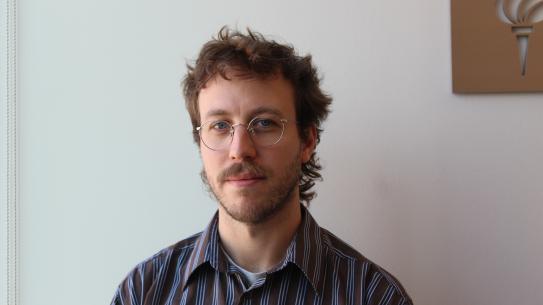
For Roy Maimon, hitting the bar stage and working in the scientific laboratory have never been separate worlds. During his Ph.D., the new NYU Tandon biomedical engineering assistant professor would spend his days pipetting samples and his nights playing drums in punk rock bands at local bars.
Now, in an essay published in EMBO Reports, he argues that science needs more of what makes music work: improvisation, collaboration, and the creative freedom of a jam session.
"Queen's and David Bowie's Under Pressure, Jimi Hendrix's Voodoo Child and even Ed Sheeran's Shape of You began in jam sessions," Maimon writes. These weren't chaotic free-for-alls, but structured moments when artists from different backgrounds played freely until something new emerged. The same principle, he contends, should guide how scientists work together.
Maimon calls it the "jam-based discovery framework" — a pattern where scientists meet in short cycles to discuss and analyze their data, recording every step so that ideas and failures remain accessible. Unlike musical jams, which create sound for its own sake, scientific jams have a specific goal: to solve problems, explain observations, and test hypotheses through disciplined improvisation.
The essay outlines five design principles for fostering these collaborative sessions. Labs should remove physical and digital barriers, creating open spaces where interdisciplinary conversations happen naturally. They should record every iteration — whiteboard snapshots, exploratory notebooks, pilot scripts, even "failed" analyses — making reproducibility a built-in feature. They should normalize visible thinking, run rapid low-cost experimental cycles, and rotate leadership so early-career researchers can propose and drive ideas, not just execute them.
"Improvisation without discipline is chaos; discipline without improvisation is stagnation," Maimon writes, capturing the delicate balance his framework seeks.
The approach isn't purely theoretical. Maimon describes real breakthroughs from his own lab: when custom glass slides were too large for a microscope stage, the team improvised with a diamond cutter rather than ordering expensive hardware. When spatial transcriptomics experiments bogged down in repetitive pipetting, biologists, engineers, and programmers met at the whiteboard and designed an automated device.
For Maimon, NYU Tandon represents the ideal environment for this jam-based approach. The university's push toward interdisciplinary collaboration —bringing together neuroscientists, clinicians, physicists, and engineers — mirrors the diverse "instruments" needed for a productive jam session.
With his full-time arrival at Tandon not for several more months, he's already collaborating weekly with Tandon colleagues like Assistant Professor David Truong and Assistant Professor Irene de Lázaro on stem cell research, and working with Professor Jeffrey Hubbell on delivery platforms for neurological therapies.
“I hope to cultivate many more scientific jam sessions across NYU, spanning Tandon, Langone, Abu Dhabi, Courant, and beyond, where ideas move freely, disciplines collide, and discovery accelerates at a scale that no single field could achieve alone,” said Maimon.
True to his vision, Maimon is drawn to lab members with creative backgrounds. His first postdoc plays bass guitar, and his first student handles both guitar and drums. "I always ask, do you play any instrument?" he says. "I hope to have real jam sessions, also, with my students." He is also organizing international scientific meetings called Cajal Challenge Accepted, extending this jam session mindset into a global scientific forum.
The essay arrives at a pivotal moment for scientific culture. As biology becomes increasingly computational and AI-driven, the need for diverse perspectives has never been greater. Maimon's framework offers a concrete vision: labs designed as studios, where creativity is infrastructure rather than accident, and where breakthrough discoveries emerge from the unexpected collisions between different ways of thinking.
"Science is not only a protocol," Maimon concludes. "It is a performance. We need to redesign the studio."
Maimon will share more about his work and vision at a TEDxSDSU talk on March 22, 2026, in San Diego, California. The event is open to the public.