

When art meets engineering: Tega Brain's climate interventions at Pioneer Works
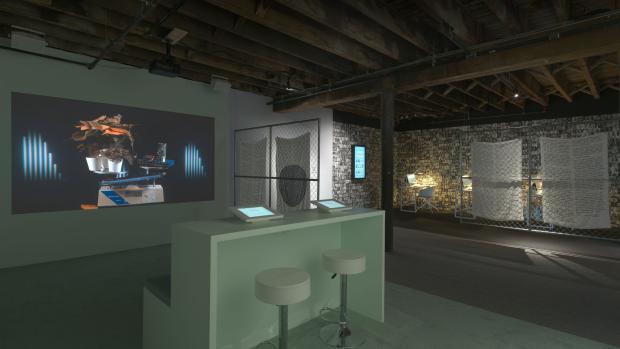
Installation view of Tega Brain & Sam Lavigne, How To Get To Zero, 2025. Courtesy of the artists and Pioneer Works. Photo by Dan Bradica Studio.
Pioneer Works is currently hosting a groundbreaking exhibition that places NYU Tandon School of Engineering faculty member Tega Brain at the forefront of an innovative artistic movement — one that transforms technology from a tool of environmental destruction into a medium for climate activism and systemic critique.
For the past 15 years, Brain has worked in installation, video, software, artificial intelligence, and other media, examining how our technological frontiers are deeply entwined with our ecological futures. "How To Get To Zero," the first comprehensive survey of her work, alongside that of frequent collaborator Sam Lavigne, represents a decade of what Brain calls "eccentric engineering": installations that blur the boundaries between art, ecology, and traditional engineering practice. For Brain, this approach isn't merely aesthetic — it's a radical reimagining of how technology can serve environmental and social justice.
The exhibition's centerpiece, "Offset" (2025), exemplifies their provocative methodology. This project sees the launch of an online marketplace where visitors can purchase carbon credits derived from acts of direct action and industrial sabotage. Examining how market-based solutions have failed to address climate change, Brain and Lavigne playfully reimagine a carbon registry that redirects funds from credit sales directly to incarcerated climate activists. It's a pointed critique of carbon offsetting schemes that allow corporations to continue polluting while purchasing environmental indulgences.
Throughout the exhibition, Brain's NYU-honed technical expertise becomes a weapon against the very systems that typically deploy such knowledge. "Fragile States" (2022) archives interviews with imprisoned climate activists through video and print, while "Cold Call" (2023) invites gallery visitors to phone fossil-fuel executives with one simple goal: keep them on the line as long as possible, turning corporate time into a resource that activists can waste.
The third-floor installation "Perfect Sleep" (2021) reveals Brain's interest in how capitalism's assault on natural systems extends to the human body. Participants experiment with their own sleep cycles, exploring how sleep deprivation and climate change emerge from the same system that devalues rest, regeneration, and ecological limits. Nearby, "Synthetic Messenger" (2021) operates a botnet across cellular devices, artificially inflating the value of climate news coverage by clicking advertisements — a gesture that simultaneously critiques and exploits the attention economy.
Brain's solo works further demonstrate her unique position at the intersection of art and engineering. "Being Radiotropic" (2016) and "Solar Protocol" (2021 - present), for example, propose alternative digital networks in which profit motives and surveillance tactics take a back seat.
The retrospective makes clear Brain's broader mission — using technical knowledge not to optimize existing systems, but to fundamentally question and restructure them. "How To Get To Zero" ultimately asks visitors to consider their complicity in systems of extraction and environmental destruction while offering speculative alternatives. Brain's work suggests that addressing climate collapse requires more than individual action or market solutions — it demands that we reprogram the technological infrastructure itself, allowing ecological intelligence to guide our digital futures.
Note: “How to Get to Zero” marks the official premiere of “Offset,” a Creative Capital–funded project. The exhibition is also supported by Pioneer Works and their funders.