
Students Reimagine the Library Experience During the Hack Dibner Competition
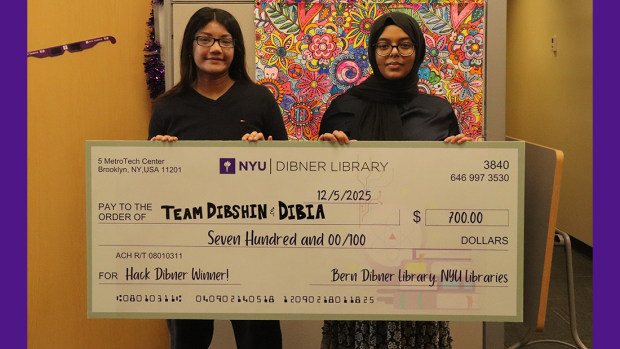
Grand prize winners, Alia Khan and Noshin Siddiq
What happens when you challenge engineering students to solve real problems in their own academic space? At NYU Tandon, the answer is Hack Dibner — an annual semester-long competition where student teams blend creativity, technical skills, and user research to reimagine the library experience. This year's competition drew almost a dozen teams, each tackling a different pain point they'd experienced firsthand: the frustration of hunting for available seats, the challenge of discovering relevant resources, and the acoustic challenges of shared study spaces, among them.
Solving the Sound Problem
Grand prize winners Noshin Siddiq and Alia Khan of Team Dibshin & Dibia addressed an often-overlooked issue: sound leakage from group study rooms disrupting nearby quiet study areas. Their solution started simply — install white noise machines — but evolved into something more innovative: the Whisper Box, a prototype device that automatically adjusts ambient noise based on surrounding sound levels.
When thorough literature review revealed their initial idea wasn't feasible, the team pivoted successfully, drawing on a semester's worth of workshops, surveys, and faculty interviews to build a strong alternative solution.
"For me, the most fun part of Hack Dibner was integrating engineering skills, particularly CAD modeling and building electronics, into a problem that affects us directly as well as our peers," says Siddiq, a biomedical engineering master's student graduating in May 2026. The project also taught valuable lessons about the gap between classroom concepts and real-world implementation. "In classes, it's often enough to just have a conceptual idea, but Hack Dibner really pushed us to look at the details to come up with a final implementable version," she explains.
Taking the Guesswork Out of Finding a Seat
Runner-up team Who Got Dibs? — Pavithra Rajan and Anna Susan Cherian — tackled another common frustration: the time-consuming hunt for an available seat with power access. Their research found that 50% of library users spend more than 10 minutes searching for suitable seating.
The pair, both computer science students, bring complementary goals to their work: Anna is passionate about technology at the intersection of inclusivity and sustainability, while Pavithra aims to "design systems that bring clarity, structure, and flow to complex problems."
Their solution pairs passive infrared sensors placed under seats with a mobile app, providing real-time information about which seats are vacant, occupied, or near power outlets. "This was where we grew the most," they say of wrestling with sensor selection and cost analysis. "It really showed us how impact, feasibility, creativity, and user experience are required to transform an idea into reality."
The Discovery Process
Among the audience-voted fan favorites was Team Dibnerds' GNNIEUS, an ambitious vision for transforming library search into a conversational, multimodal learning experience. Sejal Lanjekar and Bhagyashree Patil were motivated by survey data showing that 85.7% of students feel overwhelmed by scattered library resources.
Their proposed system would use graph neural networks to create smart resource bundles, learning from user interactions to provide personalized study pathways. "We came to one common problem that everyone faced during research and studying: searching for the right study materials," explains Lanjekar, a Management of Technology master's student. "Our library certainly provides a huge number of resources, but it's easy to get overwhelmed."
Another fan favorite, the A-Team's LibraryLink, approached discovery from a different angle. Rather than bringing users to the library catalog, they proposed bringing library data to users wherever they already are — embedding it as they shop on Amazon or browse course pages.
"The library has the resources. The problem is making them discoverable at the point of decision," the team observed, noting that more than 50 students per week ask "Where is this book?" at Dibner alone.
More than a Competition
What sets Hack Dibner apart is its emphasis on the complete journey from problem identification to implementable solution. Teams attend workshops throughout the semester, conduct user research, consult with librarian mentors, and develop detailed proposals including cost estimates and implementation timelines. Judges — including library administrators, instruction librarians, and student workers — evaluate projects on impact, feasibility, contextual inquiry, creativity, and engagement.
"I learned the power of a strong narrative on how to frame a technical project not just as a tool but as a transformative experience for the end users," Lanjekar reflects on the experience.
With a $700 grand prize and $300 for second place, Hack Dibner offers financial incentive but also much more: “We want to give students an opportunity to apply their technical skills to problems they encounter daily, learning how to balance visionary thinking with both practical constraints and crucial consideration of user experience,” Amanda He, STEM Instruction and Engagement Librarian at Dibner, says. As the competition wraps another successful year, one thing is clear: when students are invited to reimagine their own academic spaces, they bring not just technical expertise but an authentic understanding of users who live these challenges every day.
We caught up with one of the originators of the competition, Interdisciplinary Science and Technology Librarian and Poly Archivist Lindsay Anderberg, to get her perspective.
How did the idea for the hackathon come about?
The first iteration of this Dibner Library competition was called Project Shh! in 2016-2017. With an increasing student population, we were getting an increasing number of noise complaints in the library. We thought: We are surrounded by smart STEM students — what if we put it to them to propose solutions to the real-world problem of excessive noise in their library? The year after Project Shh!, we decided to open the contest to ideas beyond noise issues. Ever since 2018, Hack Dibner has asked students to use technology to improve user experience in NYU Libraries.
What has been your role over the course of the contest?
Matthew Frenkel, Amanda He, and I all serve as Hack Dibner Library Mentors. This means that we promote the contest during Welcome Week, host a kickoff event to explain the contest rules, deliver workshops and 1:1 consultations to help the teams strengthen their ideas (and earn bonus points), give feedback on written proposals and practice pitches, and organize the Hack Dibner Showcase for the finalist teams to pitch their ideas to the judges.
Do the winning ideas ever get implemented?
It's always been a hope that one day we will create a pathway for full implementation of Hack Dibner ideas in Dibner Library. So far we haven't had enough funding to make that a reality. But, Hack Dibner proposals give us great insights into what needs more attention. For example, some years many Hack Dibner proposals will be about room reservation; other years it's wayfinding or printer issues. Even if we can't enact the full proposal, we try to be responsive to these needs by providing more signage and staff support.
We think of Hack Dibner as a relatively low-stakes incubator in which students can practice researching and pitching a solution with support. Some teams have carried their ideas forward into other competitions and some have considered using Hack Dibner prototypes as the basis of a start-up. I wouldn't be surprised if we (or other libraries) were buying a Hack Dibner solution in the future!
What do you find most gratifying about being involved?
The most gratifying part about Hack Dibner is when finalists say they've talked about the competition in job interviews as an example of using their engineering skills to solve a real-world problem for clients (and that the interviewer is impressed!). It's also really rewarding to build a closer relationship with students who are actively trying to make a positive change on our campus and are building solid research skills. Unlike a typical short-term hackathon, we ask students to complete a written proposal, including a literature review with proper citations of related research studies, to ground their pitch as feasible and impactful. All of the teams truly put in a lot of work and they are all better researchers and superior library users by the end of Hack Dibner.
This year’s judges included:
- David Millman, Associate Dean for Technology and Chief Information Officer, NYU Libraries
- Scott M. St Martin, Reference Services Supervisor, NYU Libraries
- Sam Mandani, Online Instruction Librarian, NYU Libraries
- Aliyah Murphy, Student Worker, NYU Dibner Library
The other teams:
- Chai & Bytes (Swapnil Sharma and Uttam Singh)
- Colibrary (Ziyi Xu)
- Fynd (Pooja Gayathri Kanala and Harshitha Jonnagaddala)
- Kang Gang (Ahmet Can Karaaslan, Felix Zhang, Eric Shao, Adam Kobor, Connor Ng, and Jiwon Kang)
- QRiosity (Akshata Manjunath Swamy and Aaditya Rengarajan)
- Shelf-Driven (Abhinav Ompraskash Patil, Pranav Vaithiya Subramani, and Yashwanth Kasanneni)
- Team Nik & Michael (Nikhil Khatwani and Michael Zhu)
Want to learn more about who runs Dibner? Read our Q&A with Library Director Samuel Putnam