
Meet Samuel Putnam, Director of the Dibner Library
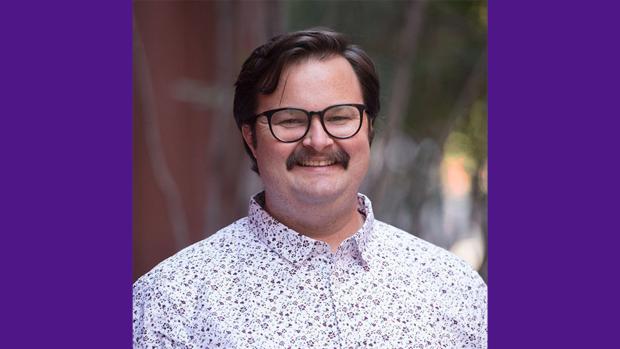
When you step into the Dibner Library at NYU Tandon School of Engineering, you're entering more than just a repository of books and journals — you're accessing a gateway to knowledge that serves the entire engineering community.
At the helm is Samuel Putnam. His is a job that can sometimes be invisible to the students who spend countless hours at the library, but he plays a vital role in everyday life at our school.
Get to know more about him, below. (And FYI, if you happen to bump into him, he knows a ton of great dad jokes!)
What drew you to library science, and specifically to working in an engineering library?
My first library job was in 4th grade, reshelving books and checking materials in and out, so it seems like I was always drawn to libraries. Why I ended up at an engineering library specifically, might be a less interesting story. Open librarian jobs that are looking for candidates from outside the organization are just few and far between. I think a lot of librarians don’t envision themselves working in STEM libraries when they start their careers. But once I was in, I found I really enjoyed working with engineering students. My background is in history, sociology, and library science, which is a much needed lens for these students. I think my work here allows them to see their field differently.
How did your career path lead you to this role?
I started out in archives at a small history museum and then a large public university. From there, I migrated over to STEM libraries. I was an engineering librarian at the University of Florida for about five years before I came to NYU. One day, I got an email from the Associate Dean of Libraries here asking me to apply and the rest is history.
What experiences or positions were most formative in preparing you for the director position?
I have had really great bosses and really horrible bosses, which has greatly informed the kind of boss I want to be. But I have also had really nice bosses who were nonetheless not that effective and that informs my work, as well. I think someone in a leadership role should create opportunities for their employees and organizations and work to remove roadblocks.
Has your perspective on engineering education or library services evolved over the course of your career?
I had a narrow, prescriptive view on libraries when I first started out as a librarian. But I spent a lot of time early in my career talking to students and faculty about their needs and perspectives, which changed my approach.
Engineers need a lot of high-quality information to do their work but that has really been the bread and butter of libraries for ages. What I wasn’t seeing was how libraries can educate students to be critical of the information that they were using. I wasn’t seeing libraries expand their collections to include VR headsets or laptops or manga in support of their students. And I wasn’t seeing academic libraries react to current issues by supporting their students’ non-academic needs.
How do you balance physical collections with expanding digital resources, particularly given the rapid evolution of engineering research?
NYU Libraries is an e-preferred library, which means that if there is an electronic copy, we will buy that before a physical copy. So our physical collection is going to stay the same size (around 20,000 items) but our electronic library will continue to grow. This way we can maintain everyone's access to the most recent research while also keeping the classics on the shelves.
What services have you found most effective in supporting engineering students' unique research and learning needs?
I think our students really appreciate having collaborative spaces in the library to study and learn alongside each other. Engineering work is group work, and we want to be a library that provides the resources to facilitate that.
Is AI affecting what resources you provide and how students conduct research?
This latest AI boom is really a watershed moment for higher education. Faculty are asking us about it, students are asking us about it, librarians are talking about it.
For better or for worse it is affecting everything right now. One thing that we are grappling with currently is academic AI platforms. ScienceDirect, Scopus, and JSTOR (just to name a few) have all added AI products that accompany their platforms, which the libraries have chosen to not license at this time. There are also a number of independent platforms that email me and my colleagues regularly, asking us to license their AI platform. And NYU has added Google Gemini and NotebookLM as well as its own LLM. It’s everywhere.
As a librarian, I have always believed in quality over quantity and, for most academic applications, AI falls short on quality. AI also shortcuts the learning process. The act of searching for and discovering information is part of the learning process (even if most people don’t view it that way). If you are having trouble finding resources for your work, I would suggest reaching out to the library. That’s our expertise and we are here to help.
What's your vision for the library's role as engineering education continues to evolve?
I would like to see the libraries integrated into the curriculum to a greater degree than we are now. We just completed a great partnership with Intro to Engineering to add more information literacy content and have had great partnerships with EWP for years. But I think we still have less contact with our community than we did 30 years ago. Fewer students know what a call number is and more are relying on Google and AI to begin their search for information. I think it is our job to make students and faculty better and more knowledgeable consumers of information.