
NYU Tandon’s newest industry professors

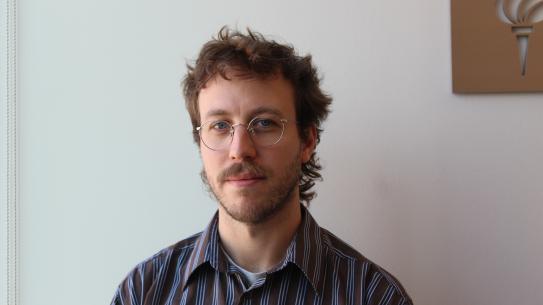
Qian Wang and Alon Hillel-Tuch
Industry professors have significant professional experience working in their field outside of academia, and they bring real-world expertise, practical knowledge, and the ability to connect theories and concepts to hands-on applications.
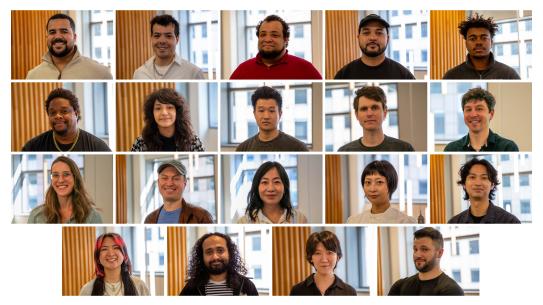
We caught up with some of the most recent industry professionals to join our faculty to find out more about them and how they view their roles.
Alon Hillel-Tuch
Industry Assistant Professor of Computer Science and Engineering
Can you tell us about your academic and professional journey?
After graduating from Hamilton College, I spent several years in industry before returning to graduate school at Columbia to study negotiation and conflict resolution; I later served as a research fellow at the Earth Institute's Advanced Consortium for Conflict, Complexity, and Cooperation. I also trained in computer science and cybersecurity at NYU.
My career has spanned founding a crowdfunding platform (RocketHub, which was later acquired), building payment systems, partnering with governments and NGOs globally, and managing an early-stage fund focused on deep, frontier, and infrastructure technologies. I've also been involved in policy work, advising regulators and testifying before Congressional subcommittees on technology issues.
The common thread throughout has been turning ideas into systems people can trust, while staying focused on how technology shifts affect individuals and communities.
Why did you decide to teach?
Because fundamentals paired with critical thinking can change trajectories. In our fast-moving industry, I want students to carry durable concepts forward — ones that help them navigate new tools with good judgment and build responsibly. It's about understanding the process behind real systems, reasoning from first principles, and always considering how our choices affect people.
What's the biggest advantage you bring as an industry professor?
I connect theory to practice, showing how first principles apply to real constraints. These constraints come from everywhere: regulatory mandates, internal company strategies, resource limitations, legacy systems, security requirements, and emerging spaces where the rules are still being written. We learn to identify stakeholders, craft the right assumptions, and validate them as technology, policy, and incentives shift.
What courses are you teaching?
Currently, I am focused on graduate-level Application Security and Computer Networking courses. AppSec covers threat modeling, secure design, testing, and balancing trade-offs in real systems. Networking moves from fundamentals to performance measurement, with hands-on labs that make protocols tangible.
Do you have an overall teaching philosophy?
It comes down to connecting your work, being able to clarify and reason, and then moving towards creation. To explain further:
Connect – Link fundamentals to real-world impact. Show how concepts affect people, systems, and communities, making learning relevant and grounded.
Clarify – Make thinking transparent through clear explanations, documented reasoning, and explicit trade-offs. Understanding why is as important as knowing how.
Create – Enable learning through hands-on experience: labs, prototypes, and experiments within realistic constraints. Students learn best by doing, testing, and iterating.
How do you measure success in your class?
Through evidence of critical thinking grounded in fundamentals. Students should be able to analyze any new technologies, understanding what they solve for (if at all), their trade-offs, and whether they're relevant to their work and goals. They can explicitly state assumptions and continuously validate them. Finally, they demonstrate lasting practices: readable work, proper verification, clear documentation of thought process, and ethical reasoning that extends beyond the classroom
Do you have any advice for students?
Lead with curiosity and kindness. Start from fundamentals, write down your assumptions, and test them regularly. Look for where systems bend or break, then design for resilience. Build small and often, document as you go, and remember that there's a person behind every interface. And please use office hours: I’m here to help!
Qian Wang
Industry Professor of Civil and Urban Engineering
Can you tell us about your academic and professional journey up until now?
I was a practicing structural engineer for six years, which gave me a profound appreciation for the practical application of engineering principles. I eventually realized that my greatest fulfillment came from mentoring and guiding students. This led me to transition into academia, where I've spent the past 13 years as an engineering professor, focused on bridging the gap between theory and practice and preparing students for the real-world challenges of the profession.
Why did you decide to teach?
I am dedicated to mentoring the next generation of engineers. My goal is to foster a love for problem-solving and critical thinking in my students, so that they can go on to innovate and build a better world. Helping my students succeed gives me a great sense of achievement.
What do you think is the single biggest advantage you bring to the classroom as an industry professor?
My biggest advantage is the holistic perspective I can provide. Having worked as both an engineer and a professor, I've seen the lifecycle of a project and a career. I can speak to students about what a day in the life of a professional engineer is really like, the different career paths available to them, and the skills that truly matter in the industry. This helps me prepare them for a successful career, not just for a single class or a single exam.
What course/s are you teaching?
I'm teaching a required course in structural engineering, which is a critical building block for all civil engineers. I'm also teaching a specialized course in steel design. My focus is on ensuring a seamless progression for students, helping them master the core concepts and build a solid foundation so they are well-prepared for their capstone design projects and future careers.
Do you have an overall teaching philosophy?
My teaching philosophy is built on developing a deep, conceptual understanding of the subject matter. I believe that building a strong foundation in core principles is the most effective way for students to achieve true mastery. Instead of just memorizing facts, I encourage students to actively engage with the material through hands-on examples and open discussion, which gives them the intellectual agility to solve new challenges and adapt to the ever-evolving demands of the profession.
How will you measure success in your class?
I measure success on three levels. First, academic mastery is measured through traditional exams and assignments, where I'm looking for a deep, conceptual understanding, not just memorization. Second, active engagement is gauged by their participation in class and their collaboration on group projects. Finally, I measure personal growth through their ability to apply core concepts to new challenges, their increased interest in the topics, and their confidence in their own abilities.
Do you have any advice for students?
My advice for students centers on three key areas: passion, work ethic, and the ability to lead and communicate effectively. My years in the industry taught me that technical skills are just the baseline. What really sets a person apart is their passion for solving problems, their commitment to putting in the hard work, and their ability to communicate and lead. I encourage students to practice these qualities in all their courses and projects, not just for a grade, but to prepare for a successful career.