
An Integrated Design & Media project immerses students in a whole new world

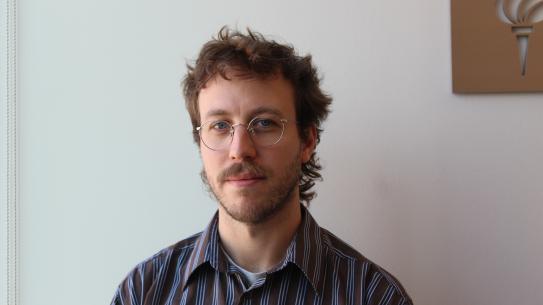
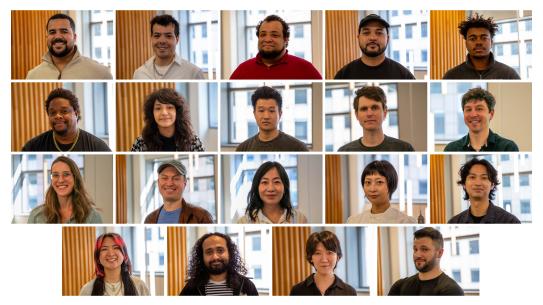
Standing left to right: Justin Melillo (founder of the MONA platform that will host wwwanderkammer), Carla Gannis, Caroline Guo, Pua Farm, and Sohini Paul.
Since 2018, Industry Professor Carla Gannis has been working on a long-term digital-art project she calls wwwunderkammer. She draws upon the idea of wunderkammern, known in English as cabinets of curiosities, which first became popular in mid-16th-century Europe, where collectors displayed natural specimens, diagrams, and other interesting or exotic objects; often they were part fact and part fantasy, operating at the intersection of science and speculation or superstition, and Gannis’s version reimagines that rich concept for a post-human, post-colonial, post-singularity world.
Inviting viewer-participants to consider how they interact with the virtual every day in the form of culture, dreams, fantasy, and ideologies, wwwunderkammer currently contains several thematic cabinets — ranging from obsolete technology to humor, feminist digital culture, decolonial knowledge, and emerging ecosystems — all layered with metaphor, memory, and resistance.
Long hosted on Mozilla Hubs, the project was recently forced to find a new home when the company announced it was withdrawing support from that metaverse platform. With one door closing, however, others opened, and as Gannis prepared to migrate wwwunderkammer to Unity 6, she broadened her vision, which now encompasses both the archival reconstruction of the original wwwunderkammer and a narrative prequel, peopled by an avatar she has dubbed C.A.S.S.A.N.D.R.A. — the Compassionate and Altruistic Semi-Sentient Assistant and Negotiator of Dreams, Rationality, and Aspiration.
Gannis, who recently contributed an essay to the book Human-Computer Creativity: Generative AI in Education, Art, and Healthcare, recruited a trio of students to work on the project, which was made possible by a New York State Council on the Arts grant ("Preservation of Virtual Worlds at NYU Tandon at The Yard"), the Tandon Undergraduate Summer Research Program (UGSRP), and consulting support from TRANSFER Data Trust. Read more about the students below
Sohini Paul
Tell us a little about your background.
I grew up in Hyderabad, in southern India, and I attended an International Baccalaureate program that allowed me to study design and visual art. One of my projects involved making yarn for textiles from plastic bags and other discarded items. I realized that art didn’t have to mean only things hung up on a wall.
What part have you played in the project?
I have worked a lot on C.A.S.S.A.N.D.R.A., animating the 3D forms. The narrative has snowballed, and now she introduces viewers to the background of the wwwunderkammer. The idea is that she’s living in a sort of digital exile where she constructs what Carla has called “a sanctuary of memory, myth, and resistance,” and now, we’ve come along to reconstruct her digital chambers. Carla has written that the project “bridges speculative fiction and practical preservation.” The world we’re recreating never existed, but maybe it should have!
What have you learned thus far on the project, and how do you foresee drawing upon that knowledge in your future career?
I had used some of this software before coming to Tandon, but I would have never described myself as tech-savvy, so I’ve gained confidence in that area. Carla has taught us the workflow and tools needed to refine an idea and execute it. I have broad interests, so when I think about my future, I can imagine working in a variety of realms, as long as they involve creative direction. I love furniture design, for example: it forces you to think about how people interact in an environment, and your work can last for generations.
Caroline Guo
Tell us a little about your background.
I grew up in China, but I personally felt that an environment with little encouragement for individuality and creative expression wasn’t the best fit for me. I thought that it would be better in the U.S., so from 2018 to 2022, I attended high school in North Carolina, which is a coincidence because that’s where Carla grew up.
I had just really gotten settled in when the COVID-19 pandemic hit. I didn’t have a driver’s license, and I couldn’t travel home, so I felt stuck. I ended up playing a lot of video games, but it wasn’t just for fun; I began to think about them on a deeper level.
I had a good guidance counselor who seemed to “get” me. She steered me towards interactive design but advised me to think on a broader scale – well beyond just video games. Integrated Design & Media turned out to be the perfect fit.
What part have you played in the project?
I’m helping fabricate the artifacts in the wwwunderkammer and working to reconstruct the world using Unity 6 instead of Mozilla Hubs. We’re also migrating from SteamVR, which is no longer supported, to OpenXR, which allows for universal XR inputs from a variety of VR headsets.
It’s a little ironic that I’m working in the XR space, because I suffer from motion sickness, but we’re working on making the camera movement smoother and fixing interaction issues.
What have you learned thus far on the project, and how do you foresee drawing upon that knowledge in your future career?
I really appreciate learning Unity 6, and I’ve honed my ability to incorporate humor into effective storytelling. We work mainly at the Navy Yard, and there’s equipment here that I never dreamed I’d have the chance to become familiar with. It’s like a playground for anyone interested in interactive design, and the experience I’m getting is invaluable.
Pua Farm
Tell us a little about your background.
I’m half native Hawaiian and half Chinese, and I grew up on Maui. From preschool until I graduated from high school, I attended a Hawaiian immersion program, where I learned about our history and culture. I also learned to speak our mother tongue, which is called ʻŌlelo Hawaiʻi. At one point, it was in danger of dying out, but now younger people are learning it, growing it, and it’s still a living language.
I was uncertain what I really wanted to do after that, and it was hard for me to decide on a college. I did some searching on the West Coast but ultimately decided I wanted to be in New York City at NYU; the diversity here reminds me of Maui. I decided upon majoring in electrical engineering but pretty quickly realized it wasn’t for me. A friend was in the IDM program, and I decided to give that a try. I had always liked art and design — I had even considered fashion design as a career at one point — so, luckily, IDM turned out to be a much better match for me.
What part have you played in the project?
I work a lot on social VR, which involves virtual worlds in which people can interact not just with their surroundings but with each other through their avatars. In this new iteration of wwwunderkammer, we wanted to increase the number of interactivities so that the experience would be even more immersive. We want to ensure that the avatars are as expressive as possible and that they can teleport from one virtual space to another smoothly.
Successful social VR helps build connections across physical boundaries, and that aspect of my work is important to me.
What have you learned thus far on the project, and how do you foresee drawing upon that knowledge in your future career?
I’ve found I love working with my hands, and I want that to be a part of anything I do in the future. Carla holds space for us to talk about our cultures, and I appreciate that chance to tie the technical knowledge I’m gaining to who I am as a person.
My aim is to use my education to contribute to Maui one day. I know that because Hawaiians revere nature, some people think of us as anti-science and technology. That’s not true at all, though.
Beyond the basic headset
Anyone who has ever put on a VR headset knows the aesthetics: sleek, boxlike, usually white.
But Gannis poses a question: what if the devices instead reflected the bodies, histories, and imaginations of their users?
As an extension of the wwwunderkammer project, she asked her students to reimagine the hardware and develop a series of speculative prototypes — not intended to work but to provoke critical thinking about the design ethics, aesthetics, and inclusivity of immersive technologies.
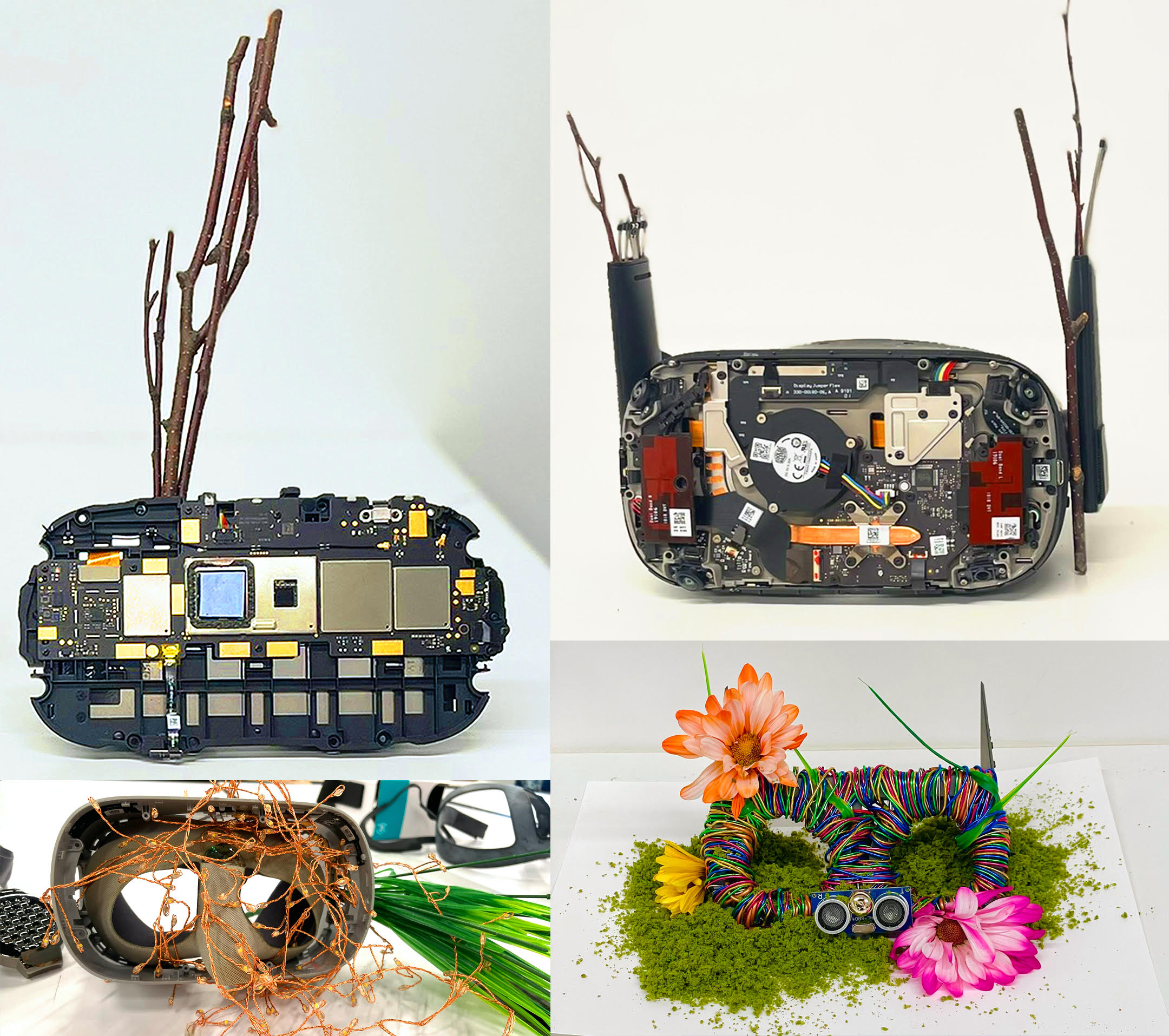
Drawing upon their personal backgrounds and cultures, the results are museum-worthy — adorned with Hawaiian leis, Indian-inspired jewels, and other elements. “I wanted them to ask themselves what if entering a virtual world felt more like a ritual than a product launch?” Gannis explains. While the prototypes are fantastical, their creation had a forward-looking, practical component. “We're also designing with the future of XR hardware in mind,” Gannis says, “imagining a time when advances in display and optical technologies allow for lighter, more compact, and less obtrusive devices.”