

Could Physics Replace the Computer Keeping Your Robot Upright?
Researchers have found that switching between two unstable states at exactly the right rhythm can produce stability, no sensors or computer controls required.
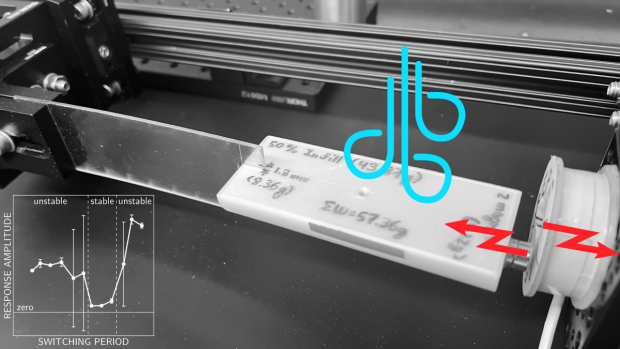
The "Frankenstein oscillator," with a graph of the results overlaid on top. Two separate forces each push the beam toward instability on their own. Switching between them at just the right rhythm produces the narrow "stable" window shown in the graph, where the beam's motion nearly disappears.
A new discovery in physics could help engineers stabilize robots and structures without relying on complex sensors and control systems, and design metamaterials and network systems that are presently beyond reach.
The finding, published in Nature Communications by researchers at NYU Tandon School of Engineering and Stony Brook University, shows that a mechanical system can be kept stable simply by switching between two behaviors at the right rhythm, even when neither behavior is stable on its own. No sensors watching the motion. No software constantly correcting it.
Once the timing is set, the physics does the rest.
Many machines must constantly stabilize their motion — keeping a walking robot from tipping over or preventing an aircraft wing from vibrating uncontrollably. Robots and other actively controlled systems typically do this by monitoring their environment and correcting their motion in real time, which requires sensors, processing power and software.
To test an alternative, the researchers built what they informally call the Frankenstein oscillator: a thin plastic strip fixed at one end with a small weight at the tip, subject to multiple loading conditions.
They then created two different kinds of instability. A magnetic coil pushed the beam away from its resting position in a way similar to a ball balanced on a horse’s saddle: if it moves slightly off center, it slides away in certain directions. A small fan blew air across the strip, feeding energy into the motion so that its swings grew larger rather than fading away, similar to how a playground swing rises higher when someone pushes at the right moment.
Both forces were switched on and off in carefully timed pulses.
The result was striking. Stability appeared only within a narrow band of switching speeds, with periods between roughly 218 and 238 milliseconds. Inside that window the beam stayed nearly still. Outside it, the motion quickly grew and the beam swung away.
Why should switching between two unstable behaviors make anything stable?
The idea builds on Kapitza's pendulum, named after Russian Nobel laureate Pyotr Kapitza. Vibrate the base of an inverted pendulum at exactly the right frequency and it stays upright, with no one watching or adjusting. Unlike a person balancing a stick on one hand, constantly shifting to stop it from falling, Kapitza's pendulum requires no such attention. Physics takes over.
In the classic case, the vibration provides a stabilizing effect, making the system virtually alternate between one stable and one unstable state. The new research asked a different question: what would happen if there were no stable states at all, if the physics were always pushing the system away from its resting position?
The answer depends on the type of instability involved. The “sliding” type — like the ball on the saddle — has one special direction in which motion actually shrinks instead of growing. The “swinging” type continually rotates the motion through different directions.
If the switching is timed correctly, that rotation can steer the motion into the shrinking direction before it has time to run away. The two instabilities, surprisingly, end up stabilizing each other.
“I have been thinking about the problem of stabilization of unstable systems through switching for over two decades,” said the paper’s senior author Maurizio Porfiri, an NYU Tandon Institute Professor and Director of both the NYU Urban Institute and the Center for Urban Science + Progress (CUSP). “In between ups and downs on the research, I was almost convinced that stabilization of two unstable systems would require some form of nonlinearity or even chaotic dynamics, but that is not the case: a simple, linear mechanical system can do the trick. The solution was in front of me for years, an extension of the marvelous ideas presented by Landau and Lifshitz in their Mechanics textbook that my uncle gave to me as a gift when I took my undergraduate dynamics class."
The researchers developed the theory first and then confirmed it experimentally with the beam. The narrow stability window they observed in the lab closely matched what the mathematical model predicted.
"Honestly, I had no belief that we would be able to demonstrate this phenomenon experimentally, as this involved working with a system that not only is unstable, but also features multiple sources of instability,” said Paolo Celli, Assistant Professor in Civil Engineering at Stony Brook University and co-corresponding author of the study. “The joy we felt when our carefully-designed experiment showed that narrow stability window is hard to explain. I am now super excited to see how this dynamic stabilization idea can be applied to other structural and robotic systems on the verge of instability"
The broader implication is a new design philosophy. Instead of always trying to eliminate instability, engineers may sometimes be able to build stable systems out of unstable pieces, harnessing the laws of physics rather than fighting them
The research was supported by the National Science Foundation through grants to both institutions. Along with Porfiri — who wrote about this research in a Behind the Paper post — and Celli, David Xiedeng — a Ph.D. student in Celli’s lab — is a co-author on the paper.