

Inside Ben Riviere's Quest to Bring Autonomous Intelligence to Space
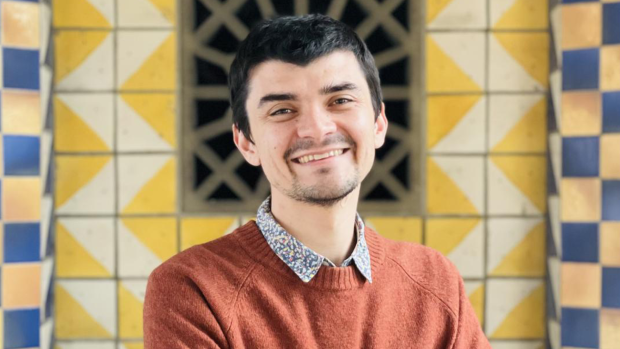
Benjamin Riviere is an Assistant Professor at NYU with a dual appointment in the Department of Mechanical and Aerospace Engineering at the Tandon School of Engineering and the Department of Computer Science at the Courant Institute of Mathematical Sciences
In the 54 years that separated the Apollo 17 mission and this year’s Artemis II flyby, a lot has changed, especially the economics of space flight. Launching a new satellite costs tens or hundreds of millions of dollars. The emerging alternative — refueling, repairing, or upgrading spacecraft already in orbit — could extend their lifespans dramatically and reshape the economics of the entire industry. But doing that safely requires autonomous machines that can operate without constant human input. That requires these robots to understand its environment, respond to unexpected failures, and make intelligent decisions in real time.
That's exactly the problem being taken on by Benjamin Riviere, Assistant Professor of Mechanical Engineering at NYU Tandon. "We work on algorithms that make robots smart," he says. And those smart robots are being designed for the autonomous servicing of spacecraft already in orbit.
"We want to understand robot-like autonomy sufficiently well, using machine learning models to control a robot, so that it becomes a safer option than a human operator," Riviere says.
In 2024, the Riviere Robot Lab had two papers accepted by Science Robotics. The results marked a shift in what the robotics community believes is computationally possible.
The first paper addressed what Riviere calls "real-time robot thinking", referring to the use of search algorithms for complex, messy, real-world problems. Conventional wisdom in the field held that search algorithms were too computationally expensive to work in dynamic environments. Riviere's team showed otherwise. They found a new way for robots to think at high speed, applying search in ways the field hadn't considered viable.
The second paper tackled a different challenge: low-level self-diagnosis. When a robot breaks, when a joint fails, a sensor drifts, or a motor underperforms, how does it know? And how does it adapt without human intervention? Riviere's algorithm figures out what is broken and responds accordingly, a capability that is essential for any robot operating autonomously in a remote or inaccessible environment.
Together, the two papers address both ends of the intelligence stack: high-level decision-making and low-level fault awareness. The implications for space robotics, where a technician is simply not an option, are significant.
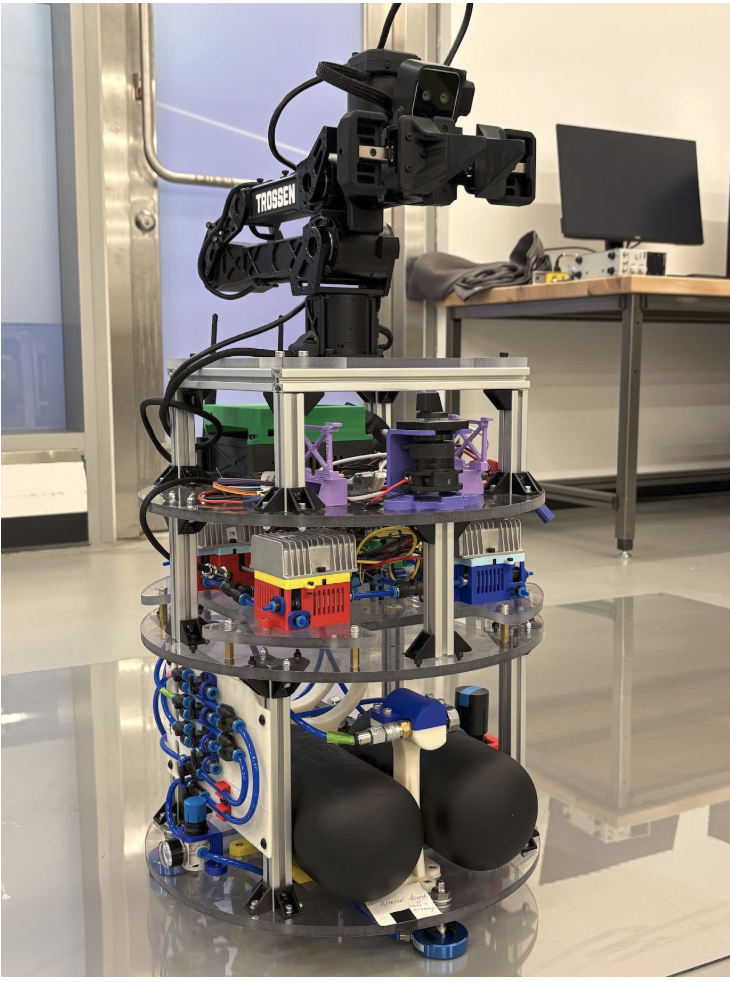 One of the most vivid applications of this work sits at the intersection of robotics and environmental stewardship: spacecraft that act as orbital cleanup crews, collecting and removing the debris that now clutters low Earth orbit. It's a problem that grows more urgent with every launch, and Riviere's lab is among those working on the technical groundwork to make it possible.
Progress is real, if measured. The lab is partnering with space agencies and local companies, including collaborators who are preparing to launch within the next two to three years. But Riviere is candid about the timeline for full autonomous intelligence.
"Studying robot intelligence will take a lot that we can't predict as of right now, but it is still a main area of research," he says. "Insurance, risk, the science of autonomy and intelligence, there are short-term milestones, but we're still a long way from fully understanding it." The conversation around AI and how it will reshape everything, including what autonomy even means, adds another layer of complexity and possibility.
"We want to understand robot-like autonomy sufficiently well so that it becomes a safer option than a human operator."
From Stanford and Caltech to Brooklyn
Riviere's path to NYU Tandon wound through two of the country's most storied engineering institutions, Stanford and Caltech, before landing him in Brooklyn. The draw, he says, wasn't just a job offer. It was an environment.
"The department has created a center for robotics and a collaborative space with a lot of PIs working together," Riviere explains. "It's a positive and fun environment, intellectually exciting. About half the department sits at the intersection of mechanical engineering and robotics, which is inherently interdisciplinary. There aren't a lot of boundaries here. You have the option to work on what you actually want to work on."
The staff culture mattered too. Friendly, open, and genuinely invested, qualities that aren't guaranteed even at the most prestigious institutions. For a researcher whose work demands creative freedom and cross-disciplinary collaboration, NYU Tandon offered something the others couldn't quite match.
"There aren't a lot of boundaries here. You have the option to work on what you actually want to work on."
Clearing the Final Frontier: Space Debris and the Road Ahead
Riviere's ambitions extend into the classroom. He teaches a graduate-level course on autonomous space robots, a course unlike almost anything else being offered at the master's level in the country.
"It's aimed at students who already have some experience with systems and want to learn more about space," he says. "But not having prior space experience is completely fine, the course is built around a project." That project-first structure creates space for genuine creativity. Last year's cohort explored ideas ranging from rockets and robotics to spacecraft swarms and space telescopes, a breadth that reflects the course's deliberately open-ended design.
The kind of student Riviere is hoping to see walk through the door: curious, technically grounded, and ready to think at the systems level about problems that don't yet have clean answers.
Riviere came to academia from a place of genuine choice. Industry was an option, and in many ways an easier one. But the freedom to study what he wanted, to take an idea from zero to one on his own terms, and to do it alongside students who are themselves just beginning to discover what's possible, that combination proved more compelling.
"Teaching is fun," he says simply. "There's more freedom to study what I wanted. Industry research has its place, but I really enjoy taking ideas from zero to one and working with students."
The moment that hooked him into research sits at the core of what he still finds meaningful. It was when his first paper came together, not just the result, but the experience of building an intellectual argument from scratch, finding the right way to communicate an idea, and then watching it open into new questions.
"There was a moment, creative and intellectual, where I thought: this is it," he recalls. "Thinking about how to communicate an idea, building on it or going in a different direction. Having a continual creative process that's both intellectual and social. Talking to colleagues. That's what I love about this work."
"There was a moment, creative and intellectual, where I thought: this is it."
The Riviere Robot Lab is accepting graduate students interested in space robotics and autonomous systems. For information on joining the lab or on the graduate course in autonomous space robots, contact the Department of Mechanical and Aerospace Engineering at NYU Tandon.

