
C2SMART and Port Authority of New York and New Jersey Launch Pilot Project to Automate Airport Traffic Monitoring With AI
Computer vision system analyzes camera feeds to detect highway congestion and monitor terminal curbside activity
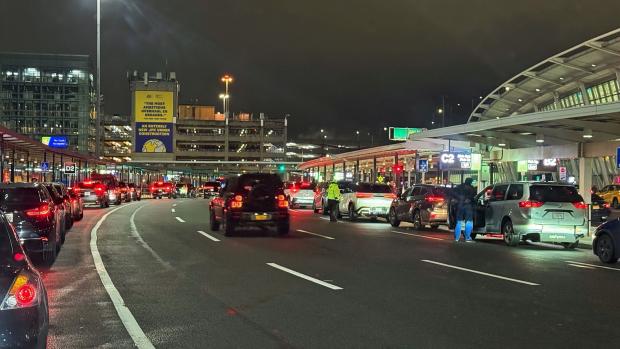
Traffic at JFK airport's Terminal 4. Photo credit: Jingqin Gao
Managing the constant flow of cars, taxis, and shuttles arriving at and circulating around airports presents a complex operational and planning challenge. Today, airport operators often rely on watching banks of camera screens around the clock to support tasks such as estimating queue lengths or curbside congestion.
This labor-intensive approach limits quick responses to congestion and makes it nearly impossible to gather the comprehensive data needed to evaluate whether changes actually work.
NYU Tandon School of Engineering's C2SMART transportation research center partnered with the Port Authority of New York and New Jersey (PANYNJ)—which runs JFK, LaGuardia, and Newark airports—to apply artificial intelligence to help solve this persistent operational challenge. Their approach offers a roadmap for airport operators worldwide.
Over a year-long collaboration, the research team adapted computer vision—AI that enables computers to "see" and interpret visual information—to work with existing airport cameras, automatically extracting actionable traffic data from video feeds without active human monitoring.
"What makes this research especially valuable is that it is designed specifically for fast-paced and complex airport operations," said Jingqin Gao, the project's Principal Investigator (PI) and C2SMART's assistant director of research. "Wide-angle cameras, intense stop-and-go activity, drivers forming informal lanes, and passengers loading and unloading in active travel lanes— these conditions make airports fundamentally different from typical roadways."
The project offers two primary applications.
The first is an advanced queue detection system which monitors airport approach highways and ramps, automatically detecting when traffic begins to back up. The system tracks vehicle speeds and measures how far queues extend across multiple highway regions, immediately alerting operators as congestion builds. Staff can respond quickly by redirecting traffic, deploying additional personnel to problem areas, or adjusting operations before backups worsen.
The system is specifically customized to detect moving queue dynamics, capturing slow-rolling congestion that traditional queue detection methods may not fully capture.
The system adjusts for camera angles by mathematically transforming angled camera views into bird's-eye perspectives, ensuring vehicles are measured accurately regardless of their
position in the frame. Over time, this continuous data collection can enable airports to evaluate whether infrastructure changes like roadway adjustments actually improved traffic flow by comparing traffic patterns before and after modifications.
The second application monitors terminal curbside areas, where constant passenger pickups and dropoffs create complex traffic patterns.
The system tracks vehicle counts by type and lane occupancy rates, and alerts staff when vehicles dwell beyond designated time limits. It also monitors passenger activity in travel lanes. This helps operations staff identify bottlenecks in real time and understand which lanes are being used efficiently.
The researchers developed a data-centric training approach, customizing the AI using carefully labeled images drawn from real airport operating conditions. This targeted training achieved approximately 90% accuracy detecting passenger cars and improved shuttle bus detection from 57% to 96%.
"The analytical power of this system is significant," said Kaan Ozbay, C2SMART's director and the project's co-PI. "This gives airports objective evidence to evaluate infrastructure investments. Did that new terminal layout actually reduce congestion? Did the roadway redesign improve traffic flow? Now airports can answer these questions with detailed, automated analysis instead of relying on limited manual observations."
To demonstrate the effectiveness of the AI tools, researchers conducted a case study on JFK Terminal 4's remote for-hire vehicle operation, which uses shuttle buses to transport passengers from the terminal to a parking lot for taxi and ride-share pickup. The analysis compared curbside traffic conditions before and after implementing this approach, revealing a 15% reduction in traffic density along with shorter dwelling times across most lanes.
“As we continue advancing a historic capital program across our airports, delivering a world class passenger experience remains central to our mission,” said Asheque Rahman, JFK Redevelopment Senior Program Traffic Engineer for the Port Authority of New York and New Jersey. “By leveraging innovative, data-driven tools to better manage roadway and curbside operations, we are improving reliability, reducing congestion, and helping ensure that the millions of passengers who travel through our facilities each year benefit from a more efficient, predictable, and less stressful journey.”
Beyond these specific applications, the core innovation lies in a scientific framework that tailors AI to the high-stress, unpredictable variables of airport landside infrastructure. Unlike generic models, this 'Context-Adaptive' methodology transforms existing, non-specialized camera feeds into a high-fidelity data network capable of decoding unique travel behaviors at airport landside.
The project proves that AI can be engineered as a bespoke, scalable layer of intelligence that interprets complex 'micro-geographies,' and offer insights for turning complex transportation
hubs into responsive, self-analyzing systems without the need for costly infrastructure overhauls.
Multiple divisions of PANYNJ participated in this project, with Traffic Engineering leading the overall effort, supported by the JFK Airport Operations Center and Landside Operations teams.
Along with Gao and Ozbay, the NYU Tandon team members involved in this project are Fan Zuo, a postdoctoral associate; Donglin Zhou, a master’s degree student; and Holly Chase, the project manager.