
Alum Erol Gelenbe (’68, '70) is elected as a Fellow of the Indian National Science Academy
The pioneering researcher is celebrated for his seminal contributions to computer networks and systems

Even a partial list of Erol Gelenbe’s laurels reads a bit like the itinerary of a whirlwind global tour.
Right here in Brooklyn, he was honored with the 2010 NYU Tandon School of Engineering Distinguished Alumnus Award, but that’s just a starting point. From France comes the insignia of Commandeur de l’Ordre National du Mérite (Commander of the National Order of Merit), the insignia of Chevalier de la Légion d’Honneur (Knight of the Legion of Honor), the Prix France-Telecom from the French Academy of Science, and membership in the National Academy of Technologies of France.
From elsewhere in Europe, he holds the London Institution of Engineering and Technology (IET) Oliver Lodge Medal and the titles of Knight Commander of the Order of the Star of Italy and Commander of Merit of the Republic of Italy, Commander of the Order of the Crown of Belgium, and Officer of the Order of Merit of Poland. Then, there are the Fellowships in the Royal Academy of Sciences, Arts and Letters of Belgium; the Polish Academy of Sciences; the Hungarian Academy of Sciences, which awarded him its Dennis Gabor Prize; the Turkish Academy of Sciences; and Academia Europaea, and an Honorary Fellowship in the Islamic World Academy of Sciences.
And that’s not to mention the Association for Computer Machinery (ACM) Lifetime SIGMETRICS Achievement Award, the Mustafa Prize in Information and Communication Science and Technologies from the Organisation of Islamic Cooperation (OIC) member states; and the Institute of Electrical and Electronics Engineers (IEEE) Meritorious Service Award and Computer Society Meritorious Service Award — along with Fellowships in the IET, ACM, IEEE, International Federation for Information Processing (IFIP), and Royal Statistical Society (RSS).
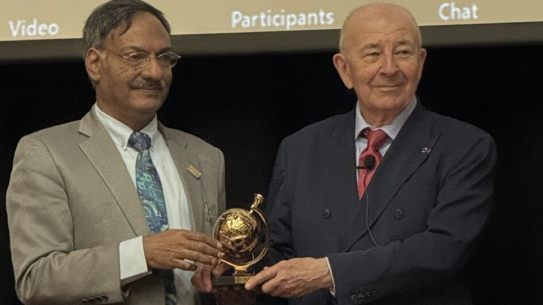
Gelenbe — who founded and directed the Modeling and Performance Evaluation of Computer Systems research group at the renowned INRIA research institution in France, Chaired the Electrical and Computer Engineering Department at Duke University, was Director of the School of EECS at University of Central Florida, held the Dennis Gabor Chair at Imperial College London, and is now a professor at the Institute of Theoretical & Applied Informatics in Poland — recently added another country to that already impressive list: this year, he was elected a foreign fellow of the Indian National Science Academy (INSA), based in the capital of India, which was established in 1935 and is now widely acknowledged as that nation’s premier scientific academy.
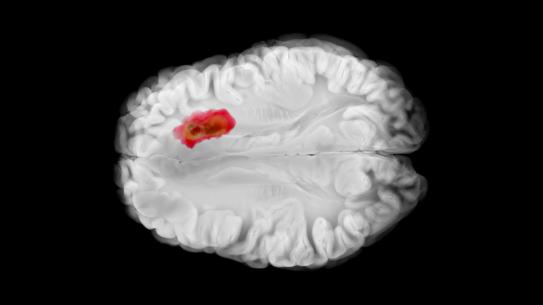
The INSA (New Delhi) cited his seminal and pioneering research: Gelenbe designed and patented the world’s first many-to-many packet-voice telephone switch some 20 years before Zoom or Skype came into existence, and designed and built the first random-access Local Area Network that used fiber-optic connections some years before Ethernet became a de facto standard. His other fundamental contributions include the development of mathematical models known as G(elenbe)-networks for the analysis and optimization of communication networks with widespread applications like traffic re-routing and network optimization, the invention of the Random Neural Network with applications in deep learning, and adaptive network routing and anomaly detection both in networks and brain scans.
"To be elected a Foreign Fellow of the prestigious Indian National Science Academy is a profound honor, adding a crucial Indian chapter to a career of truly global recognition in the field of information and communication science,” Senior Vice Dean Eray Aydil said. “It is a testament to the universal impact of Professor Gelenbe's pioneering work, from inventing the first packet-voice switch to developing the foundational G-networks."