

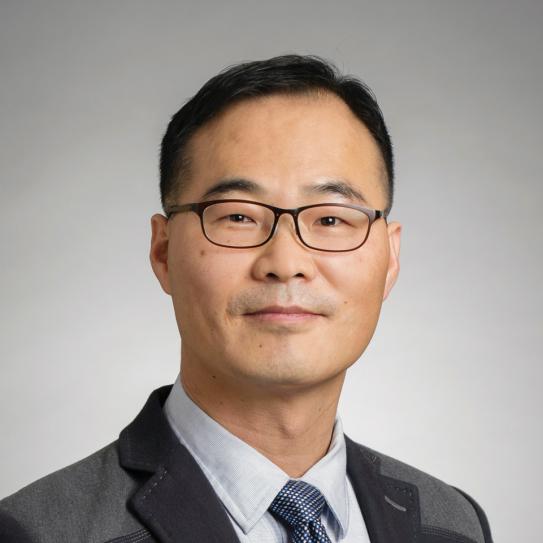
Dr. Kim’s research focuses on the development of mathematical and computational models of transport-related biological systems, which includes characterization of light-tissue interaction, 3D tomographic imaging of physiologically relevant parameters in biological systems such as oxy-hemoglobin and deoxy-hemoglobin, 3D molecular imaging, and modeling of chemical species transport.
Dr. Kim has been applying these models and related technologies in preclinical and clinical studies that focus on the ultrahigh spatiotemporal resolution direct imaging of neuronal brain imaging, diagnosis of rheumatoid arthritis and Lupus in finger joints, the early detection and treatment monitoring of breast cancer, imaging of prostate cancer and risk stratification, cancer diagnostics and drug efficacy based on fluorescence and bioluminescence molecular imaging, assessment of peripheral arterial disease, Melanoma early diagnosis, and detection and monitoring of infantile hemangiomas.
Experience
Columbia University, New York, 2020-2022 Associate Professor, Department of Radiology
Columbia University, New York, 2011-2019 Assistant Professor, Department of Radiology
Columbia University, New York, 2009-2011
Associate Research Scientist, Department of Biomedical Engineering
Education
Columbia University, New York, 2006-2008
Postdoctoral Research Scientist, Department of Biomedical Engineering
Korea Advanced Institute of Science & Technology (KAIST), South Korea, 2001-2004 PhD, Department of Mechanical Engineering
Korea Advanced Institute of Science & Technology (KAIST), South Korea, 1999-2001 MS, Department of Mechanical Engineering
Publications
1. H.K. Kim, Y. Zhao, A. Raghuram, J. T. Robinson and A. N. Veeraraghavan, A.
Hielscher, " Ultrafast and Ultrahigh-Resolution Diffuse Optical Tomography for Brain Imaging with Sensitivity Equation based Noniterative Sparse Optical Reconstruction (SENSOR)," accepted to Journal of Quantitative Spectroscopy and Radiative Transfer, 107939 (2021)
2. Y. Zhao, A. Raghuram, H.K. Kim, A. Hielscher, J. T. Robinson and A. N. Veeraraghavan, "High Resolution, Deep Imaging Using Confocal Time-of-flight Diffuse Optical Tomography," IEEE Transactions on Pattern Analysis and Machine Intelligence (2021), doi: 10.1109/TPAMI.2021.3075366.
3. L. Altoe, K. Kalinsky, A. Marone, H.K. Kim, Hua Guo, H. Hibshoosh, M. Tejada, Ka. Crew, M. Accordino, M. Trivedi, D. Hershman, and A.H. Hielscher, “Changes in diffuse-optical-tomography images during early stages of neoadjuvant chemotherapy correlate with tumor response in different breast cancer subtypes, Clinical Cancer Research 27(7):1949-1957 (2021)
4. Y. Kim, A. Marone, G. Danias, W. Tang, H.K. Kim, A.D. Askanase, I. Kymissis, A.H. Hielscher, “A flexible optical imaging band system for the assessment of arthritis in patients with systemic lupus erythematosus,” Biomedical Optics Express 12, 1651- 1665 (2021)
5. M.L. Altoe, K. Kalinsky, A. Marone, H. K. Kim, Hua Guo, H. Hibshoosh, M. Tejada, Ka. Crew, M. Accordino, M. Trivedi, D. Hershman, and A.H. Hielscher, “Effects of neoadjuvant chemotherapy on the non-tumor bearing breast assessed by diffusion optical tomography,” Breast Cancer Research 23(1):16 (2020).
6. M. L. Altoe, A. Marone, H. K. Kim, K. Kalinsky, D. L. Hershman, A. H. Hielscher, and R. S. Ha, "Diffuse optical tomography of the breast: a potential modifiable biomarker of breast cancer risk with neoadjuvant chemotherapy," Biomed. Opt. Express 10, 4305- 4315 (2019)
7. A. Marone, J. W. Hoi, M. A. Khalil, H. K. Kim, G. Shrikhande, R. Dayal, D. R. Bajakian, and A. H. Hielscher, "Modeling of the hemodynamics in the feet of patients with peripheral artery disease," Biomedical Optics Express 10, 657-669 (2019).
8. J. E. Gunther, E. A. Lim, H. K. Kim, M. Flexman, M. Altoé, J. A. Campbell, H. Hibshoosh, K. D. Crew, K. Kalinsky, D. Hershman, A. H. Hielscher, “Dynamic Diffuse Optical Tomography for Monitoring Neoadjuvant Chemotherapy in Patients with Breast Cancer,” Radiology 287(3), 778-786 (2018).
9. J. W. Hoi, H. K. Kim, C. J. Fong, L. Zweck, and A. H. Hielscher, "Non-contact dynamic diffuse optical tomography imaging system for evaluating lower extremity vasculature," Biomedical Optics Express 9, 5597-5614 (2018).
10. E. A. Lim, J. E. Gunther, H. K. Kim, M. Flexman, H. Hibshoosh, K. Crew, B. Taback, J. Campbell, K. Kalinsky, A. H. Hielscher, L. L. Hershman, “Diffuse optical tomography changes correlate with residual cancer burden after neoadjuvant chemotherapy in breast cancer patients,” Breast Cancer Research and Treatment 162, 533-540 (2017).
11. H. K. Kim, L. Montejo, J. Jia, A. H. Hielscher, “Frequency-domain optical tomographic image reconstruction algorithm with the simplified spherical harmonics (SP3) light propagation model”, International Journal of Thermal Science 116, 265–277 (2017).
12. H. K. Kim*, J. Jia*, A. H. Hielscher, “Fast linear solver for radiative transport equation with multiple right hand sides in diffuse optical tomography”, Journal of Quantitative Spectroscopy and Radiative Transfer 167, 10-22 (2015).(*Equal Contribution)
13. M. Khalil, H. K. Kim, J. W. Hoi, I. Kim, R. Dayal, G. Shrikhande, A. H. Hielscher, “Detection of Peripheral Arterial Disease Within the Foot Using Vascular Optical Tomographic Imaging,” European Journal of Vascular and Endovascular Surgery 49(1), 83-89 (2015).
14. J. H. Lee, H. K. Kim, C. Chandhanayingyong, F. Y. Lee, A. H. Hielscher, “Non-Contact Small Animal Fluorescence Imaging System for Simultaneous Multi-directional Angular-dependent Data Acquisition,” Biomedical Optical Express 5(7), 2301-16 (2014).
15. M. L. Flexman, H. K. Kim, J. E. Gunther, E. A. Lim, M. C. Alvarez, E. Desperito, A. H. Hielscher, “Optical biomarkers for breast cancer derived from dynamic diffuse optical tomography”, Journal of Biomedical Optics, 18(9) (2013).
16. L. D. Montejo, J. Jia, H. K. Kim, U. J. Netz, S. Blaschke, G. A. Muller, A. H. Hielscher,”Computer-aided diagnosis of rheumatoid arthritis with optical tomography”, Part 2: image classification. Journal of Biomedical Optics 18 076002 (2013)
17. L. D. Montejo, J. Jia, H. K. Kim, U. J. Netz, S. Blaschke, G. A. Muller, A. H. Hielscher, "Computer-aided diagnosis of rheumatoid arthritis with optical tomography, Part 1: feature extraction." Journal of Biomedical Optics 18, 076001 (2013)
18. S. R. Sirsi, M. L. Flexman, F. Vlachos, J. Huang, S. L. Hernandez, H. K. Kim, T. B. Johung, J. W. Gander, A. R. Reichstein, B. S. Lampl, A. Wang, A. H. Hielscher, J. J. Kandel, D. Y. Yamashiro, M. A. Borden, “Contrast Ultrasound Imaging for Identification of Early Responder Tumor Models to Anti-Angiogenic Therapy”, Ultrasound in Medicine and Biology 38(6), 1019-1029 (2012).
19. M. A. Khalil, H.K. Kim, I.-K. Kim, M. Flexman, R. Dayal, G. Shrikhande, A. H. Hielscher, “Dynamic diffuse optical tomography imaging of peripheral arterial disease”, Biomedical Optics Express 3, Issue 9, pp. 2288-2298 (2012).
20. H. K. Kim*, M. Flexman*, R. Stoll, M. Khalil, C. Fong, A. Hielscher, “A wireless handheld probe with spectrally-constrained evolution strategies for absolute chromophore measurements and dynamic imaging”, Journal of Biomedical Optics 17, 016014 (2012). (*Equal Contribution)
21. M. L. Flexman, F. Vlachos, H. K. Kim, J. Huang, S. L. Hernandez, T. J. Johung, J. Gander, A. Reichstein, B. S. Lampl, A. Wang, D. J. Yamashiro, J. J. Kandel, A. H. Hielscher, “Monitoring early tumor response to drug therapy with diffuse optical
tomography and magnetic resonance imaging”, Journal of Biomedical Optics 17,
016014 (2012).
22. M. L. Flexman, H. K. Kim, .E. Lim, E. Desperito, R. R. Barbour, D. Hershman, A. H.
Hielscher “Detecting Breast Cancer with Dynamic Diffuse Optical Tomographic Imaging”, Cancer Research 71(24), Supplement 3, doi: 10.1158/0008-5472.SABCS11- P2-10-09 (2011).
23. M. L. Flexman, M. A. Khalil, R. A. Abdi, H. K. Kim, C. J. Fong, R. R. Barbour, E. Desperito, D. Hershman, A. H. Hielscher, “Digital optical tomography system for dynamic breast imaging”, Journal of Biomedical Optics 16, 076014 (2011).
24. A. H. Hielscher, H. K. Kim, L. Montejo, S. Blaschke, U. Netz, P. Zwaka, G. Müller, J. Beuthan , “Frequency domain optical tomographic imaging of finger joints” , IEEE Transactions on Medical Imaging 99, pp. 1, (2011)
25. H. K. Kim, M. Flexman, D.J. Yamashiro, J. Kandel, and A.H. Hielscher, “PDE- constrained Multispectral Imaging of Tissue Chromophores Concentrations with the Equation of Radiative Transfer,” Biomedical Optics Express 1(3), 812-824 (2010).
26. H. K. Kim, A.H. Hielscher, “A diffusion-transport hybrid method for frequency domain optical tomography,” Journal of Innovative Optical Health Sciences 3, 1–13 (2010).
27. H. K. Kim, A.H. Hielscher, “A PDE-constrained SQP algorithm for optical tomography based on the frequency-domain equation of radiative transfer,” Inverse Problems 25, 015010 (2009).
28. H. K. Kim, U. Netz, J. Beuthan, A.H. Hielscher, “Optimal source-modulation frequencies for transport-theory-based optical tomography of small-tissue volumes,” Optics Express 16, 18082–18101(2008).
29. H. K. Kim, J. Lee, A.H. Hielscher, “PDE-constrained fluorescence tomography with the frequency-domain equation of radiative transfer,” IEEE Journal of Selected Topics in Quantum Electronics 16, 793-803 (2010).
Patents
-
JH Lee, HK Kim, LIM Emerson, AH Hielscher, “Transrectal Diagnostic Device,” US Patent
App. 16/303,706, published as US20200008737A1 on 2020-01-09.
-
AH Hielscher, M Khalil, R Dayal, IK Parrack, HK Kim, “Dynamic Optical Tomographic
Imaging Devices Methods and Systems,” US Patent App. 16/216,137, published as
US20190282134A1 on 2019-09-19.
-
AH Hielscher, ML Flexman, R Stoll, HK Kim, “Compact Optical Imaging Devices, Systems,
and Methods,” US Patent App. 16/129,925, published as US20190239751A1 on 2019-
08-08.
-
AH Hielscher, CJ Fong, J Hoi, HK Kim, M Khalil,” Monitoring Treatment of Peripheral
Artery Disease (PAD) Using Diffuse Optical Imaging,” US Patent App. 16/093,775,
published as US20190125195A1 on 2019-05-02.
-
HK Kim, AH Hielscher, “Tomographic Imaging Methods, Devices, and Systems,” US
Patent App. 16/211,693, published as US20190110024A1 on 2019-04-11.
-
A.H. Hielscher, H.K. Kim, L.D. Montejo, S. Blaschke, U.J. Netz, G.A. Mueller, J. Beuthan,,
“Medical Imaging Devices, Methods, and Systems,” Korean Application No. 2013-
7018117, based off PCT/US2011/064723 filed December 12, 2011, allowed September
27, 2018. (patent number pending)
-
H.K. Kim, A.H. Hielscher, “Tomographic Imaging Methods, Devices, and Systems,“ U.S.
Application No. 14/356,924 filed May 8, 2014; based from PCT/US2012/064163 filed
November 8, 2012, allowed September 19, 2018. (patent number pending)
-
A.H. Hielscher, C.J. Fong, J. Hoi, H.K. Kim, M. Khalil, M. Khalil, “Monitoring treatment of peripheral artery disease (pad) using diffuse optical imaging,“ PCT/US2017/029027 filed
2017-04-23, WO2017189376A1 filed 2017-11-02.
-
J.H. Lee, H.K. Kim, E. Lim, A.H. Hielscher, “Transrectal Diagnostic Device,” (PTC/US2017/
034800, WO2017205808A1), Application filed 2016-05-27, published 2017-05-26.
-
A.H. Hielscher, H.K. Kim, L. D. Montejo, “Systems, methods, and devices for image
reconstruction using combined PDE-constrained and simplified spherical harmonics algorithm,” (PCT/US2013/071269), US Patent No. 9,495,516 (issued November 15, 2016).
-
A.H. Hielscher, M. Khalil, R. Dayal, I.-K. Kim, H.K. Kim, “Dynamic Optical Tomographic Imaging Devices, Methods, and Systems,” Atty. Docket No. T4356-19064WO01, T4356- 18602US01; PCT/US2011/060489, US 13/876,861) US Patent No. 9,429,089 (issued November 15, 2016); Announcement to intention to grant by European Patent Office on June 15, 2015.
-
A.H. Hielscher, H.K. Kim, L. D. Montejo, “Medical Imaging Devices, Methods, and Systems,” Atty. Docket No. T4356-18601US01, PCT/US2011/064723, US 13/993,592), US Patent No. 9,486,142 (issued November 8, 2016)
13. H.K. Kim, A.H. Hielscher, “Tomographic Imaging Methods, Devices, and Systems,” (Columbia Invention Report # CU12119, PCT/US2012/064163, Application # US 14/356,924), filed November 8, 2012; National filings for US, Korea, Japan, and Europe submitted May 8, 2014; published October 23, 2014 (Publication No. 20,140,313,305)
-
A.H. Hielscher, M.L. Flexman, R. Stoll, H.K. Kim, “Compact optical imaging devices, systems, and methods,” (CU12093, PCT/US2012/058065, US 14/348,081), filed September 28, 2012; published August 28, 2014. (Publication No. 20,140,243,681)
-
A.H. Hielscher, H.K. Kim, L. D. Montejo, S. Blaschke, U. Netz, G.A. Mueller, J. Beuthan, “Medical Imaging Devices, Methods, and Systems,” (CU invention reports # M11-007 and M11-122, PCT/US2011/064747, US 13/993,578,) filed Dec 13, 2011; published on March 27, 2014 (Publication No. 20,140,088,415)
Research News
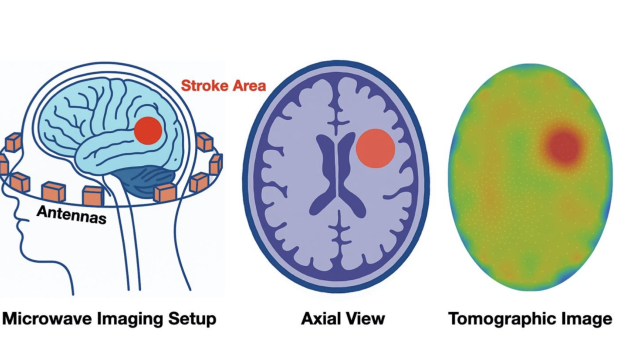
New Algorithm Dramatically Speeds Up Stroke Detection Scans
When someone walks into an emergency room with symptoms of a stroke, every second matters. But today, diagnosing the type of stroke, the life-or-death distinction between a clot and a bleed, requires large, stationary machines like CT scanners that may not be available everywhere. In ambulances, rural clinics, and many hospitals worldwide, doctors often have no way to make this determination in time.
For years, scientists have imagined a different world, one in which a lightweight microwave imaging device, no bigger than a bike helmet, could allow clinicians to look inside the head without radiation, without a shielded room, and without waiting. That idea isn’t far-fetched. Microwave imaging technology already exists and can detect changes in the electrical properties of tissues — changes that happen when stroke, swelling, or tumors disrupt the brain’s normal structure.
The real obstacle has always been speed. “The hardware can be portable,” said Stephen Kim, a Research Professor in the Department of Biomedical Engineering at NYU Tandon. “But the computations needed to turn the raw microwave data into an actual image have been far too slow. You can’t wait up to an hour to know if someone is having a hemorrhagic stroke.”
Kim, along with BME Ph.D. student Lara Pinar and Department Chair Andreas Hielscher, believes that barrier may now be disappearing. In a new study published in IEEE Transactions on Computational Imaging, the team describes an innovative algorithm that reconstructs microwave images 10 to 30 times faster than the best existing methods, a leap that could bring real-time microwave imaging from theory into practice.
It’s a breakthrough that didn’t come from building new devices or designing faster hardware, but from rethinking the mathematics behind the imaging itself. Kim recalls spending long nights in the lab watching microwave reconstructions crawl along frame by frame. “You could almost hear the computer groan,” he said. “It was like trying to push a boulder uphill. We knew there had to be a better way.”
At the heart of the problem is how traditional algorithms work. They repeatedly try to “guess” the electrical properties of the tissue, check whether that guess explains the measured microwave signals, and adjust the guess again. This is a tedious process that can require solving large electromagnetic equations hundreds of times.
The team’s new method takes a different path. Instead of demanding a perfectly accurate intermediate solution at every iteration, their algorithm allows quick, imperfect approximations early on and tightens the accuracy only as needed. This shift, which is simple in concept, but powerful in practice, dramatically reduces the number of heavy computations.
To make the process even more efficient, the team incorporated several clever tricks: using a compact mathematical representation to shrink the size of the problem, streamlining how updates are computed, and using a modeling approach that remains stable even for complex head shapes.
The results are striking. Reconstructions that once took nearly an hour now appear in under 40 seconds. In tests with real experimental data, including cylindrical targets imaged using a microwave scanner from the University of Manitoba, the method consistently delivered high-quality results in seconds instead of minutes.
For Kim and Hielscher, who have worked collaboratively for decades on optical and microwave imaging techniques, the speed improvement feels like a long-awaited turning point. “We always knew microwave imaging had the potential to be portable and affordable. But without rapid reconstruction, the technology couldn’t make the leap into real clinical settings,” Hielscher said. “Now we’re finally closing that gap.”
The promise extends far beyond stroke detection. Portable microwave devices could one day provide an accessible alternative to mammography in low-resource settings, monitor brain swelling in intensive care units without repeated CT scans, or track tumor responses to therapy by observing subtle changes in tissue composition.
The team is now focused on extending the algorithm to full 3D imaging, a step that would bring microwave tomography even closer to practical deployment. But the momentum is palpable. “We’re taking a technology that has been stuck in the lab for years and giving it the speed it needs to matter clinically,” Kim said. “That’s the part that excites us: imagining how many patients someday might benefit from this.”
Accelerated Microwave Tomographic Imaging with a PDE-Constrained Optimization Method, IEEE Transactions on Computational Imaging, VOL. 11, 1614 – 1629 (2025), Authors: Stephen H. Kim, Lara Pinar, and Andreas H. Hielscher.