
Ryan Hartman
-
Professor
-
Director of Faculty Awards, Office of the Provost
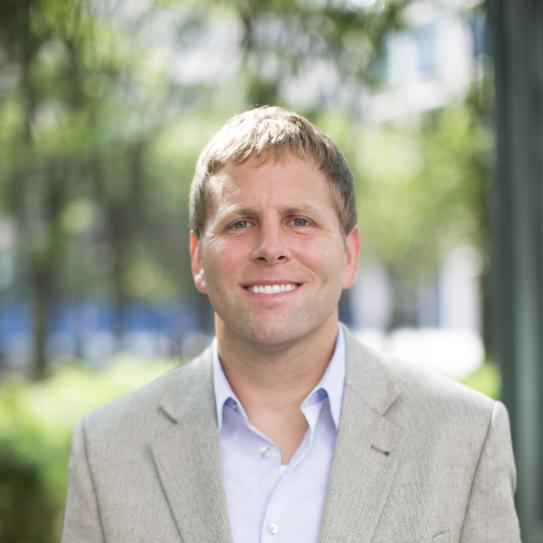
The Hartman Research Laboratory investigates impactful problems related to sustainability through application of chemical reaction engineering principles. In 2012, Prof. Hartman began investigating artificial intelligence for its application in computer-aided experimentation with microreactors. There is a need for autonomous laboratory-scale flow reactors that can high-throughput screen and generate sufficient experimental data to decipher reaction kinetics and mechanisms. Integration of in-situ spectroscopic methods with microfluidics and their automation creates the possibility of computers working synchronously with a handful of key experiments. Thus, the design of artificial intelligence and machine learning methods with continuous-flow microreactors for faster discovery has become a central theme in much of his research. Rethinking how laboratory experiments are performed can reduce the chemical waste, energy requirements, make experiments safer, and it can yield molecular-scale information needed for predictive models for applications in chemicals, energy, healthcare, and materials towards a sustainable future.
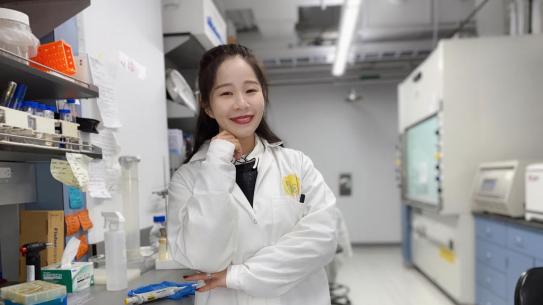
Ryan L. Hartman is Full Professor in the Department of Chemical and Biomolecular Engineering in the NYU Tandon School of Engineering. Prof. Hartman completed his postdoctoral research in the Department of Chemical Engineering at the Massachusetts Institute of Technology (Cambridge), his Ph.D. in Chemical Engineering from the University of Michigan (Ann Arbor), and his B.S. in Chemical Engineering from Michigan Technological University (Houghton). He is also NYU's Director of Faculty Awards and has served as Senator for NYU Tandon, on its Faculty Executive Committee, the Immediate Past Chair of NYU's Tenured/Tenure-Track Faculty Senators Council, and on NYU's Senate Executive Committee. He has also filled various leadership roles for the American Institute of Chemical Engineers (AIChE), the Past President and Current Member of the Executive Board of Directors of the International Symposia on Chemical Reaction Engineering (ISCRE), and Associate Editor of Reaction Chemistry & Engineering, a Royal Society of Chemistry Journal. He has been honored as Visiting Professor at The Dow Chemical Company, Visiting Assistant Professor of the Institute of Condensed Matter Chemistry of Bordeaux (ICMCB) CNRS, winner of the NSF CAREER Award, and a member of the National Academy of Inventors. Hartman returned to academia following his private sector career with Schlumberger Limited in which he developed global-scale energy technology by designing steady-state and unsteady-state, batch and continuous-flow, reactor methodologies.
Prof. Hartman's philosophy on the preparation of doctoral students revolves around critical thinking and creative problem solving, with emphasis on Socratic reasoning. Society needs independent thinkers who are capable of “peeling the onion” of large, complex problems to understand their governing fundamentals.
Education
Massachusetts Institute of Technology, Cambridge, 2010
Postdoctoral, Chemical Engineering
University of Michigan, Ann Arbor, 2006
Doctor of Philosophy, Chemical Engineering
University of Michigan, Ann Arbor, 2003
Master of Science in Engineering, Chemical Engineering
Michigan Technological University, Houghton, 2001
Bachelor of Science, Chemical Engineering
Experience
Full Professor (2024-)
New York University, Department of Chemical and Biomolecular Engineering
Associate Professor (2019-2024)
New York University, Department of Chemical and Biomolecular Engineering
Assistant Professor (2015-2019)
New York University, Department of Chemical and Biomolecular Engineering
Invited Visiting Assistant Professor (2015)
Institute of Condensed Matter Chemistry (CNRS), University of Bordeaux
Assistant Professor and Reichhold-Shumaker Fellow (2010-2015)
University of Alabama, Department of Chemical and Biological Engineering
Postdoctoral Associate, Novartis-MIT Center for Continuous Manufacturing (2008-2010)
Massachusetts Institute of Technology, Department of Chemical Engineering
Chemical Engineer III (2005-2007)
Schlumberger, Pressure, Pumping, and Chemistry, Sugar Land, Texas
Other Appointments
Associate Editor (2026-)
North America, Reaction Chemistry & Engineering
Chair (2024-2026)
NYU Tenured/Tenure-Track Faculty Senators Council
Visiting Professor (2023-2024)
Core R&D, The Dow Chemical Company
President (2023-2024)
International Symposia on Chemical Reaction Engineering (ISCRE), Inc.
Faculty Senate Council, Senator (2020-2023, 2024-2026)
NYU Tandon School of Engineering
Executive Board Member (2021-2033)
International Symposia on Chemical Reaction Engineering (ISCRE), Inc.
Faculty Senate Council, Alternate (2019-2020)
New York University
Catalysis and Reaction Engineering Programming Chair (2017-2021)
CRE Executive Board, American Institute of Chemical Engineers
Faculty Engineer in Residence (2016-2018)
New York University, Department of Chemical and Biomolecular Engineering
Reaction Engineering Programming Chair (2014-2016)
American Institute of Chemical Engineers
Adjunct Professor, Tri-Campus Materials Science Program (2011-2015)
University of Alabama, Department of Chemical and Biological Engineering
Department Quality Steering Committee Chair (2006-2007)
Schlumberger, Pressure, Pumping, and Chemistry, Sugar Land, Texas
Engineering Intern (2002, 2003-2004)
Schlumberger, Pressure, Pumping, and Chemistry, Sugar Land, Texas
Graduate Research Assistant/Fellow (2001-2005)
University of Michigan, Ann Arbor, Department of Chemical Engineering
Summer Chemical Engineering Intern (2000)
BASF Corporation, Vitamins Manufacturing, Wyandotte, Michigan
Selected Publications
Ryan L. Hartman, Daniel A. Hickman, Amanda Palumbo, and Narayan Ramesh, "Breaking Barriers for Academic-Industry Sabbaticals", AIChE Journal, 71, 1-13, 2025.
Bruce A. Garetz, and Ryan L. Hartman, "25+ Years of Research on Nonphotochemical Laser-Induced Nucleation (NPLIN)", Crystal Growth & Design, 25, 2756-2763, 2025.
Praveen Bollini, Moiz Diwan, Pankaj Gautam, Ryan L. Hartman, Daniel A. Hickman, Martin Johnson, Motoaki Kawase, Matthew Neurock, Gregory S. Patience, Alan Stottlemyer, Dionisios G. Vlachos, and Benjamin Wilhite, "Vision 2050: Reaction Engineering Roadmap", ACS Engineering Au, 3, 364-390, 2023.
Ryan L. Hartman, "Flow chemistry remains an opportunity for chemists and chemical engineers", Current Opinion in Chemical Engineering, 29, 42-50, 2020.
Benjamin A. Rizkin, Albert S. Shkolnik, Neil J. Ferraro, and Ryan L. Hartman, "Combining automated microfluidic experimentation with machine learning for efficient polymerization design", Nature Machine Intelligence, 2, 200-209, 2020.
Awards and Honors
- Chief Marshal, NYU All-University Commencement, Yankee Stadium, 2026
- Keynote, SK Pharmteco Continuous-Flow Symposium, Boston, MA, 2025
- Research featured on the cover of Lab on a Chip, 2009(x2), 2014, 2017, 2019, 2025
- Faculty Banner Bearer, NYU All-University Commencement, Yankee Stadium, 2025
- Chief Marshal, NYU All-University Commencement, Yankee Stadium, 2024
- Research featured on the cover of Crystal Growth & Design, 2024, 2026
- Visiting Professor, The Dow Chemical Company, 2023-2024
- Distinguished Lecture Series, Center for Urban Science Progress (CUSP) and Sustainable Engineering Initiative, NYU Tandon, 2022
- Research featured on the cover of Energy & Fuels, 2022
- Keynote, 22nd International Conference on Petroleum Phase Behavior & Fouling, Bucaramanga, Colombia, 2022
- Elected President of the International Symposia on Chemical Reaction Engineering (ISCRE), 2021
- Election to Executive Board of the International Symposia on Chemical Reaction Engineering (ISCRE), 2021
- Invited Plenary, Celebrating the Life and Achievements of H. Scott Fogler, Boston, MA, 2021
- Keynote, Inaugural Microfluidics & Energy Symposium (Virtual), 2021
- Keynote, Center for Process Analysis & Control (CPAC) Workshop (Virtual), Rome, Italy, 2021
- Distinguished Lecture Series, Cross-MRSEC Research Seminar Series (Virtual), 2021
- Outstanding Reviewer for Reaction Chemistry & Engineering (Top 10), 2017, 2018, 2019
- Research featured on the cover of Journal of Vacuum Science & Technology A, 2019
- Research featured on the cover of Reaction Chemistry & Engineering, 2016, 2018, 2019
- Distinguished Lecture Series, 2019 Frontiers of Inorganic and Organometallic Chemistry Lecture Series, ACS Local Section, Columbia University, New York, 2019
- Article highlighted in NSF Science360 News, 2017
- Distinguished Lecture Series, Catalysis Seminar Series, University of California, Berkeley, CA, 2017
- Catalysis and Reaction Engineering Programming Chair, American Institute of Chemical Engineers, 2017-2021
- Advisory Board, Reaction Chemistry & Engineering, The Royal Society of Chemistry, 2016-2026
- Distinguished Lecture Series, Bristol-Myers Squibb, Green Chemistry Symposium, New Brunswich, NJ, 2016
- National Science Foundation CAREER Award, 2015
- Distinguished Lecture Series, NYU Courant Institute of Mathematical Sciences, Applied Mathematics Lab Seminar Series, New York, 2015
- Distinguished lecture series, ICMCB-CNRS, Université de Bordeaux, 2015
- Invited Visiting Assistant Professor, ICMCB-CNRS, Université de Bordeaux, 2015
- Research featured in Lab on a Chip 2014 HOT Articles, 2014
- Reaction Engineering Programming Chair, American Institute of Chemical Engineers, 2014-2016
- Keynote, 21st International Congress of Chemical and Process Engineering, Prague, Czech Republic, 2014
- Member of the National Academy of Inventors, 2013
- Keynote, Micro Flow Chemistry and Biology Workshop, Mövenpick, Dead Sea, Jordan, 2012
- Distinguished Lecture Series, Strategic Energy Institute Seminar Series, Georgia Institute of Technology, Atlanta, GA, 2012
- AIChE Recognition as a Senior Member, 2012
- Distinguished Lecture Series, Bristol-Myers Squibb, Flow Chemistry Workshop, New Brunswich, NJ, 2012
- Chemical Engineering Distinguished Lecture Series, Auburn University, 2011
- Article highlighted in Chemistry World, 2011
- Article highlighted in Conveying News, 2011
- Research work cited in Angewandte Chemie International Edition News, 2010
- Schlumberger Inventor Award, 2007
- Schlumberger Rewards of Excellence for Innovation, 2007
- Research featured on the cover of Langmuir, 2007
- University of Michigan Rackham Travel Grant, 2004-2005
- Research Partnership to Secure Energy for America (RPSEA) Fellow, 2003-2004
- Summa Cum Laude undergraduate honors, 2001
Research News
On the mechanism and utility of laser-induced nucleation using microfluidics
This research will be led by Ryan Hartman, professor, with co-principal investigator Bruce Garetz, professor and Associate Chair, the Department of Chemical and Biomolecular Engineering at NYU Tandon.
Why does shining a laser on some liquid solutions cause them to crystallize? The researchers are awarded a National Science Foundation (Chemical, Bioengineering, Environmental, and Transport Systems) grant to elucidate the mechanisms by which light can induce nucleation — the process by which molecules cluster together and organize during the earliest stages of crystallization. Understanding these mechanisms could result in “greener” industrial processes by which a wide range of materials and chemicals that we use every day, such as dyes and pharmaceuticals, are made, saving energy and reducing the need for large amounts of chemical solvents.
In addition to reducing the environmental impact of manufacturing crystalline materials, laser-induced nucleation has the potential to provide better control over crystal shape and the arrangement of molecules in the crystals during the manufacturing process, properties that can be optimized for a specific application of the material. To make greener crystallization part of undergraduate and graduate education, the project will create educational activities that train students from diverse backgrounds to engineer solutions based on this new approach to crystallization, making it an inherent part of basic chemical engineering education.
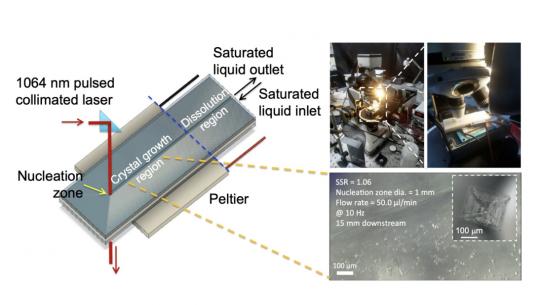
Specifically, the research program will design and study microfluidic nonphotochemical, laser-induced nucleation (NPLIN) of preselected organic molecules. To understand light-field induced nucleation mechanisms, the investigators will examine molecules that crystallize into different morphologies, into different polymorphs, and that follow single-step versus two-step nucleation. The team will look at three different mechanisms:
- The optical Kerr effect by which light can align molecules in a disordered solute cluster and thereby induce nucleation
- Dielectric polarization in which light lowers the energy of slightly sub-critical solute clusters
- The absorption of light by colloidal impurity particles resulting in the formation of nanobubbles that induce nucleation.
As part of the project, and in order to do many aspects of this research, the team will design high-pressure microfluidics coupled with a pulsed, collimated laser beam, and perform investigations of laser-induced crystallization of ibuprofen, carbamazepine, and glycine crystals. The use of microfluidics will contribute a quantitative experimental methodology for NPLIN that can also distinguish single-step nucleation from two-step nucleation. The research discoveries will set the foundation for translating fundamental findings to practical applications.
Research Centers, Labs, and Groups


NYU Tandon Future Labs
The NYU Tandon Future Labs are business incubators for a new generation.