
Kaan Ozbay
,
Ph.D.
-
Professor
-
Director of C2SMART
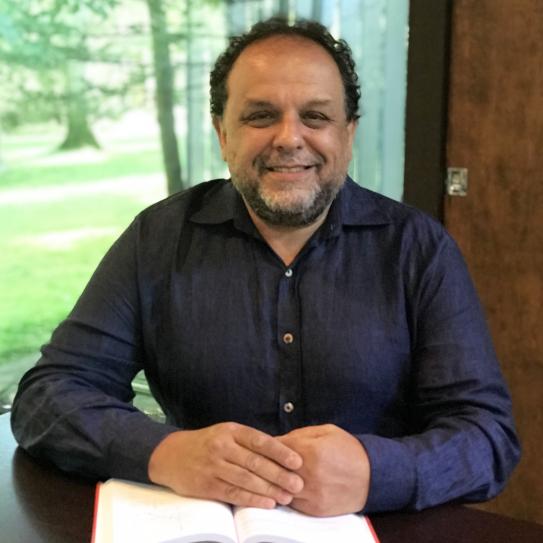
Kaan M.A. Özbay joined Department of Civil, Urban and Environmental Engineering and Center for Urban Science and Progress (CUSP) at NYU in August 2013. Since 2017, Professor Ozbay has been the Founding Director of the C2SMART Center (Tier 1 UTC funded by USDOT). He is also Global Network Professor of Civil and Urban Engineering, NYU Abu Dhabi (NYUAD) and Global Network Professor of Engineering and Computer Science, NYU Shanghai (NYUSH). Professor Ozbay was a tenured full Professor at the Rutgers University Department of Civil and Environmental Engineering. He joined Rutgers University as a tenure track Assistant Professor in July, 1996. In 2008, he was a visiting scholar at the Operations Research and Financial Engineering (ORFE) Department of Princeton University.
Dr. Ozbay is the recipient of the prestigious National Science Foundation (NSF) CAREER award. Dr. Ozbay is the co-editor of an edited book titled “Dynamic Traffic Control & Guidance” published by Springer Verlag’s "Complex Social, Economic and Engineered Networks" series in 2013. In addition to this book, Dr. Ozbay is the co-author of three other books titled “Feedback Based Ramp Metering for Intelligent Transportation Systems” published by Kluwer Academics in 2004, "Feedback Control Theory for Dynamic Traffic Assignment", Springer-Verlag and “Incident Management for Intelligent Transportation Systems” published by Artech House publishers both in 1999.
Dr. Ozbay published approximately 425 refereed papers in scholarly journals and conference proceedings. Professor Ozbay serves as the “Associate Editor” of Networks and Spatial Economic journal and Transportmetrica B: Transportation Dynamics journal. He is a member of the editorial board of the ITS journal.
Professor Ozbay served as the elected member of Board of Directors of the Intelligent Transportation Society of New Jersey in 2013. He has been an active member of national and international scientific and professional committees and organizations, including IEEE, ITE, ASCE, AASHTO and the Transportation Research Board (TRB) of the US National Academies. He also served as a member of the Board of Directors of the University Transportation Research Center (UTRC) at the City University of New York – USDOT’s Region 2 University Transportation Center.
Since 1994, Dr. Ozbay, has been the Principal Investigator and Co-Principal Investigator of 120 projects funded at a level of more than $30,00,000 by National Science Foundation, NJDOT, NYMTC, NY State DOT, New Jersey Highway Authority, USDOT, FHWA, VDOT, CUNY University Transportation Research Center (UTRC), Department of Homeland Security, USDOT ITS Research Center of Excellence. He was the founding director of the Rutgers Intelligent Transportation Systems (RITS) laboratory.
Education
Bogazici University, Istanbul, Turkey 1988
Bachelor of Science, Civil Engineering
Virginia Tech, Blacksburg, Virginia 1991
Master of Science, Civil and Environmental Engineering (Transportation)
Virginia Tech, Blacksburg, Virginia 1996
Ph.D., Civil and Environmental Engineering (Transportation)
Publications
Journal Articles
Representative recent papers
1. Yang*, H. Bartin, B., and Ozbay K. “Mining the Characteristics of Secondary Crashes”. ASCE Journal of Transportation Engineering, 2013. doi: 10.1061/(ASCE)TE.1943-5436.0000646).
2. Ozbay, K., Xiao*, W., Iyigun, C., Gursoy, M. "Probabilistic Programming Models for Response Vehicle Dispatching and Resource Allocation in Traffic Incident Management". Journal of Annals of Operations Research, March 2013, Volume 203, Issue 1, pp 389-406. doi: 10.1007/s10479-012-1174-6.
3. Ozguven*, E.E. and Ozbay K., “A Secure and Efficient Inventory Management System for Disasters, Transportation Research Part C, Volume 29, pp. 171-196, 2013, doi:10.1016/j.trc.2011.08.012 .
4. Hong*, Y. Ozbay, K., Ozturk*, O., Yildirimoglu*, M. “Modeling work zone crash frequency by quantifying measurement errors in work zone length”. Accident Analysis and Prevention Journal, Volume 55, June 2013, Pages 192–201, Elsevier.
5. Holguin-Veras, J., Wang, Q., Xu, N., Ozbay, K., “The Impacts of Time of Day Pricing on Car User Behavior: Findings from the Port Authority of New York and New Jersey’s Initiative”, Transportation, Springer, Vol.38, Issue 3, pp.427-443, May 2011.
Authored/Edited Books
1. “Dynamic Traffic Control & Guidance “(Book based on the NSF Workshop Conducted in the Summer of 2010 at Rutgers University), Edited Volume as part of the Springer Verlag’s "Complex Social, Economic and Engineered Networks" series Vol.2, 2013 (Book Co-Edited with S. Ukkusuri).
Research News
New AI Language-Vision Models Transform Traffic Video Analysis to Improve Road Safety
New York City's thousands of traffic cameras capture endless hours of footage each day, but analyzing that video to identify safety problems and implement improvements typically requires resources that most transportation agencies don't have.
Now, researchers at NYU Tandon School of Engineering have developed an artificial intelligence system that can automatically identify collisions and near-misses in existing traffic video by combining language reasoning and visual intelligence, potentially transforming how cities improve road safety without major new investments.
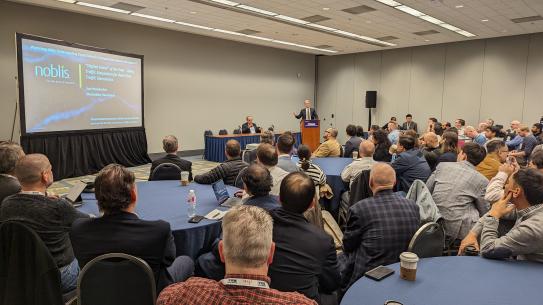
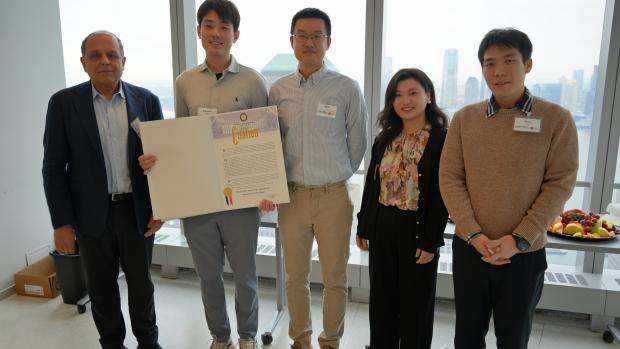
Published in the journal Accident Analysis and Prevention, the research won New York City's Vision Zero Research Award, an annual recognition of work that aligns with the City's road safety priorities and offers actionable insights. Professor Kaan Ozbay, the paper's senior author, presented the study at the eighth annual Research on the Road symposium on November 19.
The work exemplifies cross-disciplinary collaboration between computer vision experts from NYU's new Center for Robotics and Embodied Intelligence and transportation safety researchers at NYU Tandon's C2SMART center, where Ozbay serves as Director.
By automatically identifying where and when collisions and near-misses occur, the team’s system — called SeeUnsafe — can help transportation agencies pinpoint dangerous intersections and road conditions that need intervention before more serious accidents happen. It leverages pre-trained AI models that can understand both images and text, representing one of the first applications of multimodal large language models to analyze long-form traffic videos.
"You have a thousand cameras running 24/7 in New York City. Having people examine and analyze all that footage manually is untenable," Ozbay said. "SeeUnsafe gives city officials a highly effective way to take full advantage of that existing investment."
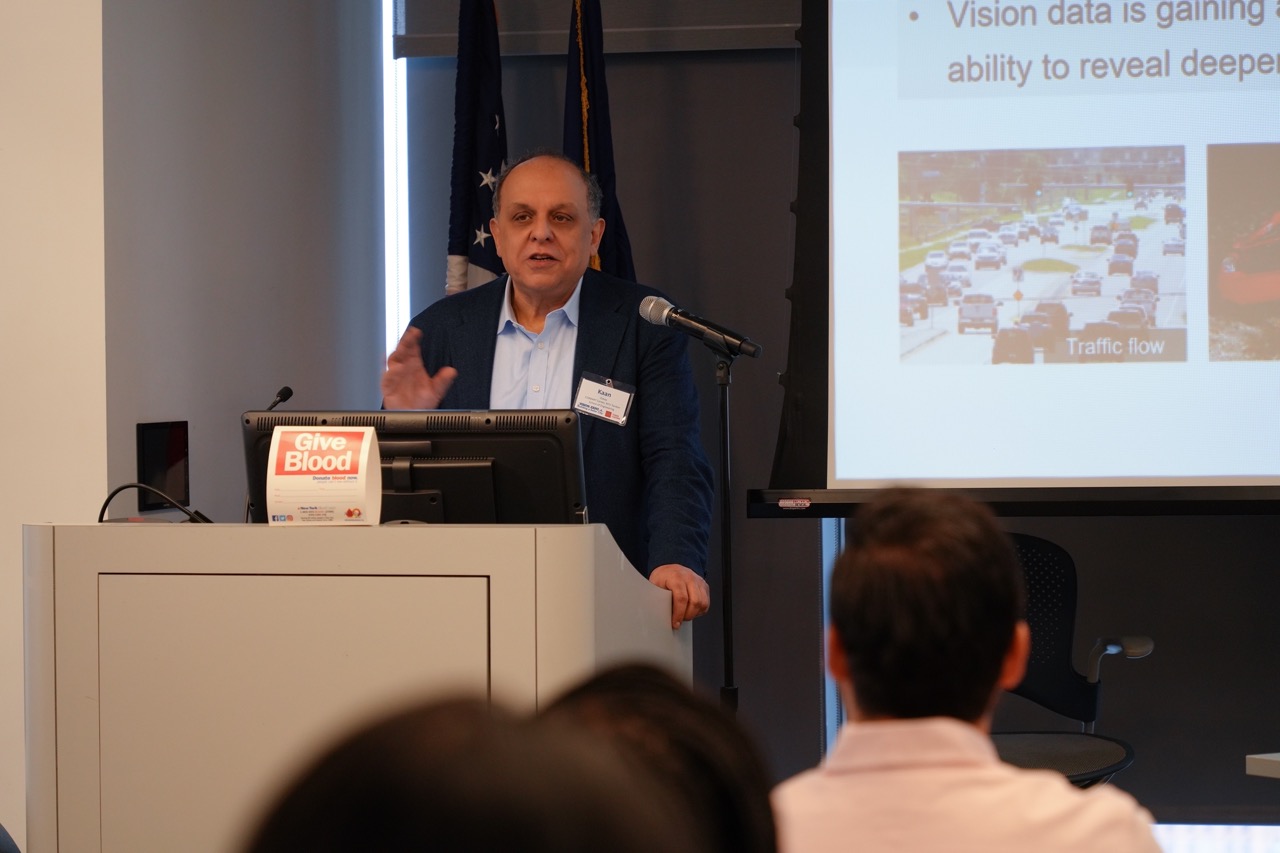
"Agencies don't need to be computer vision experts. They can use this technology without the need to collect and label their own data to train an AI-based video analysis model," added NYU Tandon Associate Professor Chen Feng, a co-founding director of the Center for Robotics and Embodied Intelligence, and paper co-author.
Tested on the Toyota Woven Traffic Safety dataset, SeeUnsafe outperformed other models, correctly classifying videos as collisions, near-misses, or normal traffic 76.71% of the time. The system can also identify which specific road users were involved in critical events, with success rates reaching up to 87.5%.
Traditionally, traffic safety interventions are implemented only after accidents occur. By analyzing patterns of near-misses — such as vehicles passing too close to pedestrians or performing risky maneuvers at intersections — agencies can proactively identify danger zones. This approach enables the implementation of preventive measures like improved signage, optimized signal timing, and redesigned road layouts before serious accidents take place.
The system generates “road safety reports” — natural language explanations for its decisions, describing factors like weather conditions, traffic volume, and the specific movements that led to near-misses or collisions.
While the system has limitations, including sensitivity to object tracking accuracy and challenges with low-light conditions, it establishes a foundation for using AI to “understand” road safety context from vast amounts of traffic footage. The researchers suggest the approach could extend to in-vehicle dash cameras, potentially enabling real-time risk assessment from a driver's perspective.
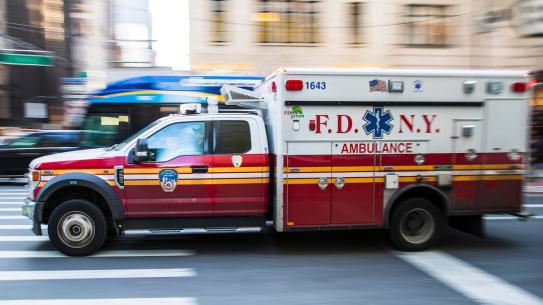
The research adds to a growing body of work from C2SMART that can improve New York City's transportation systems. Recent projects include studying how heavy electric trucks could strain the city's roads and bridges, analyzing how speed cameras change driver behavior across different neighborhoods, developing a “digital twin” that can find smarter routing to reduce FDNY response times, and a multi-year collaboration with the City to monitor the Brooklyn-Queens Expressway for damage-causing overweight vehicles.
In addition to Ozbay and Feng, the paper's authors are lead author Ruixuan Zhang, a Ph.D. student in transportation engineering at NYU Tandon; Beichen Wang and Juexiao Zhang, both graduate students from NYU's Courant Institute of Mathematical Sciences; and Zilin Bian, a recent NYU Tandon Ph.D. graduate now an assistant professor at Rochester Institute of Technology.
Funding for the research came from the National Science Foundation and the U.S. Department of Transportation's University Transportation Centers Program.
Ruixuan Zhang, Beichen Wang, Juexiao Zhang, Zilin Bian, Chen Feng, Kaan Ozbay,
When language and vision meet road safety: Leveraging multimodal large language models for video-based traffic accident analysis, Accident Analysis & Prevention, Volume 219,2025, 108077,ISSN 0001-4575,https://doi.org/10.1016/j.aap.2025.108077.
Heavier Electric Trucks Could Strain New York City’s Roads and Bridges, Study Warns
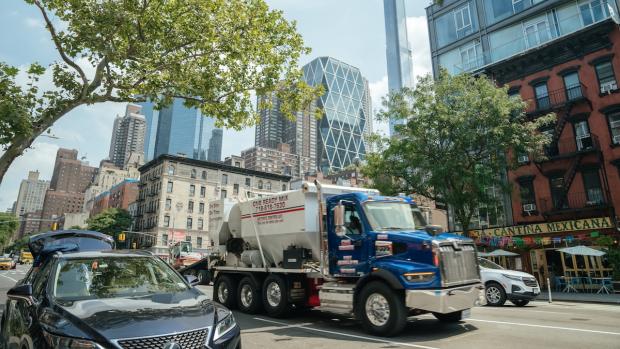
New York City’s roads and bridges already incur millions in annual damage from oversized trucks, and a new study warns the shift to electric freight could intensify that burden. As electric trucks replace diesel models, their heavier batteries could increase the city's yearly repair costs by up to nearly 12 percent by 2050.
Led by C2SMART researchers at NYU Tandon School of Engineering in collaboration with Rochester Institute of Technology (RIT) and published in Transport Policy, the study finds that oversized trucks already cause about $4.16 million in damage each year while permits bring in only $1.28 million. Electric trucks typically weigh 2,000 to 3,000 pounds more than diesel models, and in rare long-range cases as much as 8,000 to 9,000, so the financial gap is expected to grow.
“As electric vehicles become more common, our city’s infrastructure will face new and changing demands to support this transition,” said Professor Kaan Ozbay, the paper’s senior author and director of NYU Tandon’s C2SMART transportation research center. “Our framework shows that the city should adapt its planning and fee structures to ensure it can accommodate the costs of keeping bridges and roads safe as a result of more widespread adoption of e-trucks. ”
Using New York City’s Overdimensional Vehicle Permits dataset, the researchers modeled how electric-truck adoption could play out through 2050. They found that switching to e-trucks could increase damage costs by 2.23 to 4.45 percent by 2030, and by 9.19 to 11.71 percent by 2050. More extreme scenarios tied to unusually heavy batteries produced higher figures, though the authors say those outcomes are unlikely as technology improves.
The impact would not be uniform across the city. Manhattan faces the greatest increase, with parts of Brooklyn, Queens, and the Bronx also at risk due to heavy truck volumes and aging structures. Staten Island and many outer areas show lower impact. Bridges shoulder about 65 percent of the added costs because they are especially sensitive to increases in gross vehicle weight. Pavement, affected more by axle loads, wears down more gradually.
“We found that conventional oversized trucks in New York City already impose more than $4 million in annual damage,” said the study’s lead author Zerun Liu, NYU Tandon Ph.D. candidate in the Civil and Urban Engineering department’s recently established Urban Systems Ph.D. program, who is advised by Professor Ozbay. “With projected adoption of electric trucks, those costs could increase by an additional nearly 12 percent. That gap highlights the urgent need for new strategies to keep infrastructure sustainable.”
To manage the risks, the researchers created a susceptibility index identifying road segments and bridges most vulnerable to heavier vehicles. They recommend replacing flat permit fees with flexible, weight-based fees that reflect actual costs while still recognizing environmental benefits. They also call for expanding weight monitoring on high-risk corridors, especially in Manhattan, and factoring e-truck projections into city maintenance and capital plans to avoid expensive emergency repairs.
Although the study focuses on New York City, similar pressures are emerging elsewhere. The European Union allows zero-emission trucks to exceed weight limits by nearly 9,000 pounds, while U.S. rules permit an additional 2,000. The framework developed by the NYU Tandon and RIT team offers cities a way to balance climate goals with the realities of infrastructure wear.
Despite the added costs, the authors stress that the overall case for electric trucks in New York remains strong. Their scenarios suggest that widespread electrification could cut about 2,032 tons of carbon dioxide each year, improving air quality and public health.
“The proposed methodological framework can provide actionable insights for policymakers to ensure infrastructure longevity and safety as e-truck adoption grows,” Ozbay said.
In addition to senior author Ozbay and lead author Liu, the paper’s other authors are Jingqin Gao, C2SMART’s Assistant Director of Research; Tu Lan, a Ph.D. student in the Urban Systems Ph.D. program graduated under Professor Ozbay’s advisement; and Zilin Bian, a recent NYU Tandon Ph.D. graduate from the Civil and Urban Engineering department , now an assistant professor at RIT.
Funding came from the U.S. Department of Transportation’s University Transportation Centers Program.
Zerun Liu, Tu Lan, Zilin Bian, Jingqin Gao, Kaan Ozbay, A comprehensive framework for the assessment of the effects of increased electric truck weights on road infrastructure: A New York City case study, Transport Policy,
Volume 173, 2025 https://doi.org/10.1016/j.tranpol.2025.103808.

NYC speed cameras take six months to change driver behavior, effects vary by neighborhood
New York City's automated speed cameras reduced traffic crashes by 14% and decreased speeding violations by 75% over time, according to research from NYU Tandon's C2SMARTER published in Transportation Research Interdisciplinary Perspectives that tracked more than 1,800 cameras across school zones from 2019 to 2021.
With speeding contributing to approximately one-third of all motor vehicle fatalities nationwide, these findings translate to potentially hundreds of lives saved in America's most densely populated city.
The study from C2SMARTER — a US Department of Transportation Tier 1 University Transportation Center — complements the NYC Department of Transportation's (NYC DOT) own 2024 report, which similarly found a 14% reduction in injuries and fatalities at camera locations compared to control sites without cameras.
While the NYC DOT report provides valuable citywide statistics, the C2SMARTER study reveals several critical insights: cameras typically reach a strong level of effectiveness within six months, effectiveness patterns vary geographically across the city, and changes in driving behavior may exhibit a ‘time-lag’ effect.
"Our research methodology provided an in-depth short-term and long-term analysis of these cameras, taking into consideration the continuous installation of new cameras," explained Jingqin Gao, Assistant Director of Research at C2SMARTER and the paper's lead author. "By tracking each camera's performance over time, we uncovered spatial and temporal patterns that may be less visible in citywide data, providing officials additional insights on the longitudinal effects and more strategic positioning of future cameras to maximize the program’s effectiveness."
NYC's speed camera program has evolved from a 20-camera pilot in 2013 to a network of 2,200 cameras across all 750 school zones by 2023 — expanding from limited hours (6 a.m.-10 p.m. weekdays) to 24/7 operation in 2022. C2SMARTER's research examines the critical 2019-2021 timeframe when the program first achieved citywide scale.
What sets this study apart is its longitudinal approach — tracking fixed camera sites over extended periods. The research revealed most cameras achieve their safety purpose within six months, with violations dropping and staying low — showing drivers have changed behavior to drive more slowly and the cameras are working as intended, to deter speeding.
"Our long-term analysis identified four distinct patterns in how specific camera installations performed," said Gao. "Cameras at some locations showed consistent reductions at varying magnitudes in two groups, with a surge in speeding tickets during COVID. A third group exhibited a relatively modest effect but nearly curbed speeding behaviors within 1.5 years, despite COVID-19 impacts, and a small set of camera sites saw marginal impact in the first few months but experienced dramatic COVID-era speeding increases," Gao added. "Our short-term analysis also provided evidence of a 'time-lag effect,' where driver compliance improved gradually rather than immediately after installation."
The C2SMARTER team led by its Director Kaan Ozbay, professor in the NYU Tandon Civil and Urban Engineering Department (CUE), pioneered the application of Survival Analysis with Random Effect (SARE) for before-and-after evaluation of traffic safety treatments. This statistical method models the time intervals between crashes rather than simply counting them. Their findings were published in a series of papers in top traffic safety journals, including Risk Analysis and Safety Science.
This approach alleviates the challenge posed by the need for waiting years to collect data needed to conduct before and after analysis using traditional statistical approaches. The significantly shorter time periods of data collection potentially saves lives by allowing traffic engineers to re-evaluate their deployment approaches of safety treatments.
"The SARE method can accommodate the different implementation dates of speed cameras,” said Di Yang, a paper co-author who is currently an assistant professor at Morgan State University. Yang received his Ph.D. from CUE in 2022 under Ozbay’s advisement. “This approach allows us to better leverage the time intervals between crashes to estimate the change in crash rates before and after implementing speed cameras.”
These nuanced findings provide critical guidance for policymakers and urban planners across the country. Rather than a one-size-fits-all approach, the research points to the need for targeted, data-driven strategies that combine enforcement with engineering solutions tailored to specific locations.
"This isn't just about issuing tickets," concluded Ozbay. "It's about using data analytics and advanced statistical methods to save lives on our streets, especially in dense urban areas where a single speeding vehicle can have devastating consequences."
The study contributes to C2SMARTER's work to improve NYC transportation systems’ efficiency and safety. Among its projects, the Center has created a "digital twin" of Harlem with the NYC Fire Department to reduce emergency response times; tested and deployed weigh-in-motion technology to extend the Brooklyn Queens Expressway's lifespan; and developed performance measures for NYC Department of Transportation's off-hour delivery program.
In addition to Gao, Ozbay and Yang, the paper's authors include Chuan Xu and Smrithi Sharma, both with C2SMARTER and NYU Tandon’s Department of Civil and Urban Engineering at the time of the research.
Gao, J., Yang, D., Xu, C., Ozbay, K., & Sharma, S. (2025). Assessing the impact of fixed speed cameras on speeding behavior and crashes: A longitudinal study in New York City. Transportation Research Interdisciplinary Perspectives, 30, 101373.
Mobility in post-pandemic economic reopening under social distancing guidelines: Congestion, emissions, and contact exposure in public transit
The COVID-19 pandemic has raised new challenges for urban transportation — “back to the office” policies, staggered teleworking hours, and social distancing requirements on public transit may exacerbate traffic congestion and emissions due to shifts in travel modes and behaviors.
A team consisting of C2SMART members Ding Wang, Yueshuai Brian He, Jingqin Gao, Joseph Chow, Kaan Ozbay, and researchers from Cornell University, proposed a simulation tool for evaluating trade-offs between traffic congestion, emissions, and COVID-19 spread mitigation policies which impact travel behavior. Their research has been published in the November 2021 volume of the Transportation Research Part A journal.
Using New York City as a case study, the team used open-source agent-based simulation models to evaluate transportation system usage. Additionally, a Post Processing Software for Air Quality (PPS-AQ) estimation was used to evaluate air quality impacts associated with pandemic-related transportation changes.
The research also estimated system-wide contact exposure, finding that the social distancing requirement on public transit to be effective in reducing exposure but having negative impacts on congestion and emission within Manhattan and in neighborhoods at transit and commercial hubs.
The proposed integrated traffic simulation models and air quality estimation models may have the potential to help policymakers evaluate the impact of policies on traffic congestion and emissions and also to help identify transportation “hot spots,” both temporally and spatially.
The research was conducted with the support of the C2SMART University Transportation Center, and funded in part by the 55606–08-28 UTRC-September 11th grant as well as a grant from the U.S. Department of Transportation’s University Transportation Centers Program.
Research Centers, Labs, and Groups
C2SMART
C2SMART is a solution-oriented research center taking on some of today's most pressing urban mobility challenges.