

UN Sustainability Goal
- Good Health And Well-Being
- Reduced Inequalities
Areas of Impact
- Engineering Health
- Engineering & Culture
Global Challenge: Geographic, economic, and systemic barriers prevent half the world's population from accessing essential healthcare, making proximity to a doctor or hospital a matter of life and death for billions.
Abstract:
More than 2.5 billion people require at least one assistive product to maintain basic independence, yet fewer than one in ten have access to it. A decade after the United Nations committed to Sustainable Development Goals 3 and 10, the gap between what medical technology can do and what actually reaches people remains wide. This paper argues that the failure is often not scientific, but structural. Across medical technology, the breakdown repeatedly occurs between invention and access, through reimbursement systems that early-stage developers cannot navigate, designs that depend on ideal conditions, and validation standards that treat laboratory performance as if it were enough.
To examine that pattern, this paper reviews five domains where the gap between possibility and access is especially visible: medical device innovation, tremor rehabilitation, neural communication, sensory assistance for visually impaired users, and haptic surgical training. It then presents five projects developed in response to those failures at different points along the chain between research and use. StageZero uses structured claims data and retrieval-augmented generation to support early reimbursement and market intelligence for device development. KATIB explores whether handwriting assistance for essential tremor can be built around motor relearning rather than only compensation. A neural decoding preprocessing pipeline improves the quality of hospital-room audio used to align speech with ECoG neural data, including a 24 percent improvement in speaker identification accuracy over standard baselines. Sixth Sense rethinks assistive navigation around user intent rather than continuous environmental description. ChironVR investigates whether meaningful haptic feedback for surgical training can be preserved under severe cost constraints through a low-cost wearable glove.
Taken together, these projects do not offer a single solution.
What they show is that many of the barriers separating medical innovation from human impact are not fixed limits, but design questions. The paper concludes that access should not be treated as the final stage of innovation. It has to be part of the design from the beginning.
Bio:
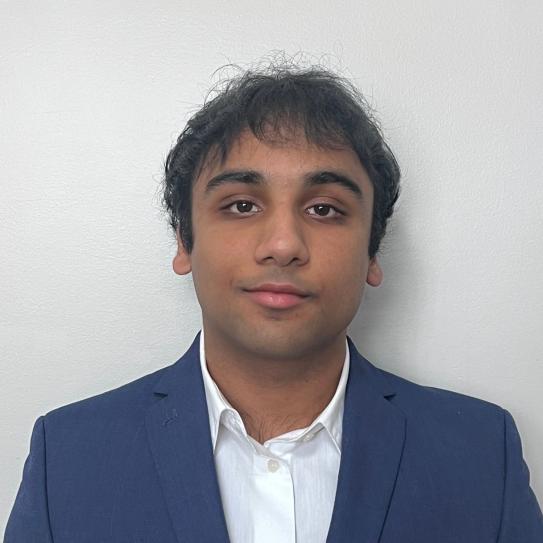
Karan Shah graduated from the NYU Tandon School of Engineering in 2026 with a Bachelor's degree in Electrical and Computer Engineering and is completing his Master's degree in Electrical Engineering. He grew up in Long Island, New York, in a large Indian household that instilled in him strong values of community, perseverance, and curiosity.
At NYU, Karan applied engineering to real-world challenges in healthcare and accessibility. His research spanned neural decoding and speech processing for brain-computer interfaces, assistive navigation for visually impaired users through the Sixth Sense project, and the use of tactile vibration devices to support mental health and well-being. His final paper, Between Science and Access, examined why medical technology so often fails to reach the people it was designed to help, and built five projects in direct response to that gap.
Beyond research, Karan was deeply involved in the NYU community. As a Resident Assistant, Orientation Leader, and GLASS Recruiter, he built environments centered on mentorship, wellness, and connection.
He is now a full-time Electrical Engineer at JB&B, where he continues to pursue the question that drove his time at Tandon: not just whether a technology works, but who it actually reaches.